Hotel reputation management is the work of monitoring, responding to, and improving what guests say about your property online, across review sites like Google, Tripadvisor, Booking.com, and Expedia. Done well, it turns real guest experiences into a higher public rating, more direct bookings, and fewer bad surprises.
Here's the part most guides skip. The best review you'll ever manage is the one-star that never gets written. This guide covers the whole playbook, from watching your reviews to responding to earning new ones, and then the move that actually protects your rating: catching the unhappy guest while they're still on property.
What is hotel reputation management?
Hotel reputation management is how a property tracks and shapes its online image. It comes down to three things:
- Watching every review and rating as it comes in.
- Responding to guests, the happy ones and the unhappy ones.
- Using what you learn to fix problems and earn more good reviews.
Your reputation lives in a lot of places at once. The same guest might rate you on Google, write it up on Tripadvisor, and score you on Booking.com, all for one stay. Reputation management pulls those scattered signals into a single view so nothing slips past your team.
Why does hotel reputation matter?
Your next guest reads your last guest's review before they book. Ratings are the first thing a traveler sees on Google and the OTAs, and half a star can be the reason someone picks you or the property down the street.
There's a threshold effect worth knowing about. BrightLocal's 2026 consumer survey found 31% of people will only use a business rated 4.5 stars or higher. Sitting at 4.3 keeps you out of consideration for roughly a third of the market before you compete on anything else.
It shows up in your rate too. Cornell's hotel school studied matched sets of properties and found a one-point gain in review score on a five-point scale lets a hotel charge about 11.2% more while holding the same occupancy. Your rating is a pricing input.
A strong reputation earns trust before a guest ever arrives, and it drives direct bookings that skip the OTA commission. A weak one quietly costs you both.
Where do hotel reviews come from?
Guests leave reviews wherever they already are:
- Google is the first thing most travelers see when they search your name. Google is also what feeds AI search now, which is why Google reviews carry more weight than Tripadvisor.
- Tripadvisor is where researchers go deep before a trip.
- Booking.com and Expedia tie each review to a real, verified stay.
- Airbnb and Vrbo carry the reputation of vacation rentals.
Past those, Yelp, Facebook, Trustpilot and Hotels.com all carry hotel reviews, and any one of them can be the top result for your property's name in a given market.
The tricky part is that each one is a separate dashboard with a separate login. Checking them one by one is how a review sits for days before anyone replies.
How do you manage your hotel's reputation?
1. Monitor every review site in one place
You can't respond to what you can't see. Bring every review site into one feed, so a new rating on any platform reaches your team the moment it lands, tied to the guest and the stay it came from.
2. Respond quickly, to everyone
Thank the happy reviewers and fix things for the unhappy ones. A calm, specific reply to a tough review does more for the next reader than the complaint itself. Speed counts too. A same-day response reads as a property that's paying attention.
3. Ask your happy guests to review you
Most delighted guests would happily leave a review. They just never get asked. A short, well-timed nudge after checkout lifts your rating and your review count together. More on how to improve your review score below.
4. Learn from the patterns
One review is a data point. Twenty reviews naming the same slow check-in are a to-do list. Read your reviews for themes, then fix the thing guests keep mentioning. Your rating follows the fix.
Reviews only tell you about the guests who bothered to write one. A short survey after checkout, with a single NPS question asking how likely they'd be to recommend you, gets you the rest. That score moves before your public rating does, so it's the earlier warning of the two.
5. Catch the bad review before it's written
This is the one that actually protects your score. Most one-stars start as a small problem during the stay, like a cold shower or a question nobody answered. Catch the guest while they're still on property and you fix the stay and save the review at the same time.
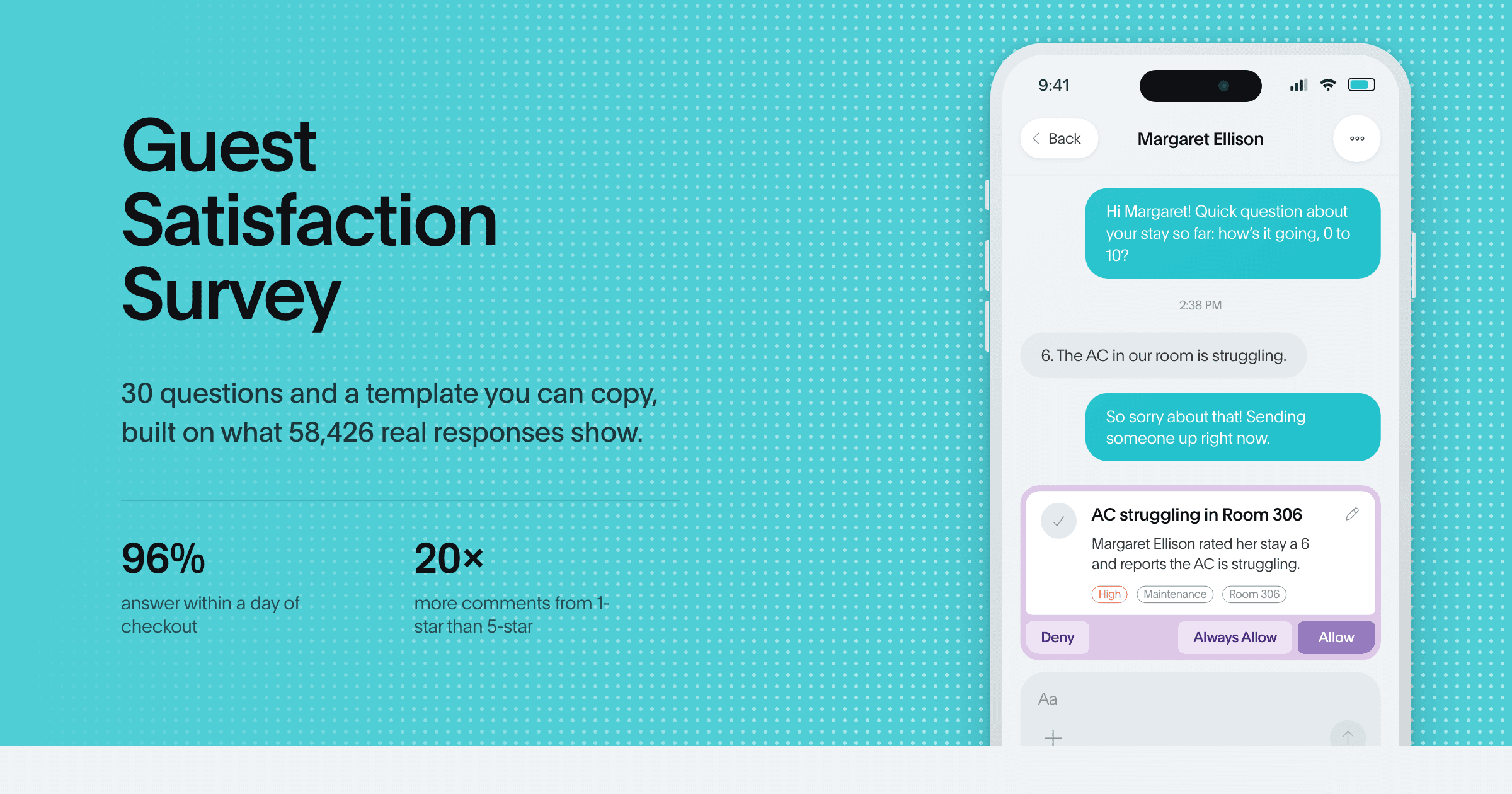
That's where an agent like Akia comes in. She's already in the guest's messages, so when someone texts that the AC is broken, she files the fix with maintenance and checks back, all before checkout. The complaint gets handled in the thread instead of on Google.
6. Watch the properties you compete with
Your rating only means something next to the property down the street. If you're sitting at 4.3 and everyone in your comp set is at 4.6, you're losing the click before a traveler reads a single word. Track their ratings next to yours, on the same sites, and a dip tells you something useful: whether it's your problem or the whole market's.
How to build a hotel review management strategy
The six pieces above don't all arrive at once. Most properties try to do all of it in one week and quietly give up by the second. Build it in this order instead.
Week one: see everything. Pull every review site into one feed. You can't plan around a problem you're still logging into four dashboards to find. This alone tells you your real rating, your reply speed, and which site your guests actually use.
Week two: fix your reply habit. Answer every new review within a day, good ones included. Write three or four openers your team can adapt so nobody's staring at a blank box at 6pm.
Week three: start asking. One short message on checkout day, pointed at a single review site. This is the piece that moves your average, and it's the one most properties skip.
Week four: read the pattern. Sort the last ninety days of low scores by what they're about. Two or three issues will account for most of them. That list is your operations plan for the quarter.
Then keep going. Once those four are running, move upstream. A guest who mentions a cold room on Tuesday becomes a two-star review on Friday unless someone gets to it first. That's where reputation work stops being cleanup.
A review management strategy isn't a project you finish. It's four habits that run every week, and the properties with 4.7 ratings are just the ones who kept them.
How to improve your hotel's review score
Your rating moves two ways: more reviews coming in, and fewer bad ones going out. Most properties put all their energy into the second one and then wonder why the average won't budge.
Volume moves your average faster than perfection does
Sitting at 4.2 across 300 reviews, one more five-star barely registers. A steady flow of them pulls the average up week after week. Google and Tripadvisor both weight recent reviews heavily, and so do travelers, who read the last handful and stop.
Ask every guest, and point them at one site
Plenty of guests would happily give you five stars and never do, because nobody asked. Send one short message after checkout, pointed at a single review site. Splitting the ask between Google and Tripadvisor gets you fewer reviews on both.
Time it to checkout, while the stay is fresh
Ask on the day they leave, when the bed and the front desk are still in their head. The same message a week later gets a fraction of the replies. Akia sends it on the day, for every stay. She never forgets one.
Make it two taps, not a login
A review that takes hunting for the right page doesn't get written. Send the guest straight to the review box on the site you picked, on the phone they're already signed in on. Every extra step costs you reviews.
What are the most common reputation management mistakes?
- Only replying to the bad reviews. Future guests read your responses to the good ones too.
- Copy-paste replies. A generic response to a specific complaint reads worse than no response.
- Waiting too long. A review answered two weeks later looks like nobody's home.
- Never asking. If you don't invite happy guests to review you, your rating is built only on the guests motivated enough to post on their own.
Do you need hotel reputation management software?
If you're getting more than a handful of reviews a week across more than one site, yes. Software brings every review into one place, tells you which ones need a reply, benchmarks you against your comp set, and asks your happy guests for reviews for you.
Good hotel reputation management software does all of that. Akia goes further. Because she's also the agent answering your guests, she catches problems in the thread before they ever become reviews.
Frequently asked questions
How do I improve my hotel's reviews?
Two things at once. Ask every guest for a review so fresh ones keep arriving, and fix the problem your reviews keep naming so you stop earning low scores. The asking moves your average in weeks. The fixing keeps it there.
How do I get more hotel reviews?
Ask on checkout day, in one short message, pointed at a single review site. Most guests would leave you a review and simply never get asked.
How do hotels respond to negative reviews?
Acknowledge the guest, apologize for the specific problem, say what you're doing about it, and offer to take the details offline. Keep it short and human. You're writing for the next reader as much as for the reviewer.
How can a hotel get more positive reviews?
Ask. A brief message after a good stay, timed to checkout and pointed at one review site, is the single most effective thing you can do.
What's the difference between reputation management and guest surveys?
Reviews are public and live on third-party sites. Surveys are private feedback you collect directly, like an NPS question after checkout. The best programs use surveys to catch unhappy guests privately and point happy ones toward public reviews.
How often should you check your hotel reviews?
Daily. A new review should reach your team the moment it posts, so a reply goes out the same day and a complaint gets caught while you can still do something about it.
What role does reputation management play in a hotel's marketing strategy?
It sits underneath the rest of it. Paid search, your website and your OTA listings all send travelers to the same place, and the rating they find there decides whether the click becomes a booking. Reputation work raises the return on every other channel you're paying for, which is why it belongs in the marketing plan and not only in operations.
Let Akia keep your reviews at five stars
She watches every review site and your comp set in one place, asks your happy guests for reviews, and catches the unhappy ones in the thread before they ever go public. See how Akia manages your reputation.