The front desk knows which guests are worth targeting. The marketing stack usually doesn't.
A general manager at a 60-room independent hotel can tell you which guests book direct, which ones stayed three times last year, and which OTA reservations cost $90 in commission each. All of that data lives in the PMS. The email newsletter she sends before peak season treats every name on the list the same: same offer, same subject line, same discount percentage. The email tool has no idea what the PMS knows.
The gap between what a property knows about its guests and what it does with that information is where most hotel marketing breaks down. Not because the intention is wrong. Because the systems don't connect.
What hotel marketing actually means.
Hotel marketing is every deliberate effort a property makes to attract new guests, convert browsers into bookers, and bring past guests back for a second stay. It spans paid channels (Google Ads, metasearch, OTA placements), owned channels (email, SMS, the direct-booking website), and retention channels (post-stay follow-up, loyalty offers, anniversary promotions).
What hotel marketing is not: a single campaign, a social post calendar, or an OTA listing. Each of those is a tactic. Hotel marketing as a system means those tactics reinforce each other: a guest who searched Google and clicked an ad gets a different follow-up than one who booked direct three times before. The goal is a direct-booking mix high enough that OTAs are one channel in the portfolio, not the whole strategy.
Why direct-booking loyalty is worth fighting for.
OTA commissions average 15–25% of the booking value. A property generating $2 million in annual room revenue with a 50% OTA mix pays $150,000 to $250,000 per year in channel costs, before any other marketing spend. Shifting even 10 percentage points of that volume to direct bookings recovers $30,000 to $50,000 a year.
Repeat guests compound that advantage. Acquiring a new guest through paid advertising or OTA placement costs five to seven times more than retaining one who has already stayed. Properties with structured post-stay email programs see measurably higher return rates; those without them largely cede the second stay to whichever OTA the guest finds next. Guest data fragmentation (OTA-masked emails, siloed PMS records, no channel attribution) is what prevents most operators from acting on this math.
Five categories of hotel marketing.
There is no single channel that does the whole job. Hotel marketing works when these five categories operate together.
Search advertising. Paid search and metasearch (Google Hotel Ads, TripAdvisor, Kayak) intercept guests actively looking for a room. Google Hotel Ads puts your direct-booking rate head-to-head with OTA rates on the results page. Properties that run these campaigns consistently see a measurable shift in direct-booking share versus those that don't.
Email marketing. The owned channel with the highest ROI in hospitality. Pre-arrival sequences, post-stay follow-up, and re-engagement campaigns all run through email. The limiting factor is list quality: an email list full of OTA-masked addresses cannot be meaningfully segmented. Properties that capture direct-booking emails build a compounding asset; each stay adds a contact the property actually owns. Our full guide to hotel email marketing breaks down which campaigns actually earn their send.
SMS marketing. SMS gets read. Open rates for hospitality text messages consistently run above 85%, versus 20–30% for email. Pre-arrival texts with upsell offers, day-of check-in updates, and post-stay review requests are the highest-performing use cases. SMS works because the channel is immediate. Guests don't treat a text as marketing the way they treat a promotional email.
Content and social. Blog content and social media build brand visibility at the top of the funnel, particularly for properties with a differentiated story around design, location, or experience. These channels rarely close a booking directly, but they shorten the consideration window for guests who find the property through other means. A strong Instagram presence can make the difference between a guest who bounces and one who spends 20 minutes on the direct-booking site.
Loyalty and retention. Post-stay emails, return offers, and structured re-engagement campaigns are the highest-ROI marketing spend a property can run. The acquisition cost is zero. The guest already stayed; the only question is whether they book direct next time or go back to the OTA. Properties with active retention programs consistently outperform comparable properties on repeat visit rate and direct-booking mix.
Six practices that separate hotel marketing programs that compound from ones that stall.
Run every approach through this checklist.
1. Your PMS data actually informs your campaigns. Segmenting guests by stay history, booking channel, or spend is only possible if your email and SMS tools connect to the PMS. Sending the same offer to every name on the list wastes budget and conditions engaged guests to ignore you because the content feels generic. Integration is the prerequisite for personalization.
2. Attribution tells you what's actually working. Knowing which campaigns drove bookings (not just opens or clicks) is the only way to allocate budget correctly. Properties that track campaign-to-booking attribution consistently find that 20% of their campaigns produce 80% of the attributed revenue. The other 80% can be cut or reworked.
3. Direct booking has a consistent advantage in your price presentation. Best-rate guarantees, direct-booking perks (free parking, late checkout, a welcome credit), and Google Hotel Ads rate matching are the mechanics that make direct booking the obvious choice for guests already considering your property. Without them, the OTA wins on convenience alone.
4. You own your email list. This means capturing real email addresses at checkout, through web chat, and during the direct-booking flow, not through OTA-passed emails the platform can revoke or obscure. A list you own grows in value with each stay. A list you borrow disappears when the platform changes its policy.
5. Post-stay follow-up runs automatically. The window to influence a guest's next booking is the 48–72 hours after checkout, when the experience is fresh. Properties that send a post-stay email within that window, with a direct-booking incentive for the return trip, see measurably higher re-booking rates than those that wait a week or don't follow up at all.
6. Paid and owned channels work as a system, not in isolation. Google Ads and metasearch bring in new guests; email and SMS retain them. Properties that treat these as a single system, using paid channels to fill the top of the funnel and owned channels to convert and retain, build a marketing program that gets more efficient over time. Those that treat each channel separately tend to overspend on acquisition and underinvest in retention.
Five marketing mistakes that cost operators real bookings.
These patterns show up across properties at every scale.
1. Treating the OTA as the marketing strategy. OTAs are a distribution channel, not a marketing program. Properties that rely on OTA listings as their primary demand source pay commission on every stay, hold no guest data to market against, and are one algorithm change away from a significant occupancy drop. OTAs belong in the mix; they should not be the mix.
2. Running email campaigns without list segmentation. Sending the same promotion to a guest who stayed twice last year and one who booked through an OTA three years ago produces very different results and trains the engaged guest to ignore your emails because the offers feel irrelevant. Segment by stay recency, booking channel, and spend before sending anything promotional.
3. Measuring paid search by clicks instead of bookings. Click-through rate and cost-per-click are inputs. Revenue attributed to the campaign is the output. Properties that measure success by clicks alone, without closing the loop to bookings, often find they're spending heavily on keywords that attract browsers rather than bookers.
4. Leaving post-stay follow-up to chance. A guest who had a good stay is the most convertible prospect in the funnel. Failing to send a timely post-stay email with a direct-booking incentive means that same guest books through whichever OTA appears first in their next search. This is recoverable revenue that most properties simply leave behind.
5. Starting a loyalty program without a mechanism to recognize returning guests. A points program requiring manual enrollment works for large chains with the marketing budget to promote it. For independent operators, the higher-return version is simpler: trigger a personalized offer whenever the PMS shows a guest has stayed before. No app download, no points balance — just a message that says the property noticed they came back.
Why hotel marketing gets harder to run well as a portfolio grows.
A single-property operator can handle hotel marketing with a reasonable amount of manual effort. One email newsletter, a few Google Ads campaigns, a post-stay follow-up sequence. It's not perfect, but it's manageable.
Add a second property and the channels start to fragment. Each property has its own email list, its own ad campaigns, its own attribution records. Adding five properties means five lists, five ad accounts, five sets of campaign data that don't talk to each other. The GM who was running all of it at one property now needs a full marketing function to maintain consistency across the portfolio.
The structural problem is that most marketing tools were built for businesses with a single customer list and a single product. Hospitality operators have multiple properties, multiple guest segments, multiple booking channels, and a PMS that none of the standard tools are built to connect with. The work compounds; the tools don't keep up.
How Akia handles hotel marketing.
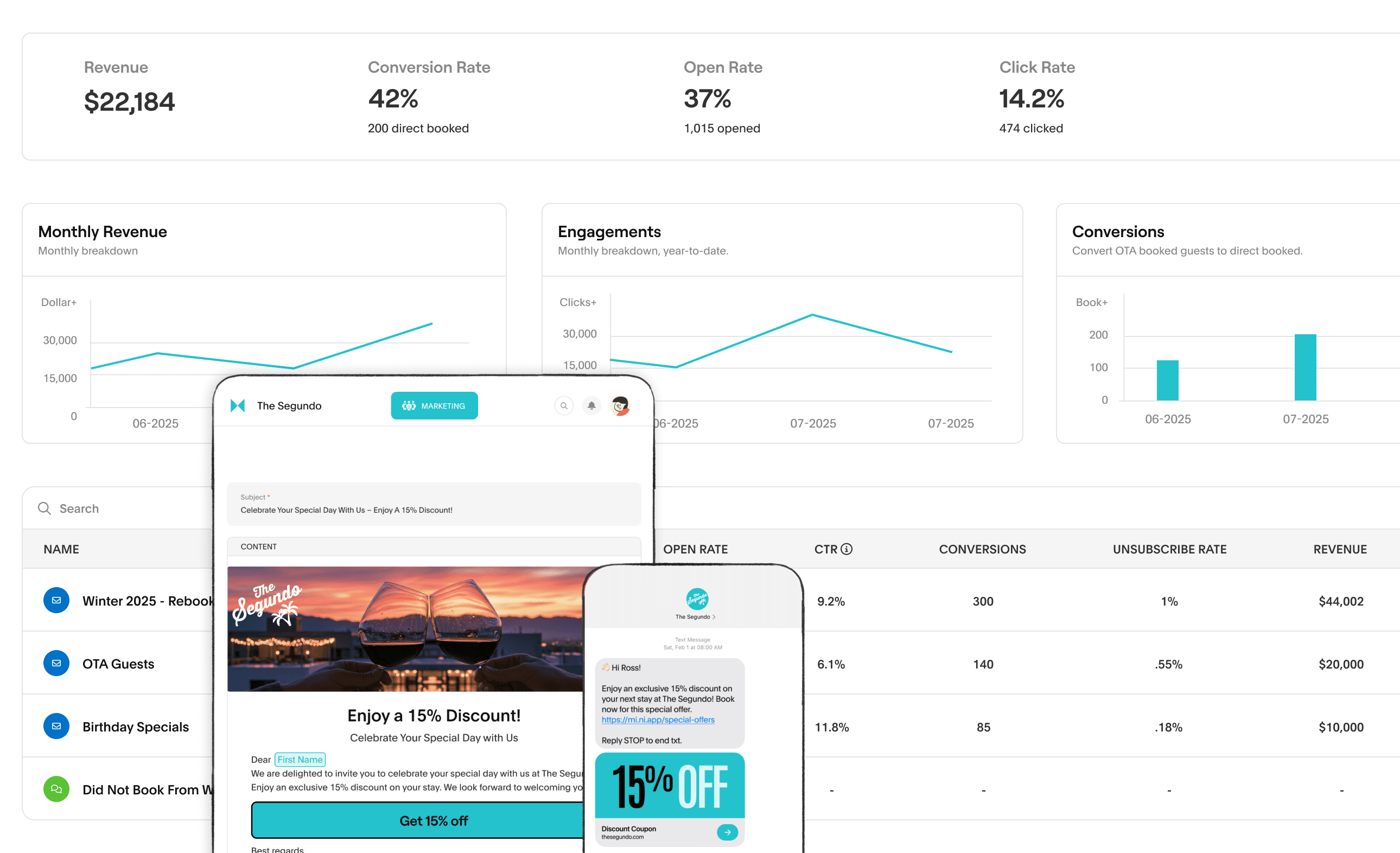
Akia is the AI Agent for hospitality. The marketing skill is one of the things Akia runs autonomously: building segments, writing campaigns, managing Google Ads, and attributing revenue back to each send, all connected directly to the guest record and the PMS rather than running as a separate system the team has to populate by hand.
Akia builds audience segments from PMS and booking data. Rather than managing lists manually, Akia reads the property's guest records and builds segments based on stay history, booking channel, spend, and communication history. A re-engagement campaign for guests who haven't returned in 12 months stays current automatically, because the segment updates as new stays come in.
Akia writes and schedules email and SMS campaigns. With the audience defined, Akia drafts campaign copy, sets the timing, and sends across email or SMS. Properties running a direct-booking offer for past guests, a pre-arrival upsell sequence, or a post-stay review request can configure those programs once and let Akia run them.
Akia manages Google Ads. For properties running paid search, Akia handles bid management and budget allocation, adjusting for occupancy and seasonal demand rather than running fixed bids regardless of what's happening at the property.
Akia attributes revenue back to campaigns. When a guest who received an email books direct, Akia records the attribution. Properties can see which campaigns drove bookings, which drove opens without bookings, and where budget is actually producing returns.
"Before Akia, we spent hours customizing different information in emails for our guests based on different criteria like day of week or condo unit. Now Akia handles all of this automatically, and it really saves time so we can really take care of our guests."
— Maren Trader, Office Manager, Fairfield Plantation Resort
"We definitely would be in a worse situation if not for Akia. With a team of only two, we'd probably need to hire at least 2 more people for example for answering phones and emails separately if we didn't invest in Akia's platform. This system has greatly helped in keeping our operational costs at bay."
— Justin Jurist, VP & Portfolio Manager, Coastal Maine Vacations
Getting started: three questions before building the program.
1. Identify which guest segment has the highest return potential. Past direct bookers who haven't returned in 6–18 months are typically the highest-ROI starting point. The acquisition cost is zero, the conversion rate on a relevant offer is higher than any paid channel, and the data is already in the PMS. Start there before building out to new guest acquisition.
2. Establish your direct-booking advantage. Before running any campaign driving guests back to the property, confirm the direct-booking value proposition: a rate that matches or beats OTA rates, a booking-direct perk, and a booking flow that doesn't require more steps than the OTA. Without a clear reason to book direct, the campaign drives awareness but the OTA closes the booking.
3. Connect marketing to the PMS before adding more channels. The single decision that creates the most long-term leverage is getting email, SMS, and ad campaigns reading from the same guest record the PMS holds. Once that connection exists, every campaign gets more relevant with each new stay. Without it, adding channels adds complexity without producing better results.
The properties that build lasting direct-booking loyalty all do the same thing: they treat every post-stay as the opening move in the next booking, and they use what they already know about a guest to make the next offer worth taking.
See how Akia's marketing skill handles campaigns, Google Ads, and attribution, or book a demo to walk through it on your property type.