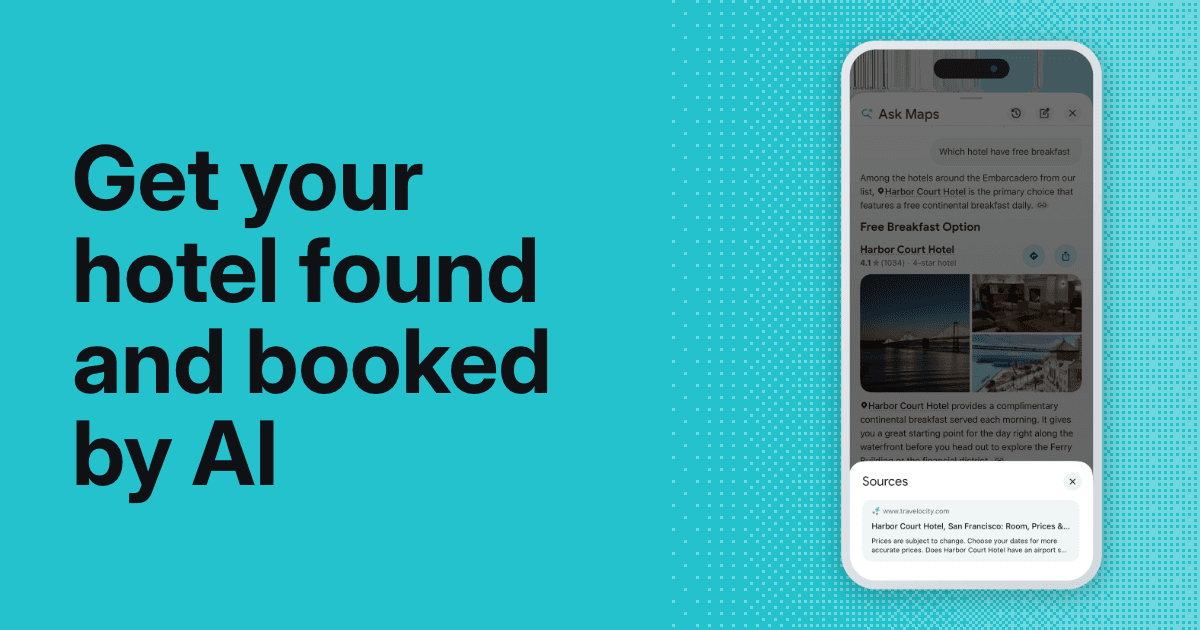
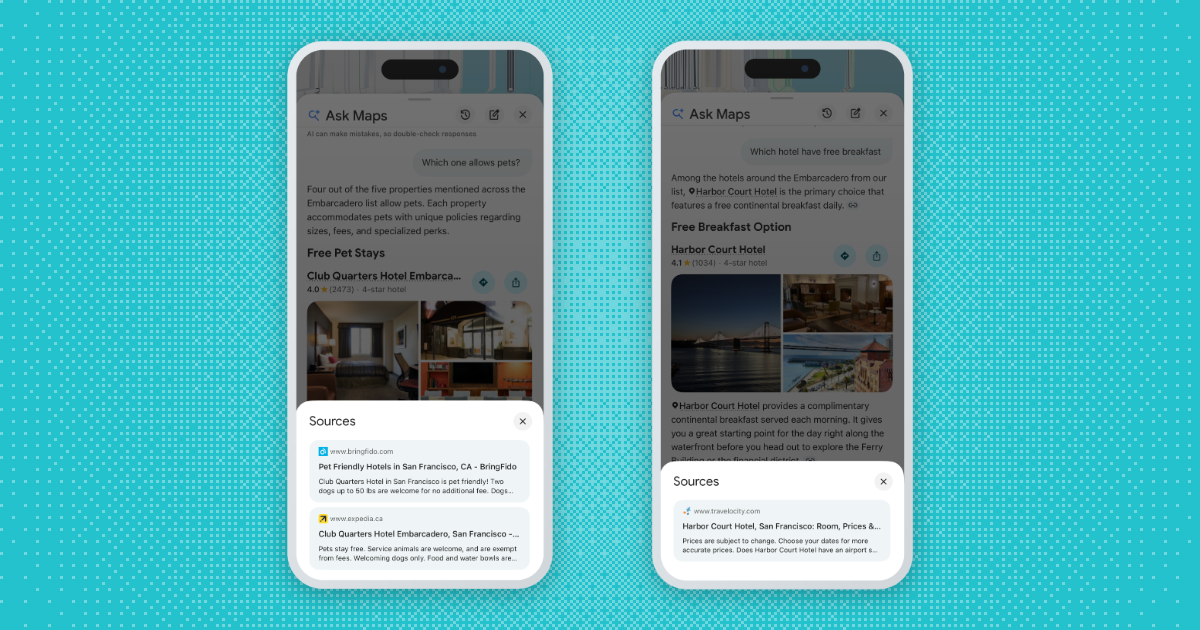
A growing number of guests will never see your website. They'll ask an AI where to stay and take the answer it gives them. Google's Ask Maps now finds and prices hotels and hands you to a partner to book, ChatGPT recommends properties outright, and the assistant does the comparing. So it comes down to one thing. The AI recommends whatever property it can read clearly and book directly, and you want that to be yours.
In our experience, you can rank first on Google and still get almost no clicks. AI pushes that further, because the guest gets the answer without ever reaching a list of links. Being found by AI is a different job from ranking on Google, and most properties haven't done either on purpose.
Here's how to do it, starting with what the words actually mean, because most of the advice out there gets this part wrong.
Three words worth getting straight
People use these interchangeably and they describe completely different outcomes.
- A mention is when the AI says your name. You're in the answer, the guest reads it, you're in the running.
- A citation is when the AI links a page as a source it used to build that answer. That's a different thing entirely, because a mention is about you and a citation is about a page. And that page can be another website.
- Share of voice is how often you get named at all across a set of questions a real guest would ask. It's the closest thing to a rank tracker that exists in this world.
It's completely normal to be named in most of the answers about your market while being the source of almost none of them. It feels like winning, because your name is right there in the paragraph. But the citations are what the answer is built out of, and if none of them are yours, you're being described entirely by other people.
So when someone tells you they show up in AI, the useful follow-up is which one they mean.
What this does to the SEO you already have
Your existing SEO still works. What changed is what it earns you.
Search engines now read the pages, write the answer themselves, and put it above everything else. The guest gets what they asked for and never scrolls. So a property can hold a strong position, keep every impression it had, and watch its actual visits fall, with nothing on the page having changed.
That's what catches teams out, because the dashboard still looks healthy. Position is stable. Impressions are stable. The visits quietly aren't.
Keep doing SEO. Ranking still matters, and a page that ranks is a page an assistant is more likely to have read. What's new is that ranking has become the input rather than the finish line, and the thing worth measuring on the other end is whether you're getting quoted.
How an AI decides which property to recommend
An AI doesn't browse the way a person does. It reads. It pulls the facts it can parse, matches them against what the guest asked for, and shortlists the properties that fit. Clean, consistent, current information wins. Gaps and contradictions lose.
But there's a second mechanic underneath that, and once you see it you'll stop being surprised by any of this. There are two kinds of question a guest asks an assistant, and they get answered from completely different places.
Superlative questions sound like: best boutique hotels in Napa, nicest place to stay in Sedona, where should I stay for a couples weekend, top vacation rentals near Joshua Tree. For these, the assistant tend to cite third parties: Magazines, review sites, roundups, directories, forum threads.
Factual questions sound like: does this property allow dogs, what time is check-in, which places downtown have free parking and breakfast, what's the cancellation policy. Here the assistant will cite your own page, and readily, because now it needs a fact about you and you're the authority on facts about you. If that fact is written plainly, in readable text, on a page it can reach, it gets lifted straight into the answer.
The assistants don't agree with each other
These systems don't behave identically. Some lean on a brand's own pages when the question calls for it. Google's AI answers weight third-party consensus much more heavily, which is consistent with how Google search has always worked. The same property, in the same week, with the same pages, can look strong in one assistant and thin in another.
Which means testing one and calling it your AI visibility is how people end up confidently fixing something that was never broken. Check them separately.
Five things to do
1. Make your facts identical everywhere
When an assistant answers a question about your property, it's reconciling. It has your site, your Google profile, a few OTA listings, a directory entry somebody made years ago, and a blog post from a writer who stayed once, and it's working out what's true from all of it at the same time. Where those sources agree, it states the fact plainly. Where they disagree, it either hedges, which produces that "policies may vary, contact the property directly" answer that sends your guest off to compare you with someone else, or it picks whichever source it trusts more. That's frequently the OTA listing rather than you, because the OTA is structured, maintained, and has been consistent for years.
A contradiction makes the model less sure of you across every question anyone asks.
What to do:
- Write down everything in a document. Check-in and checkout times, pet policy and fee, parking and what it costs, breakfast and its hours, cancellation window, deposit hold, wifi, accessibility, pool hours, minimum age. Right now that truth lives in several people's heads, which is exactly why your listings disagree. AI for hotels covers what changes once that document exists. This document can be used to update your Knowledge Base in Akia that feeds your AI Agents to handle accurate and up to date information.
- Fix the places you control in order of weight. Google Business Profile first, then your own site, then every OTA listing, then Apple Business Connect and Bing Places.
- Add
LodgingBusinessstructured data to your site with your check-in time, checkout time, pet policy, amenities, and asameAslist pointing at every profile you just fixed. ThatsameAslist is the underrated part. It tells a machine that the Booking listing, the TripAdvisor page, and the Google profile are all the same property, instead of leaving it to infer that and occasionally get it wrong. - Reach out to the sites that mention you. This is the easiest outreach in marketing, because you're reporting a factual error rather than asking for a favor, and a wrong fact makes their page look bad too. Four lines: here's the page, here's the line, here's what's true, thanks for keeping it up.
2. Write your answers where a machine can lift them
Most properties assume their website already covers this. It usually says the right things. The question is whether it says them in a form that survives being pulled out.
An assistant doesn't read your page top to bottom. The page gets broken into chunks, those chunks get retrieved individually, and the one that comes back is whichever chunk answers the question by itself. So the unit that matters is the paragraph, and a paragraph that only makes sense because of the heading above it won't survive the trip.
What to do:
- Head each section with the question the way a guest would type it. "What time is check-in?" rather than "Arrival Information."
- Answer in the first sentence, and restate the subject inside the answer. Write "Check-in at the Wexley starts at 4pm," not "Check-in is at 4pm." It reads as redundant on the page, and it's the difference between a chunk that stands alone and one that's meaningless once separated.
- Find the facts that aren't text. Rates in a PDF, amenities baked into a photo, policies that only render inside a booking widget. The test takes ten seconds. Try to select the fact with your cursor. If you can't highlight it, nothing can read it.
- Pull the questions from your own inbox rather than guessing. The things your team answers forty times a week are the same things guests ask assistants, because it's the same guests. For most properties it's about twenty questions and it's the same twenty every week. Ask Akia connects to your PMS to answer any question you have around your guests and property. "What is our cancellation policy?" "What are inquiries guest are asking?" We listed more of the prompts your team can use.
- Put them on a real page with FAQ schema, and don't hide them inside a chat widget where nothing can crawl them.
3. Get onto the pages that already get cited
Every superlative question gets answered out of third-party pages, so if you want to be in those answers, the work isn't just only on our website. And you don't have to guess which pages matter, because the assistant will tell you.
What to do:
- Spend time on what's getting cited on AI. "Best boutique hotels in [your city]", "where to stay for a couples weekend", "hotels near the convention center in [your city]." Log every URL cited, then collapse the list by domain and count. What you get is a ranked list of the eight or ten sites that decide who gets recommended in your market, specific to your city and based on evidence rather than a generic best-practice list.
- Listings you can just claim are forms with no pitch involved. Google Business Profile, TripAdvisor, Yelp, your tourism board, the CVB, the chamber, Apple, Bing. That's a day of work most properties have half-finished.
- Stale posts that already mention you have the highest hit rate of anything here, because you're pointing out an error and they're re-touching the page while they fix it.
- Roundups you're not on yet need real pitching, written to the angle their post already has, with two or three pasteable sentences and a link to usable photos.
- Press and community threads need a genuine reason and honest participation. People really do ask on Reddit where to stay in a city, and those threads really do get cited.
4. Make reviews a system
Reviews picked up a second job and most properties haven't adjusted for it.
A review still persuades a person who's deciding. It's now also a source document, raw material for a machine writing an answer about you, and assistants lean on review sites heavily for exactly the superlative questions above, because a review is the closest thing they have to independent evidence about what staying with you is like. Your own site can say your rooms are quiet. A review is what makes that believable.
A property with a steady stream of recent reviews gives an assistant enough agreement to say something confident about it. A property sitting on fourteen reviews, most of them from 2023, gives it very little to go on, so it reaches for a competitor it can describe more surely. Volume is the part most properties under-invest in, because asking is awkward and easy to skip on a busy week.
What to do:
- Prompt for specifics, because specific beats glowing every time. "Amazing stay, highly recommend" has nothing in it to lift. "The front desk picked up at 2am when our flight moved," or "parking's free but it's two blocks away," is quotable, and those lines end up inside answers close to word for word. Asking "how was your stay" gets you "great." Asking "was there anyone on our team who made a difference?" gets you the sentence you want, with a name in it.
- Keep them current. A model describes your property the way its sources describe it now, so if your best reviews are three years old, you're being described as a property that hasn't existed since the renovation.
- Ask every guest, every stay, while they're still on property or right at checkout. A request that lands four days later gets ignored by everyone except the person who's annoyed. This only works if it's automatic, which is what Akia's feedback and review capture is for. She asks every guest in the thread they already have open, so the ask goes out whether or not anyone on your team remembered.
- Ask privately first, then route on the answer. A low score should reach your team while the guest is still in the building and the stay can still be fixed, which is worth more to you than the review was. A high score is when you point them at the public site.
- Spread across platforms rather than pouring everything into one, since the assistants pull from different places. And reply to reviews, including the difficult ones, because your replies are text on that page too and they get read along with everything else. There's more on this in our reputation management guide.
5. Track citations alongside your rankings
Keep tracking rankings. They still tell you real things: whether a page is indexed and competitive, whether your commercial pages are gaining ground, whether the post you published in March actually landed. What rankings can't tell you anymore is whether you're in the answer. So citation tracking goes next to them on the same report, as a second column rather than a replacement.
What to do:
- Write down ten to twenty questions a real guest would ask, deliberately mixing the two shapes. Half superlative, half factual. Write them the way a guest types, which is messier and more specific than the way a marketer types. Type "somewhere nice in napa for an anniversary, walkable to restaurants."
- Run the same set monthly, on the same day, across ChatGPT, Google's AI answers, Perplexity, and Copilot. Do it signed out or in a temporary chat, otherwise you're measuring what the assistant knows about you personally rather than what it tells a stranger.
- Log three things per question. Were you named, were you cited, and what got cited instead.
- That last column is what turns this into a loop. Every URL in it is a page beating you in your own market, which means it belongs on the target list from step three. Your tracking generates next month's outreach for you.
- Know what good looks like so you don't panic early. Citations on factual questions should start appearing within a couple of months. Superlative presence is a two or three quarter project, and it's the part your competitors aren't doing, which is why it stays winnable.
What kinds of content actually get cited
Worth naming plainly, because it's the fastest way to decide where to spend:
- Roundups and best-of lists are the single most cited shape for superlative questions.
- Review platforms carry enormous weight, which is why step four isn't optional.
- Directories get cited constantly and are mostly free to claim.
- Community threads get cited more than people expect.
- Your own pages get cited well, on factual questions, when the fact is plainly written.
Four of those five live on somebody else's domain. That's the whole argument for step three in one line.
Being findable is half of it. Being bookable is the other half.
Everything above gets you into the answer. What happens next decides whether it turns into a reservation, and this is where agentic booking changes the stakes.
Own a direct channel an assistant can act on. A website an agent can't book against is close to invisible to it. Give the guest a channel that answers the question and takes the booking in the same place. A web chat that resolves the question and moves the guest to a direct reservation is a front door the OTA doesn't own.
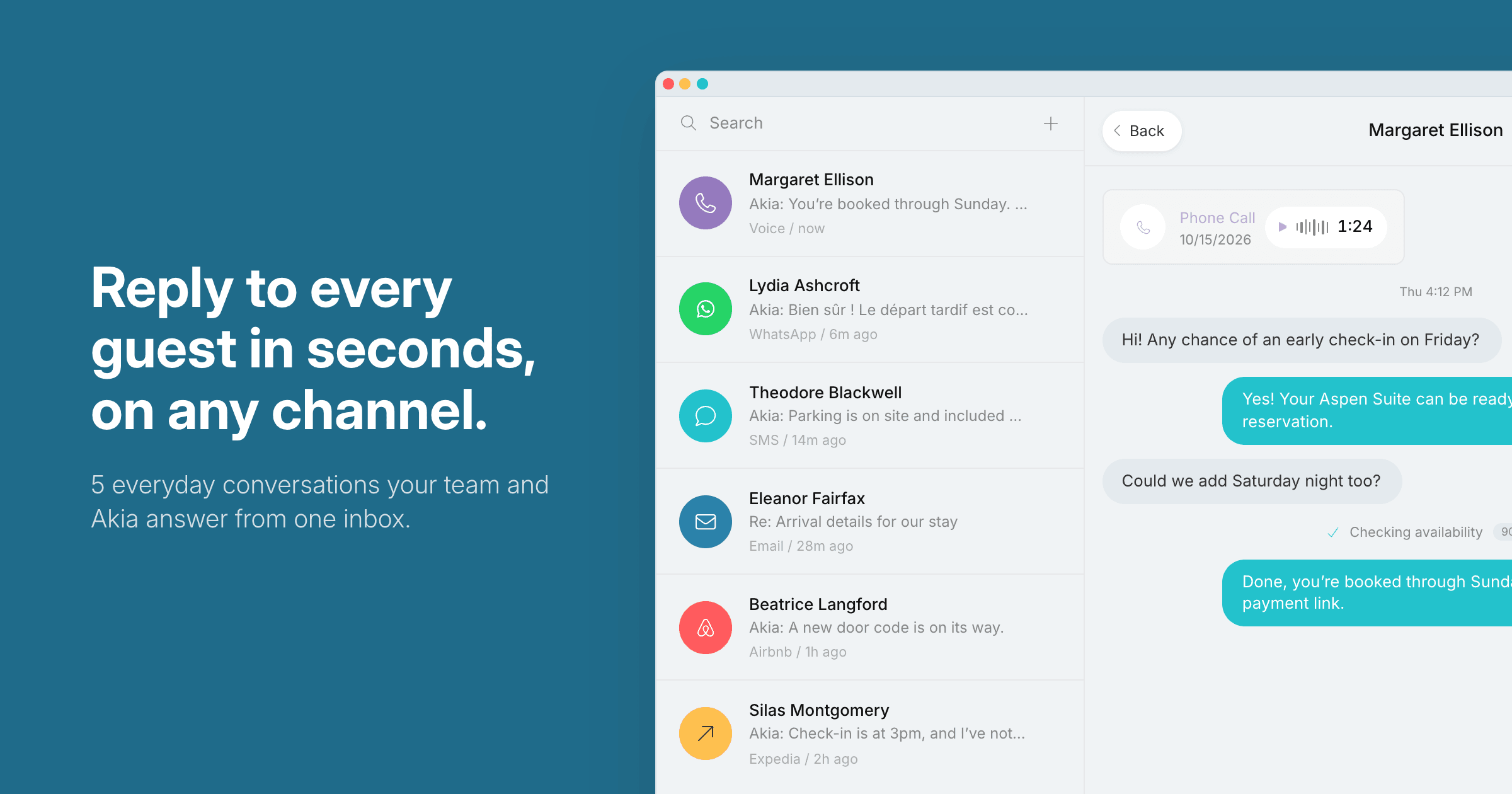
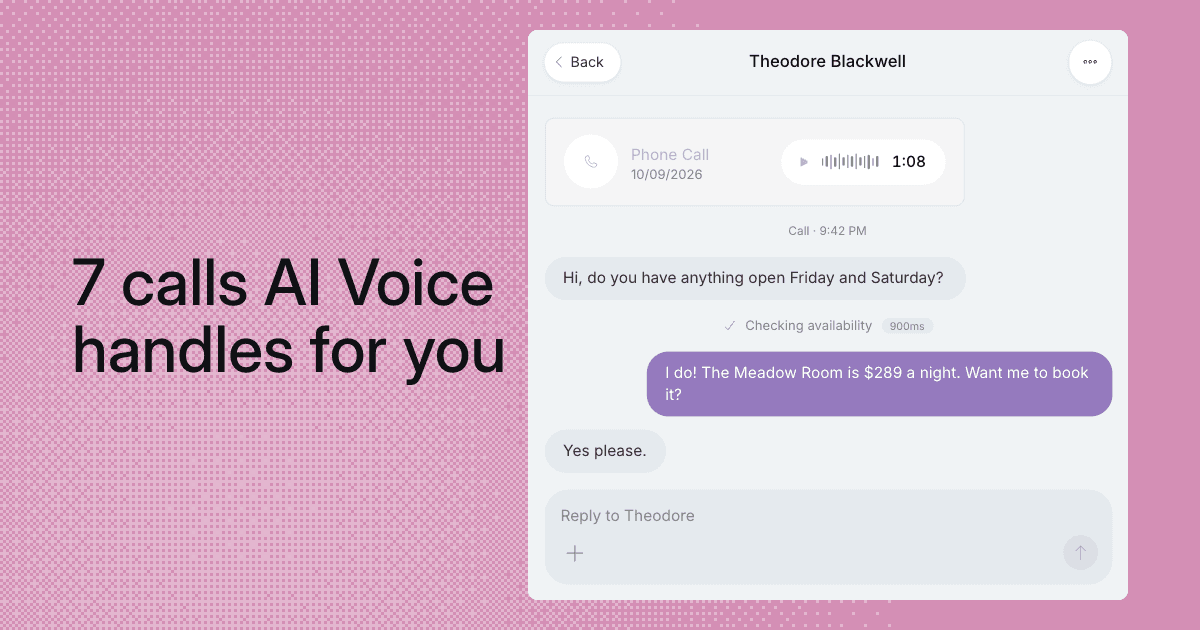
Be answerable everywhere, including the phone. Guests and their assistants reach out over messaging, web chat, and the phone, and an unanswered channel is a booking that went to the property that picked up. AI Voice and guest messaging mean the same answers show up on every channel, at any hour.
That last part matters more than it looks. The consistency you built in step one only holds if the answer a guest gets at 2am on the phone matches the one on your website.
Where Akia fits
A lot of this comes down to giving the same true answer everywhere, every time, and making sure the guests who loved the stay actually say so somewhere it counts.
Akia holds your property's real information in her Knowledge Base and answers from it across messaging, web chat, and the phone, so the version a guest gets at 2am is the version on your website. She's also the one who knows which twenty questions your guests actually ask, which is the list step two is built from. And her surveys make the review ask systematic instead of something your team gets to on a slow week, asking every guest in the thread they already have open, routing low scores to your team while there's still time, and pointing the happy ones at the review sites.
When a guest's AI comes shopping, Akia is the property's side of that conversation.
How do I get my hotel to show up in AI search?
Make your facts identical across your website, Google Business Profile, OTA listings, and directories, since assistants reconcile all of those and hedge when they disagree. Write your key facts in plain readable text that can be quoted. Get your property onto the third-party roundups, directories, and review platforms that AI already cites for your market. Keep reviews recent, specific, and steady. Then track citations monthly rather than rankings.
What's the difference between an AI mention and an AI citation?
A mention is when an AI names your property inside its answer. A citation is when the AI links a page as a source it used to write that answer. They're independent. A property can be mentioned in most answers about its market while being cited in almost none, because the sources the AI relies on usually belong to third parties like review sites, directories, and roundups.
Why does my hotel rank on Google but get no clicks?
Search engines now generate an answer above the results, so a guest can get what they asked for without scrolling to any link. Position and impressions can stay steady while visits fall. That's the reason to start measuring whether you're being quoted in the answer instead of only measuring where you rank beneath it.
Can my own website get cited by AI?
Yes, on factual questions about your property, like check-in times, pet policies, parking, or amenities, provided the fact is written plainly in text on a page an assistant can reach. On comparative questions like "best hotels in the city," AI generally cites third-party sources instead, because a property isn't treated as neutral evidence about how it compares to competitors.
Does my hotel need to be mentioned on other websites for AI to recommend it?
For comparative questions, yes. AI assistants answer "best hotels in" style questions almost entirely from third-party pages, so reviews, directories, and local roundups decide what gets said about you. Getting listed on the right ones is as much of the job as your own pages are.
How do I track AI visibility for my property?
Build a set of ten to twenty questions a guest would actually type, mixing comparative and factual ones. Run them monthly across ChatGPT, Google's AI answers, Perplexity, and Copilot while signed out. For each, record whether you were named, whether a page of yours was cited, and which URLs were cited instead. The list of URLs cited instead of you becomes your outreach target list.
What is AEO for hotels?
Answer Engine Optimization, or AEO, is making your property easy for AI assistants to read, recommend, and quote, the way SEO made a page easy for Google to rank. In practice it means consistent structured facts across every source that describes you, plainly written answers on your own pages, presence on the third-party sites AI cites for your market, and current specific reviews.
Bottom line
None of this is exotic. There's no trick and nothing you have to buy to start. It's careful, unglamorous work done deliberately, in a place where almost nobody is doing it deliberately yet, and that window closes eventually, the same way the SEO one did.
Get your facts consistent, write them where they can be read, get onto the pages that already get cited in your market, make reviews a habit, and track citations alongside your rankings. For the wider context on why this is happening now, read what Google's Ask Maps means for hotels.