Most guest satisfaction surveys fail for a boring reason. They're too long, they arrive too late, and they ask things the property already knows.
A good one is short, lands while the stay is still fresh, and asks about the moments a guest actually remembers. Below is a question bank you can pull from, a template you can copy as-is, and the timing that gets people to finish it.
Key findings
We looked at 58,426 scored survey responses and 19,144 rated stays across Akia properties.
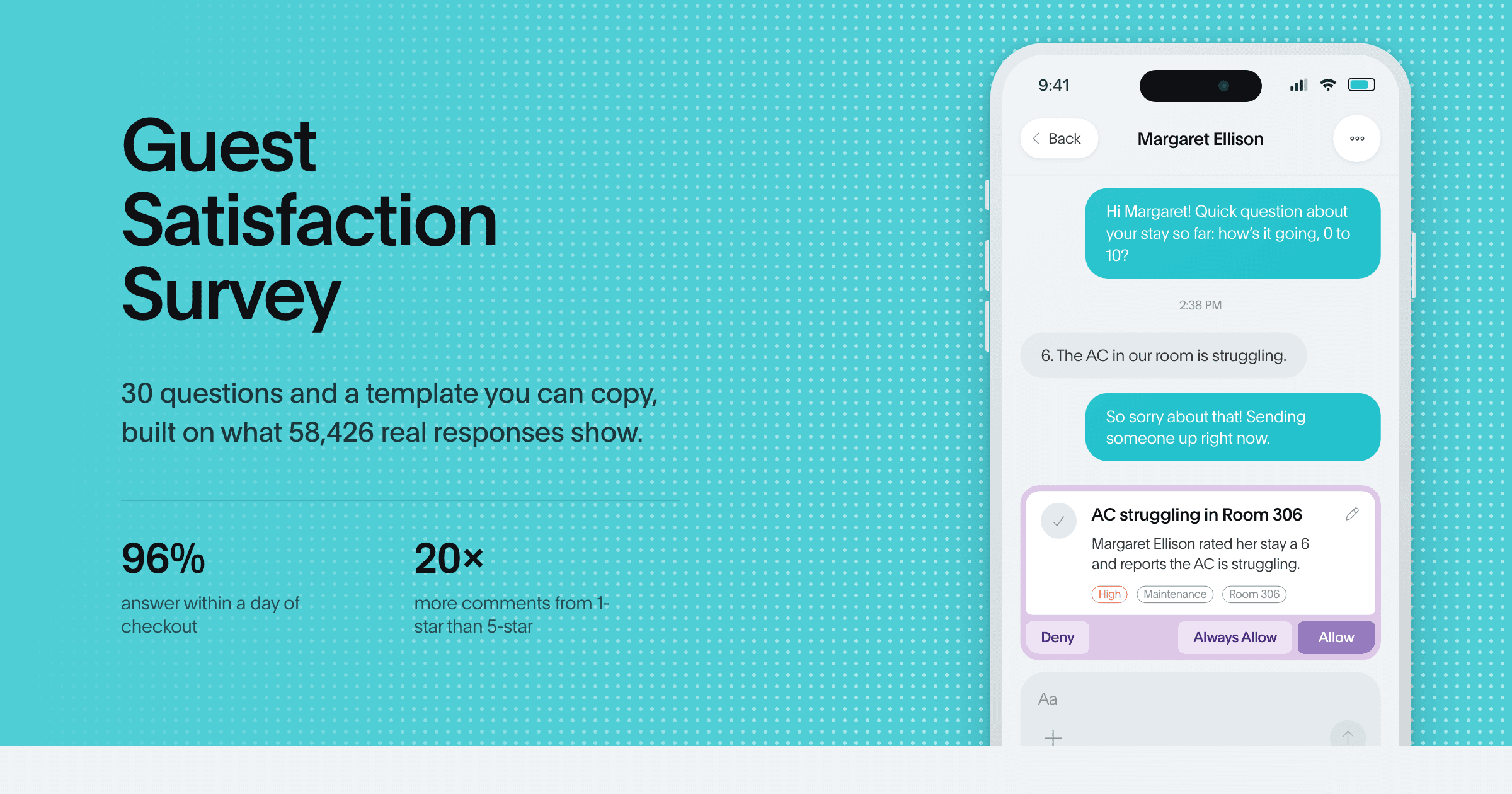
- 96% of guests who rate a stay do it within a day of checking out. 72.6% rate on checkout day itself and another 23.5% the next day. The response window is about 48 hours wide.
- Unhappy guests write, happy guests just tap. 61% of 1- and 2-star raters left a written comment. Only 3.1% of 5-star raters did, a 20× gap.
- 14% of your responses produce 55% of your written feedback. Scores of 1 to 3 are one in seven responses and more than half of everything anyone actually tells you.
- Late responses skew negative. Guests who rate more than a week after checkout average 3.76 stars, against 4.61 for same-day raters, and 32.8% of them give three stars or fewer.
What a guest satisfaction survey is
A guest satisfaction survey is a short set of questions you send a guest about their stay, collected privately by you instead of publicly on a review site. It measures how the stay actually went, and it gives you the problems in writing while you can still do something about them.
That private part matters. A guest who tells you the shower ran cold has handed you a fix. The same guest, unasked, tells TripAdvisor.
When to send it
Timing does more work than wording, and the data here is unusually clear.
Across 19,144 rated stays, almost every rating arrives in the first 48 hours:
| When the rating came in | Share of all ratings | Average stars |
|---|---|---|
| On checkout day | 72.6% | 4.61 |
| The day after | 23.5% | 4.60 |
| Two to three days later | 2.3% | 4.48 |
| Four to seven days later | 0.9% | 4.38 |
| More than a week later | 0.6% | 3.76 |
Post-stay, same day or next morning. 96.1% of guests who respond at all have responded by the day after checkout. Everything after that is a rounding error, so a survey that goes out on day three is mostly arriving after the audience has left.
Mid-stay, for anything you can still fix. A one-question check on the second morning catches the cold shower while the guest is still in the room. This is the version that protects your reviews, because you're finding the problem before the guest gets home and writes about it.
Skip the arrival survey. Guests have just walked in. There's nothing to rate yet.
One thing worth reading carefully in that table: the late responses are much harsher, averaging 3.76 stars against 4.61 for same-day. That's mostly selection rather than cause. Ten days after checkout, the only people still motivated to fill out your survey are the ones with something to complain about. Sending early doesn't make guests happier, it just means you hear from the ordinary ones too.
Which questions matter most
If you only have room for a few, weight them toward the room itself.
When we analyzed one- and two-star reviews, room condition was the top complaint category at 21.8%, six times larger than the next one. Service, location, noise, and price each came in under 4%. Inside those 1,229 room complaints, cleanliness and plumbing dominated, followed by heating and cooling, broken fixtures, smells, and electrical problems. The full breakdown is in the #1 reason guests leave a 1-star rating.
So a survey that asks four questions about your staff and one about the room is pointed at the wrong thing. Cleanliness, the bathroom, and whether everything in the room worked are the questions most likely to surface a complaint before it becomes a review.
The question bank
Pick six to eight of these. Not all of them. A survey that takes more than a minute gets abandoned halfway, and a half-finished survey tells you nothing.
Overall
- How would you rate your stay overall? (1 to 5)
- How likely are you to recommend us to a friend? (0 to 10)
- Would you stay with us again? (Yes / No / Maybe)
- Did the stay match what you expected when you booked? (Yes / Somewhat / No)
Arrival and check-in
- How easy was checking in? (1 to 5)
- Was your room ready when you arrived? (Yes / No)
- How long did you wait to be helped at arrival? (Under 5 minutes / 5 to 15 / More than 15)
- Did you get everything you needed to settle in, like the wifi and parking details? (Yes / No)
The room
- How would you rate the cleanliness of your room? (1 to 5)
- How comfortable was the bed? (1 to 5)
- Was the room quiet enough to sleep? (Yes / No)
- Did everything in the room work? (Yes / No, and what didn't)
- How would you rate the bathroom? (1 to 5)
Your team
- How would you rate the staff you interacted with? (1 to 5)
- Did anyone go out of their way for you? If so, who?
- When you asked for something, how quickly did you get it? (1 to 5)
- How easy was it to reach someone when you needed to? (1 to 5)
Amenities and the property
- Which of these did you use during your stay? (checklist: breakfast, pool, gym, parking, restaurant, bar, spa)
- How would you rate the one you used most? (1 to 5)
- Was there anything you looked for and couldn't find?
- How would you rate the common areas? (1 to 5)
Value
- How would you rate the value for what you paid? (1 to 5)
- Were there any charges that surprised you? (Yes / No, and which)
Open-ended, and worth keeping
- What was the best part of your stay?
- What's one thing we could have done better?
- Anything you'd want the next guest to know?
Question 25 is the one that earns its place, and the numbers say why. Across 58,426 scored responses, 61% of 1- and 2-star raters wrote a comment. Only 3.1% of 5-star raters bothered.
| Score given | Share of responses | Left a written comment |
|---|---|---|
| 1 star | 3.4% | 60.7% |
| 2 stars | 3.2% | 60.7% |
| 3 stars | 7.3% | 53.1% |
| 4 stars | 15.7% | 27.9% |
| 5 stars | 68.8% | 3.1% |
Happy guests tap five stars and leave. Unhappy guests want to be heard. Scores of 1 to 3 are only 14% of responses but produce 55% of every written comment you get, so the open question is doing almost all of its work for a small slice of your guests. That slice is the one about to write a public review.
For vacation rentals specifically
- How clear were the arrival instructions? (1 to 5)
- Did the property match the listing photos? (Yes / Somewhat / No)
- How easy was it to reach us during your stay? (1 to 5)
- Was the kitchen stocked with what you needed? (Yes / No)
A template you can copy
This is a full post-stay survey at seven questions. It takes about forty seconds to finish.
How was your stay at [Property Name]?
Thanks for staying with us. Seven quick questions, about forty seconds.
1. How would you rate your stay overall? ☆☆☆☆☆
2. How would you rate the cleanliness of your room? ☆☆☆☆☆
3. How would you rate the team you interacted with? ☆☆☆☆☆
4. How would you rate the value for what you paid? ☆☆☆☆☆
5. Did everything in your room work as it should? ○ Yes ○ No, and here's what didn't: ____________
6. What's one thing we could have done better?
7. How likely are you to recommend us to a friend? (0 to 10) 0 1 2 3 4 5 6 7 8 9 10
That's it. Thank you.
Four rating questions, one diagnostic, one open, one score you can track over time. Every question maps to something a guest can answer without thinking hard.
Which rating scale to use
1 to 5 for individual questions. Guests understand it instantly, and it maps onto the star ratings they already use on review sites. Anything finer than five points is false precision, because nobody meaningfully distinguishes a 6 from a 7 on a bathroom.
0 to 10 for the recommend question only. This is your Net Promoter Score. Nines and tens are promoters, sevens and eights are passives, zero through six are detractors. Subtract the detractor percentage from the promoter percentage and you have one number to watch month over month.
Keep the scale direction the same all the way through. Flipping it halfway ruins your data, because people stop reading and answer on autopilot.
How many questions before people quit
Six to eight is the working range for a post-stay survey. One or two for a mid-stay check.
Every question you add costs you completions, and the questions you drop are usually the ones you weren't going to act on anyway. If you can't name what you'd change based on the answer, cut it.
What to do with the answers
A survey nobody reads is a survey that annoys your guests for nothing.
Route the bad ones the same day. A low score with a written complaint is a service recovery window, and it closes fast. Getting to that guest before they get home is the whole point of asking privately.
Watch the patterns, not the individual scores. One person who found the room noisy is a data point. Eleven people in a month who found the room noisy is a maintenance ticket and a room you should stop selling until it's fixed.
Ask your promoters for the public review. Anyone who gives you a nine or ten has already written your review in their head. That's the moment to point them at Google.
Close the loop out loud. When you fix something a guest flagged, tell them. It's the cheapest loyalty you'll ever buy.
If reviews are the part you're worried about, our guide to building a review management strategy covers the public side of this, including how a private survey catches the bad review before it's written.
Let Akia run it
Akia sends the survey over text after checkout and reads every answer that comes back. A bad score doesn't sit in a spreadsheet waiting for someone to notice. She files it to the right person while the guest is still reachable.
She knows which room they were in and what they asked for during the stay, so the survey doesn't ask them things you already know. Guests answer in the same thread they've been texting you in all week, which is why they answer at all.
Frequently asked questions
What is a guest satisfaction survey?
A short set of questions sent to a guest about their stay, collected privately by the property rather than posted publicly on a review site. It usually covers cleanliness, staff, value, and an overall rating, and it gives the property written feedback it can act on.
How many questions should a guest satisfaction survey have?
Six to eight for a post-stay survey, one or two for a mid-stay check. Completion rates fall with every question you add, so cut anything you wouldn't act on.
When should you send a guest satisfaction survey?
Within 24 hours of checkout. Across 19,144 rated stays, 72.6% of guests rated on checkout day itself and another 23.5% the next day, so 96% of all responses land inside a 48-hour window. Send a shorter mid-stay version on the second morning for anything you can still fix before the guest leaves.
Do guests actually fill out post-stay surveys?
The ones who respond do it fast. 96% of guests who rate a stay do so within a day of checkout, and response falls off sharply after that. Guests who respond more than a week later average 3.76 stars against 4.61 for same-day responders, because by then the only people still motivated to answer are the ones with a complaint.
What rating scale should a guest survey use?
Use 1 to 5 for individual questions, since it matches the star ratings guests already know. Use 0 to 10 only for the recommend question, which gives you a Net Promoter Score you can track over time.
What's the difference between a guest satisfaction survey and a review?
A survey is private and goes to the property, so problems arrive in time to fix them. A review is public and permanent. Surveys are how you keep problems from becoming reviews.
What should you ask in a hotel survey?
Cover the moments guests remember: check-in, room cleanliness, the bed, the staff, and value for the price. Include one open question asking what you could have done better, which is where the most useful detail comes from.