The night manager's message backlog.
A resort property manager checks her phone at 6am. Fourteen messages came in overnight: three guests asking about pool hours, two asking about parking, four about early check-in availability, two about the wifi password, one about restaurant recommendations near the property, and two asking what time checkout is. Each one needs a real answer, personalized to the property's actual policy, delivered to the right channel.
Before AI: she starts working through them at 6am and is still going at 8. After AI trained on her property's references: all fourteen are answered accurately, on brand, while she was asleep.
That's the operational reality driving AI adoption in hospitality. Not robots at the front desk. Not revenue forecasting algorithms. Guest communication volume that outpaces what any team can handle manually across SMS, WhatsApp, Airbnb, Booking.com, Vrbo, and email simultaneously. Your own team gets the same assistant pointed at them, and we listed AI prompts for property managers once it's running.
What "AI for hotels" actually means.
AI in hospitality has become a catch-all phrase that covers everything from robotic room service delivery to dynamic pricing engines. Those exist, but they aren't what most independent hotels, boutique properties, and short-term rental operators are implementing right now.
What's being deployed is narrower and more useful: AI that handles guest interactions. Answering questions. Routing service requests. Timing upsell offers. Managing the communication volume that arrives at all hours across every channel the property uses.
The specific workflows:
- Answering routine guest questions (check-in times, wifi passwords, amenity hours, local recommendations)
- Handling pre-arrival communication and digital check-in flows
- Sending automated upsell offers based on reservation data
- Converting guest service requests into internal tasks routed to the right department
- Escalating complex or sensitive conversations to staff
None of that requires robotic hardware or data science infrastructure. It requires a trained AI that knows your property specifically, connected to your communication channels and your PMS.
Why AI handles guest communication better than a static FAQ page does.
The traditional alternative is a static FAQ page on the property website that guests rarely find and staff rarely update. AI handles the same information in a fundamentally different way: it surfaces answers in the channel where the guest is already asking.
A guest who texts "do you have early check-in?" gets an answer in seconds, not "please visit our website." A guest messaging via Airbnb at 11pm about parking availability gets an accurate response drawn from the property's current policies, not a morning reply after the question has compounded into an anxious call.
Guests notice when questions go unanswered for hours, particularly when those questions affect their arrival plan. Consistent fast response across multiple channels and overnight hours isn't achievable manually for most hotel teams. AI closes the gap.
The catch: generic AI gets this wrong. A general-purpose AI doesn't know that your property has a 3pm check-in and charges $45 for early arrival, or that parking requires a permit, or that the pool closes at 9pm. Untrained AI gives plausible-sounding answers that don't match reality, and guests who act on them arrive frustrated.
Hospitality AI that performs is trained on the property's own references: the specific policies, room configurations, fees, and local knowledge that make one property's answers different from the hotel two miles away.
Five AI applications hotels are actually deploying.
1. Guest messaging automation. AI that answers incoming messages from a structured knowledge base, across all channels simultaneously. Staff review conversations in a unified inbox. Routine questions resolve without intervention; anything complex flags for human response. Consistent coverage, around the clock, across every platform the property uses.
2. Digital check-in flows. AI-guided pre-arrival sequences that collect registration information, verify payment methods, explain the property's arrival process, and capture special requests before the guest travels. Arrival moves faster. The PMS is already updated. Staff spend check-in time on hospitality rather than paperwork.
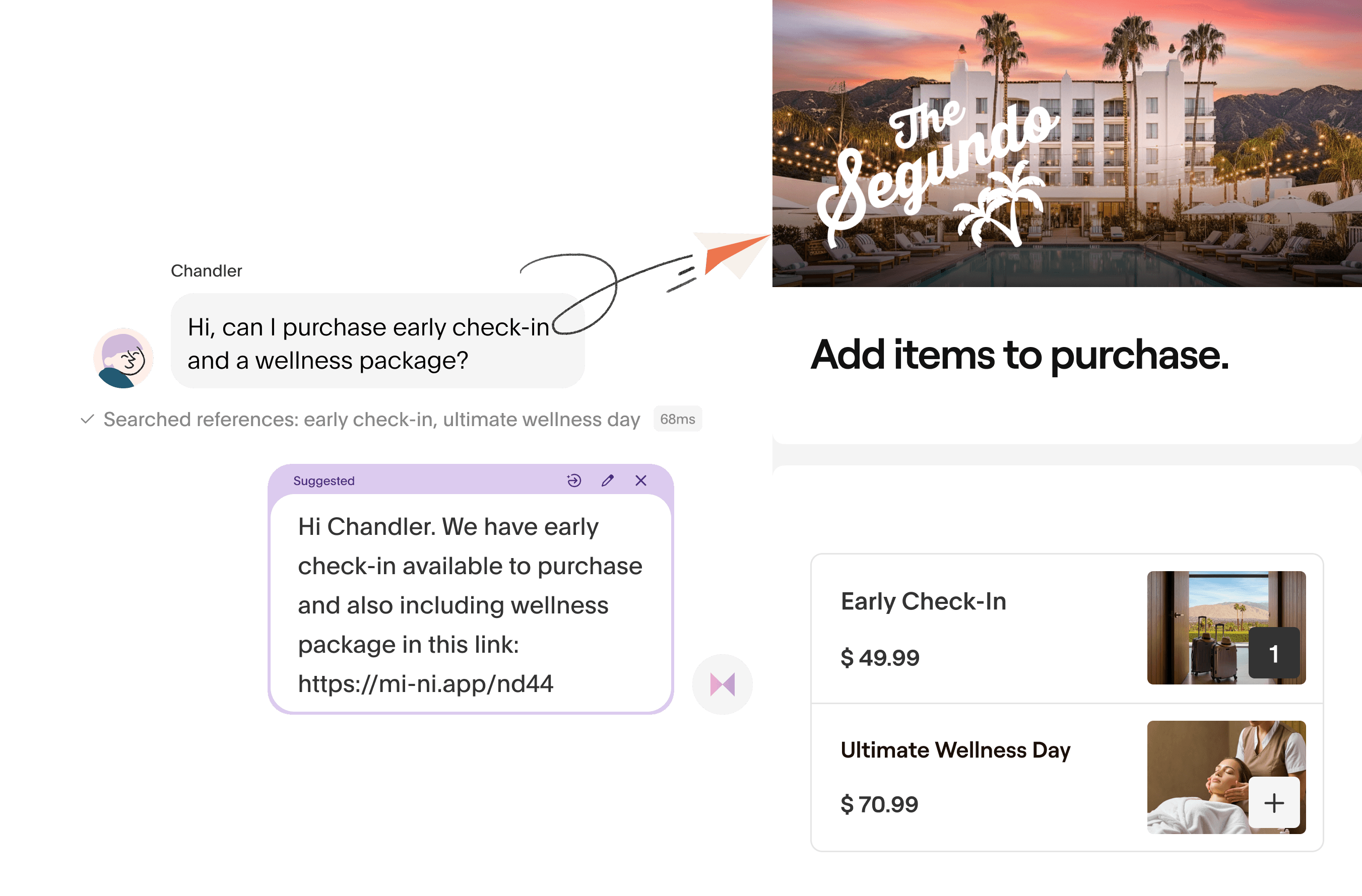
3. Pre-arrival upsell automation. AI that reads the reservation, checks available inventory, and sends a personalized upgrade or add-on offer at the highest-conversion timing window (typically 24–72 hours before arrival). Payment is embedded in the message. PMS updates automatically when a guest accepts.
4. Service request routing. AI that converts in-stay guest messages into tasks assigned to the right team. A guest who texts "the TV remote isn't working" gets a confirmation message while the task routes to maintenance. A housekeeping request routes to housekeeping. The front desk sees the conversation and its resolution status without carrying the task themselves.
5. Reference-based AI training. The knowledge layer that makes the other four applications work. A structured set of property-specific references (room types, fees, policies, local recommendations, custom handling rules) that the AI draws from when answering questions. When staff update a policy, the AI answer updates with it. When a staff member corrects an AI response, the correction becomes part of the reference.
Six practices that determine whether hotel AI actually performs.
1. Train on your property's actual policies before going live. Don't launch AI on a blank slate and let it learn from guest interactions. Load your check-in time, checkout time, parking information, pet policy, amenity hours, cancellation terms, and the ten questions your guests ask most often. Do all of this before the first message is handled automatically.
2. Start in supervised mode. Supervised mode lets the AI draft responses that staff review and approve before sending. Run supervised mode for 30–60 days to build confidence in the AI's accuracy. Move to agentic mode (where the AI replies autonomously) only on question types where you've verified the responses are consistently correct.
3. Connect to your PMS before anything else. AI that doesn't have access to live reservation data will give wrong answers for availability questions and send upsell offers for inventory that isn't available. PMS integration is the foundation everything else depends on.
4. Set response rules by channel. A guest messaging via WhatsApp at 10pm has different expectations than a guest sending an email. Configure response timing, escalation thresholds, and auto-reply behavior separately per channel rather than applying a single ruleset across all platforms.
5. Review flagged conversations weekly. Every question the AI couldn't answer confidently is a gap in the reference library. A 30-minute weekly review of flagged conversations, followed by adding the missing answers to the knowledge base, consistently improves accuracy over time.
6. Keep human touchpoints where they matter. Arrival greetings, complaint escalation, and anything a guest has flagged as emotionally significant should route to staff. AI handles volume; people handle the moments that become a guest's story about their stay.
Five mistakes that make hotel AI worse than the status quo.
1. Deploying before training. A general-purpose AI launched without property-specific references will give answers that don't match reality: check-in times, fees, and policies the property doesn't actually have. Guests who act on incorrect information arrive frustrated, and recovery costs more than the time saved.
2. Using a generic AI tool not built for hospitality. General-purpose AI assistants can write fluent responses, but they don't understand OTA message formats, PMS integration requirements, or the guest communication workflows specific to hotel operations. Hospitality AI is purpose-built for this context. The same gap shows up when properties reach for a generic hotel chatbot.
3. Skipping the supervised-to-agentic progression. Setting AI to auto-reply everything from day one, before any quality review, removes the staff feedback loop that makes the AI improve. The supervised phase is how the AI learns your property's specific answers.
4. Treating AI as a cost-cut rather than a quality improvement. Properties that deploy AI primarily to reduce headcount typically see worse outcomes than those that deploy it to improve response coverage and quality. Staff who remain in the loop, reviewing conversations, maintaining references, and handling escalations, are what separate AI that improves guest experience from AI that generates complaints.
5. Running AI across some channels but not others. AI that handles Airbnb messages but not SMS creates a two-tier guest experience. Guests who message through the uncovered channel wait longer, and staff don't have unified visibility into what guests have already been told. AI works best when it covers every channel the property uses, in a single system.
Why AI gets harder to manage without a reference layer.
A single-property operator can often run AI well with informal knowledge management. The owner knows the answers; the AI learns from corrections; inconsistencies surface quickly.
Multi-property operators, seasonal properties, and high-turnover teams face a compounding problem: the AI's knowledge base only stays accurate if someone maintains it. When the cancellation policy changes, the AI needs to know. When a new staff member joins, they shouldn't be learning the property's policies from AI responses that are three months out of date. When the pool closes for maintenance, the AI needs that information before a guest asks.
Properties that run AI reliably treat the reference library as infrastructure, not initial setup. It's updated when policies change, reviewed between seasons, and extended when new question types appear. Without that maintenance, the AI drifts from the property's actual reality, and the gap between AI response and front desk response is where guest trust breaks down.
How Akia handles AI for hotels.
Akia is the AI Agent for hospitality. The AI training layer is the foundation of how Akia handles every guest interaction: the system that makes responses accurate and property-specific rather than generically correct. See what Akia does for a hotel.
Akia trains on your property's own references. Policies, room configurations, pricing rules, local recommendations, and custom handling logic are structured as references that Akia draws from when answering any guest question. The answers are specific to your property, not generically hospitality-adjacent.
Akia supports supervised and agentic modes for progressive trust-building. In supervised mode, Akia drafts a response and staff approves before it sends. In agentic mode, Akia replies directly for question types where the reference coverage is solid. Properties move specific question types from supervised to agentic as confidence develops. There's no single on/off switch applied across everything.
Akia learns from every staff correction. When a team member edits an Akia draft or answers a question the AI flagged as uncertain, Akia surfaces a suggestion to add the new answer to the reference library. One correction becomes a permanent improvement across every future instance of that question, on every channel, at any hour.
Akia covers every channel from one inbox. SMS, WhatsApp, Airbnb, Booking.com, Vrbo, Expedia, web chat, social, and email all route through Akia's unified inbox. The AI's training applies consistently across all channels, so a guest who switches from Airbnb messaging to a text the next day gets the same accurate answers without re-explaining the context.
"Before Akia, we spent hours customizing different information in emails for our guests based on different criteria like day of week or condo unit. Now Akia handles all of this automatically, and it really saves time so we can really take care of our guests."
— Maren Trader, Office Manager, Fairfield Plantation Resort
"We definitely would be in a worse situation if not for Akia. With a team of only two, we'd probably need to hire at least 2 more people for answering phones and emails separately if we didn't invest in Akia's platform. This system has greatly helped in keeping our operational costs at bay."
— Justin Jurist, VP/Portfolio Manager, Coastal Maine Vacations
Getting started: three steps before you evaluate any AI vendor.
1. List the ten questions your guests ask most often. Check your inbox, your team's notes, and your reviews for patterns. This list is the starting dataset for any AI reference library and the benchmark for evaluating whether the AI is actually answering correctly during a demo.
2. Map which channels those questions arrive through. Some questions come via Airbnb messaging; some come via text; some come through web chat late at night. Mapping this before you demo any tool tells you which channels the AI must cover and which integrations are non-negotiable for your operation.
3. Ask every vendor to demonstrate supervised mode during the demo. Supervised mode is how you verify the AI's answer quality before trusting it to reply autonomously. If a vendor doesn't offer a supervised stage, the only way to catch wrong answers is after they've been sent to guests.
Guest communication volume doesn't decrease as properties add booking platforms and communication channels. The question is whether that volume gets handled by AI that knows the property or by an overextended team handling it inconsistently at 2am.
See how Akia's AI training works, or book a demo to see how a trained Akia handles your property's most common questions.