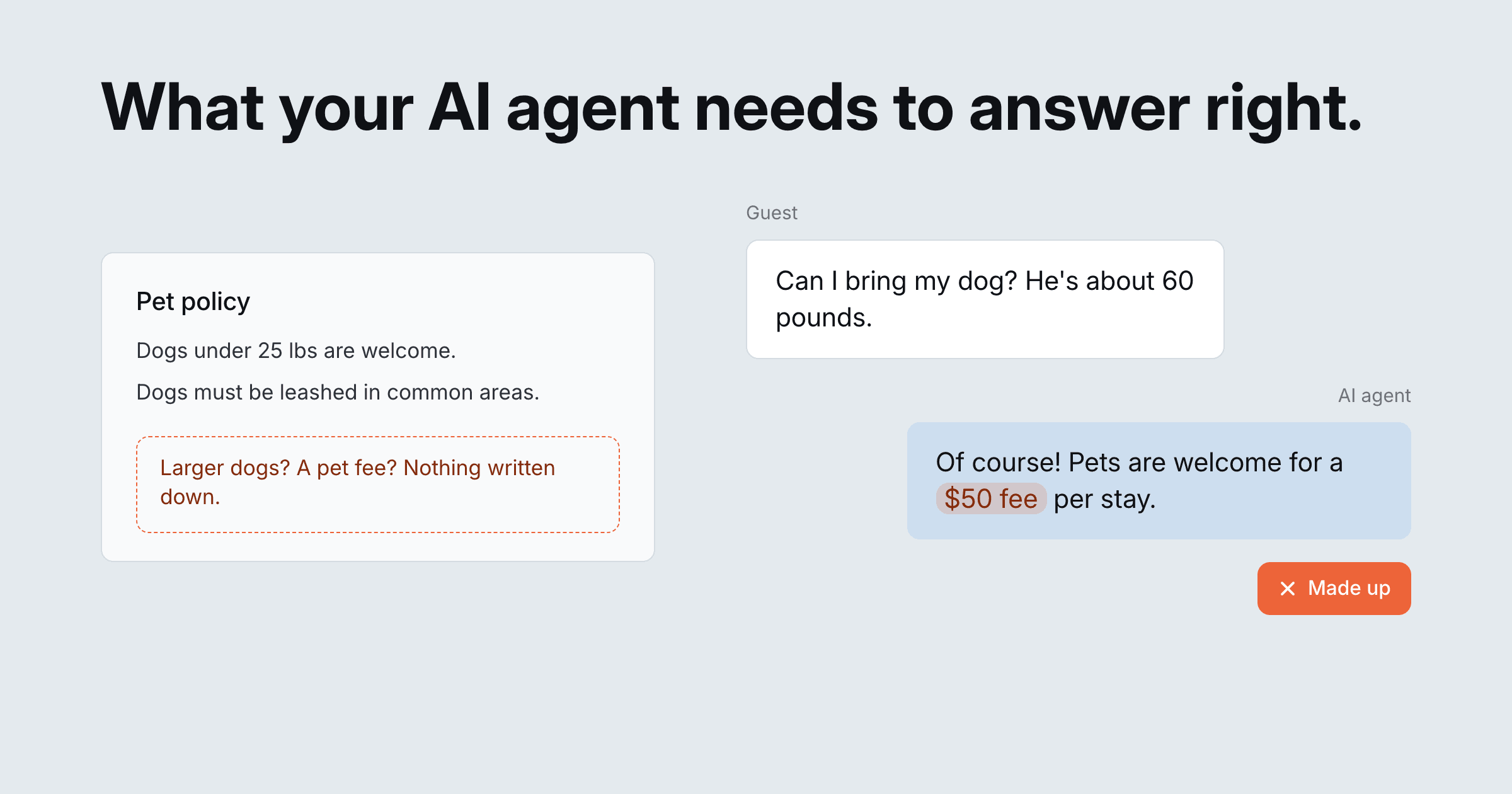
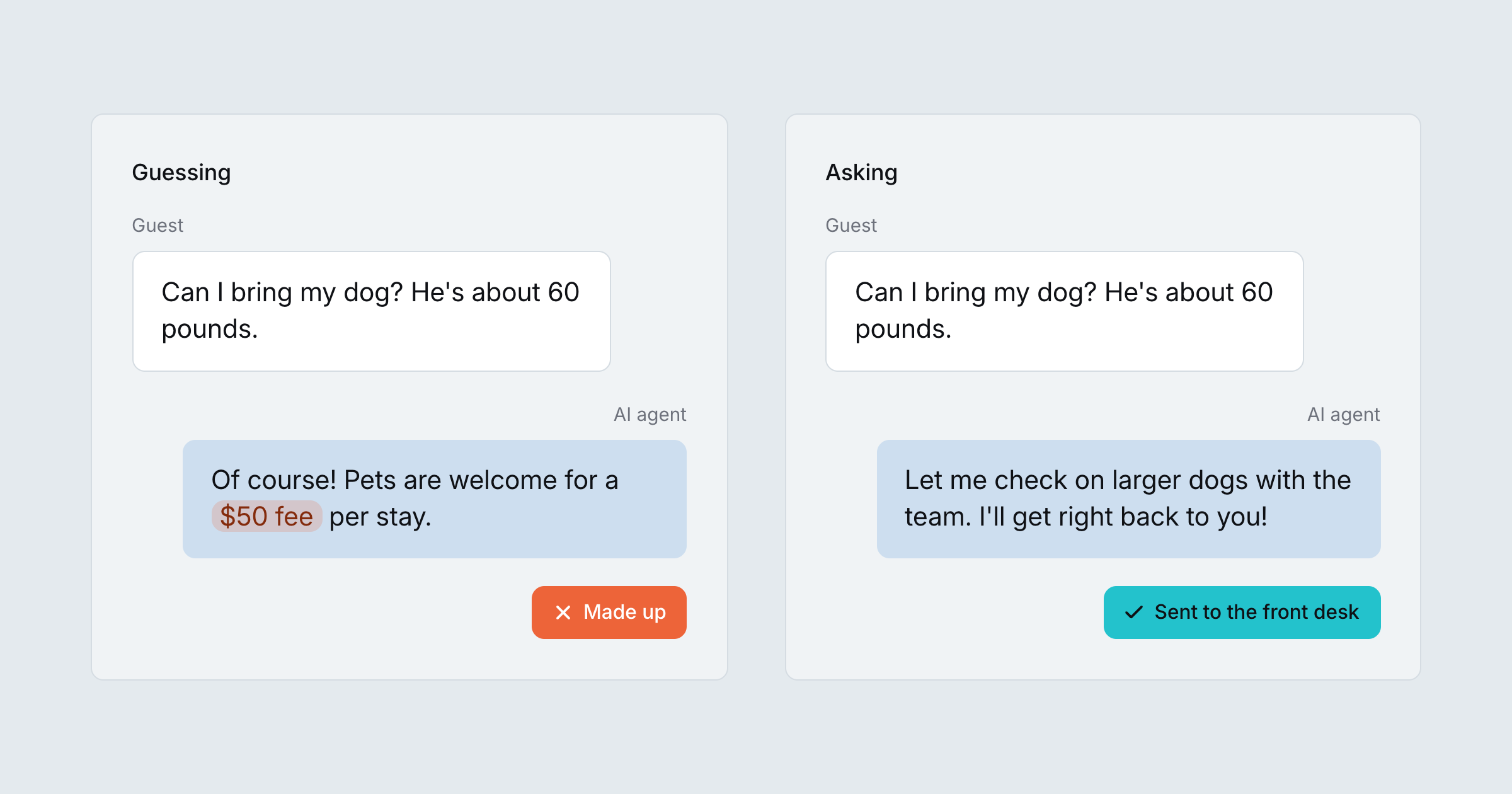
A guest texts at 9:40pm: "Can I bring my dog? He's about 60 pounds." The AI agent replies right away: "Of course! Pets are welcome for a $50 fee per stay."
Your policy allows dogs under 25 pounds. There's no $50 fee. Now a guest is pulling up to the front desk with a large dog and a screenshot, and your night agent has to be the one who says no.
Most operators take a moment like this to mean the AI is broken. Usually it isn't. It did exactly what it was built to do with the information it had, and the information had a hole in it. Once you understand how an agent actually comes up with an answer, most bad replies become easy to trace and pretty easy to fix.
How an AI agent writes a reply.
Underneath every AI agent is a language model. A language model does one thing: it looks at the words so far and predicts which word should come next. Then it does it again, and again, until it has a full reply. It learned to do that by reading an enormous amount of text, so it's very good at producing sentences that sound right.
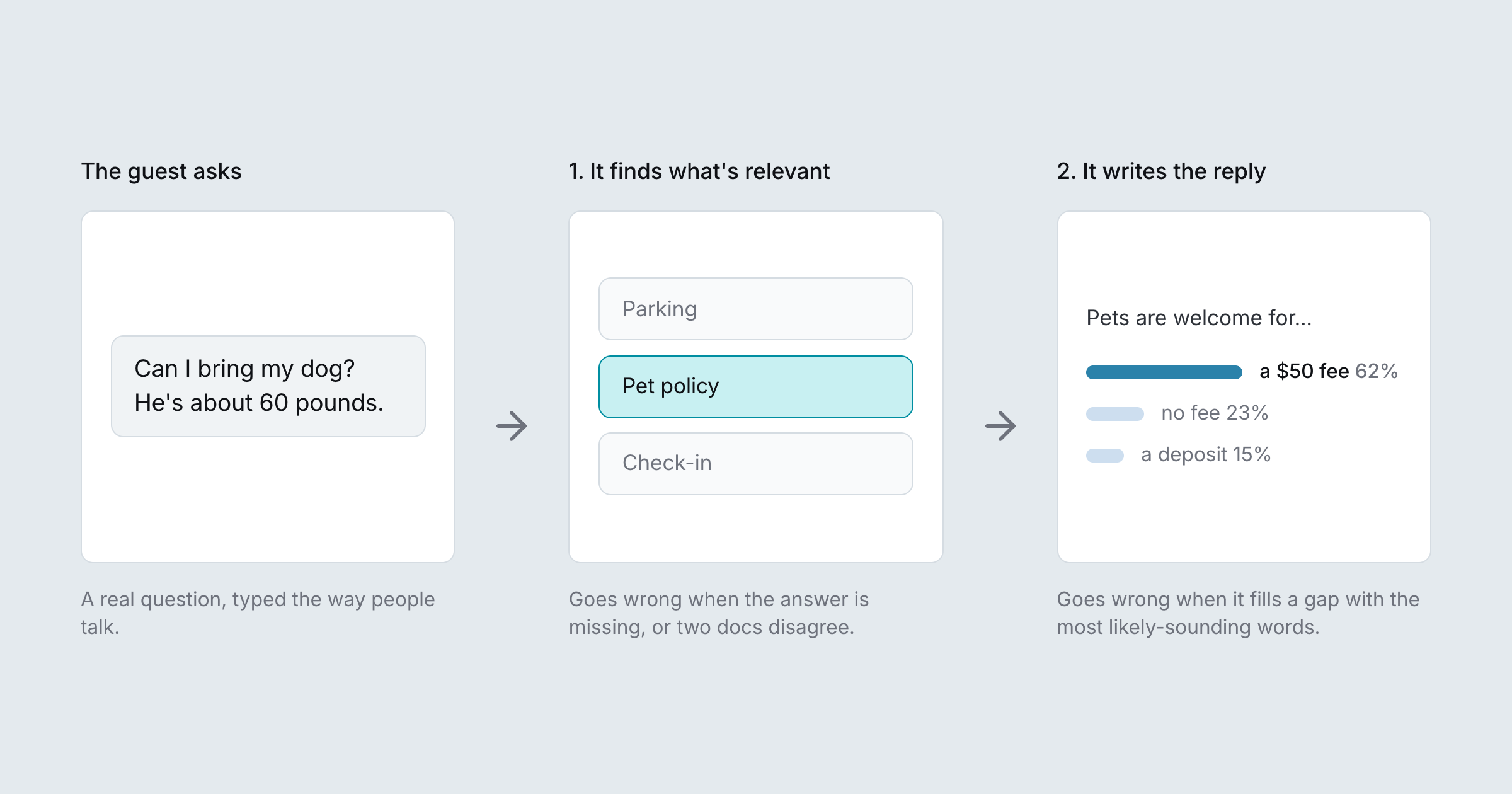
Sounding right and being right are different things. The model has read thousands of hotel pet policies, but it has never read yours. So a good agent doesn't just let the model talk. Before it writes anything, it looks up your property's information, like your policies and the guest's reservation in your PMS, and hands the relevant pieces to the model with an instruction like "answer using this."
That means every reply goes through two steps. First the agent finds what it thinks is relevant. Then the model writes an answer based on what it found. A bad answer almost always traces back to one of those two steps going wrong, and in hotels it tends to happen in four specific ways.
The four reasons your agent gets it wrong.
1. The information is missing.
This is the pet fee problem. Your policy says "dogs under 25 lbs are welcome." It says nothing about bigger dogs, and nothing about fees either way. The agent looks for the answer, finds a policy that's close, and the model fills in the rest with what pet policies usually say. Plenty of properties charge a pet fee, so "$50 fee" is a very likely-sounding thing to write.
Fix it by writing down the edges, along with the rule. "Dogs under 25 lbs are welcome. We can't accommodate larger dogs. There is no pet fee." Three sentences, and the guess has nowhere to go.
2. Two sources disagree.
Your website says checkout is 11am. An old FAQ document from before your renovation says noon. The PMS says 11am but a group block has a noon late checkout built in. The agent finds two answers and has to pick one, and it has no way of knowing which one is stale.
This one is sneaky because the agent will be right most of the time, so nobody notices the conflicting doc is still in there. Then one day it pulls the old one.
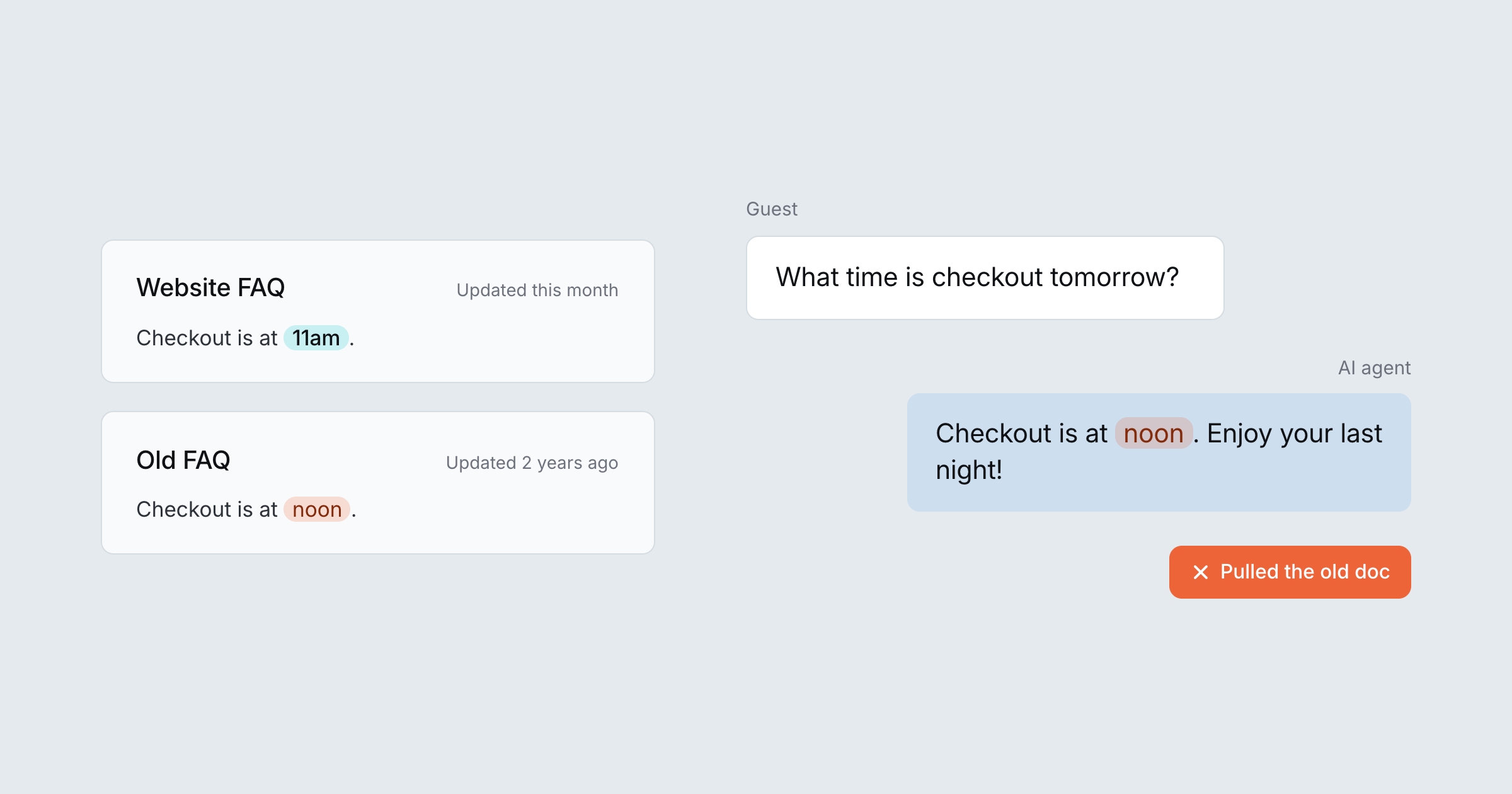
Fix it by keeping one source of truth for every fact. When a policy changes, delete the old version instead of adding a new one next to it. If you find yourself saying "well, it depends which document you look at," your agent is saying it too.
3. The question is vague.
"Is the pool open?" sounds simple. But you have an indoor pool and a seasonal rooftop pool, the rooftop closes at 8pm, and it's October. The guest might mean right now or tomorrow. The agent has to pick a meaning before it can answer, and if it picks the wrong one, the reply is technically accurate and completely unhelpful.
Guests write the way they talk, short and full of assumptions. "What time is breakfast" from a guest booked in your suite package might mean the in-room breakfast, while the same question from everyone else means the restaurant.
Fix it by giving the agent the context it needs to resolve the ambiguity, and permission to ask when it can't. If the guest's reservation is connected, the agent can see which package they booked. If it's genuinely unclear, a quick "Do you mean the indoor pool or the rooftop?" is a better reply than a confident wrong one.
4. The agent guesses when it should ask.
This is the root of the other three. Language models are trained to be helpful, and a fluent, confident answer reads as helpful. Left alone, the model would rather produce something plausible than say "I'm not sure."
Fix it by telling the agent exactly what to do when the answer isn't in its information. "If the answer isn't in the property's documents, tell the guest you'll confirm with the team and send the question to staff." That one instruction turns a made-up pet fee into "Let me check on that for you," which is exactly what a good front desk agent would say.
What hallucination actually is.
"Hallucination" is the industry word for when an AI states something false as if it were true.
Remember that the model is always predicting the most likely next word. It has no built-in sense of "I know this" versus "I don't know this." When it has your real policy in front of it, the most likely next words are the ones in your policy. When it doesn't, the most likely next words are whatever sounds like a typical property's answer. Either way, the reply comes out with the same confident tone, because tone is just more predicted words.
So the $50 pet fee was the most average answer to the question, written by something that didn't have yours.
That's also why the fixes above work. They keep your real answer in front of the model, and give it a clear, acceptable thing to say when the answer isn't there.
Why the same question gets two different answers.
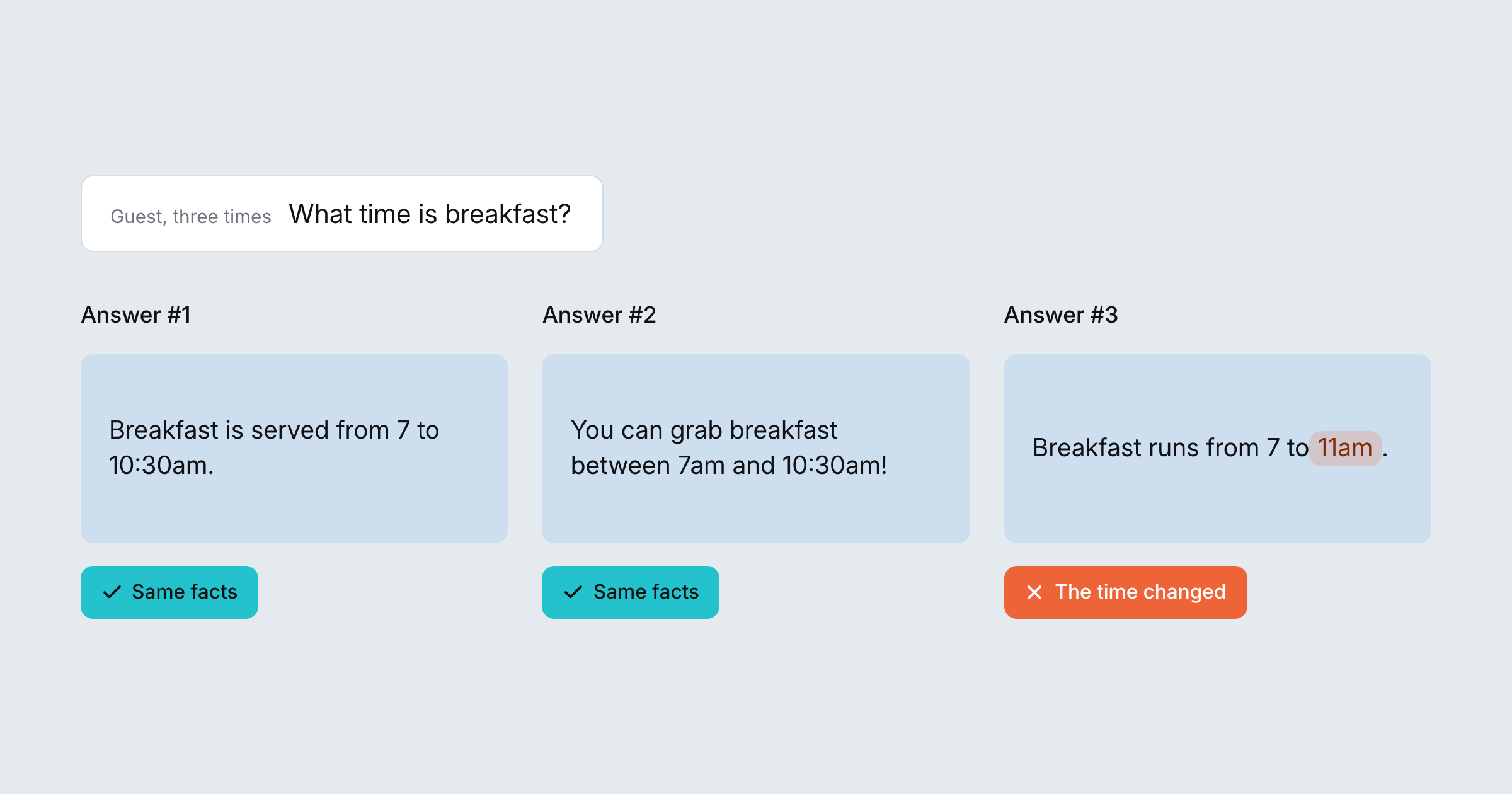
Ask your agent "what time is breakfast?" twice and you might get "Breakfast is served from 7 to 10:30am in Meadowlark" and then "You can grab breakfast at Meadowlark between 7am and 10:30am!" That's normal, and it's fine.
Here's why it happens. When the model predicts the next word, it doesn't always pick the single most likely one. It picks from the top few, weighted by how likely each one is. That small bit of randomness is what makes replies sound natural instead of robotic. If it always chose the top word, every reply would read like the same form letter.
The wording changing is fine. The facts changing is a warning sign. If one reply says breakfast ends at 10:30 and another says 11, the model isn't reading a clear answer. It's filling a gap or choosing between two conflicting sources, and the randomness is just showing you where the weak spot is, which makes it easy to test for.
A 15-minute audit you can run tonight.
Pick ten questions your guests actually ask, and lean toward the awkward ones. Ask your AI agent each question three times, worded a little differently each time. Then check two things: whether the facts match your real policy, and whether the facts stay the same across all three tries.
Some good questions to start with:
- Can I bring a large dog?
- Can I check in at 10am?
- Is there parking for an oversized vehicle?
- Do you have a shuttle to the airport, and does it cost anything?
- Can someone else pick up my room key?
- What happens if I need to cancel tomorrow?
Every answer that's wrong or changes between tries points to one of the four problems above: a missing edge, a conflicting document, a question that needs more context, or a spot where the agent should have asked instead of answered. Fix the information, ask again, and watch the answer settle down.
Run it once a month, and again any time a policy changes. The agent's answers can only be as good as what it's been given to read.