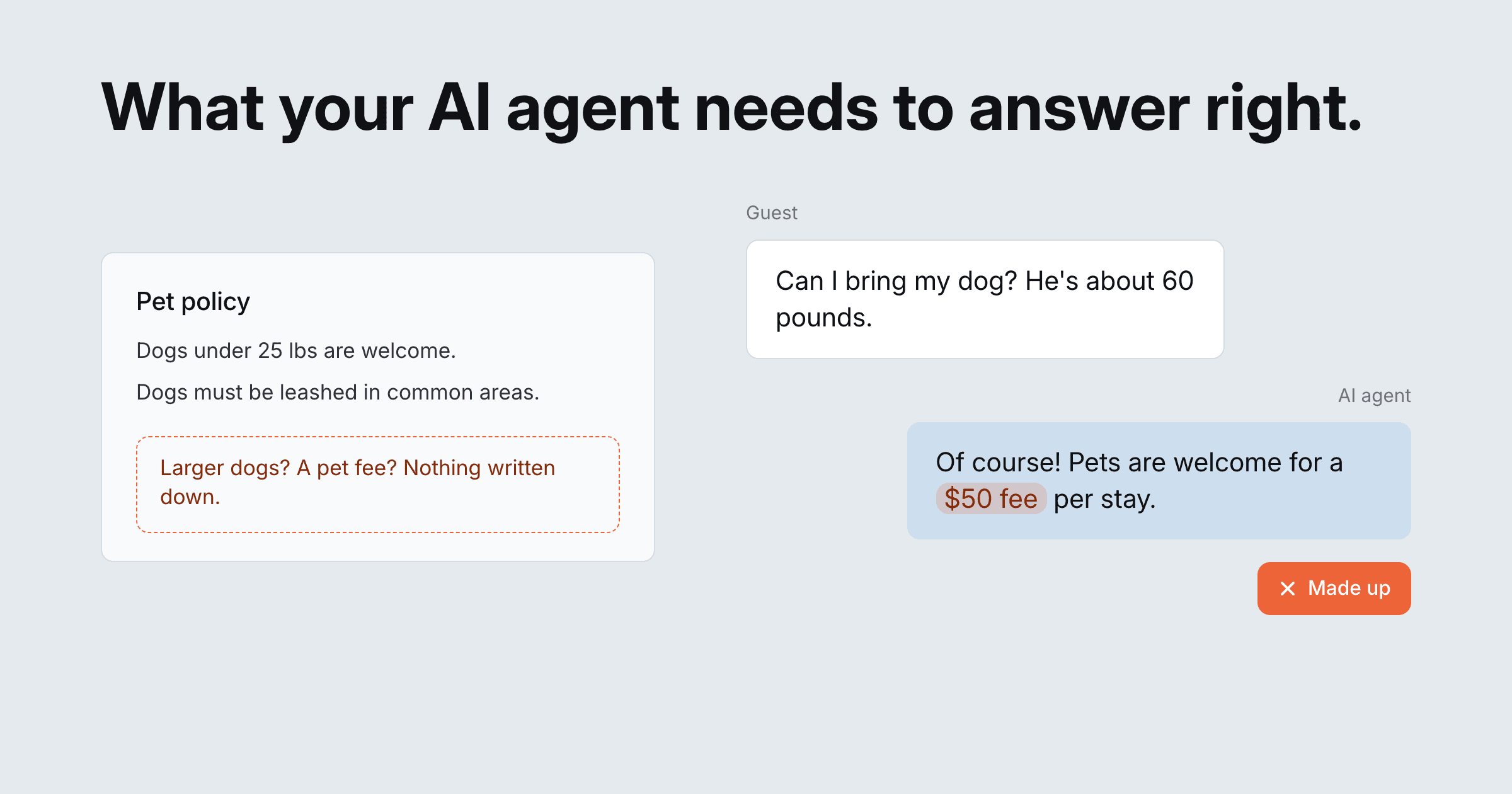
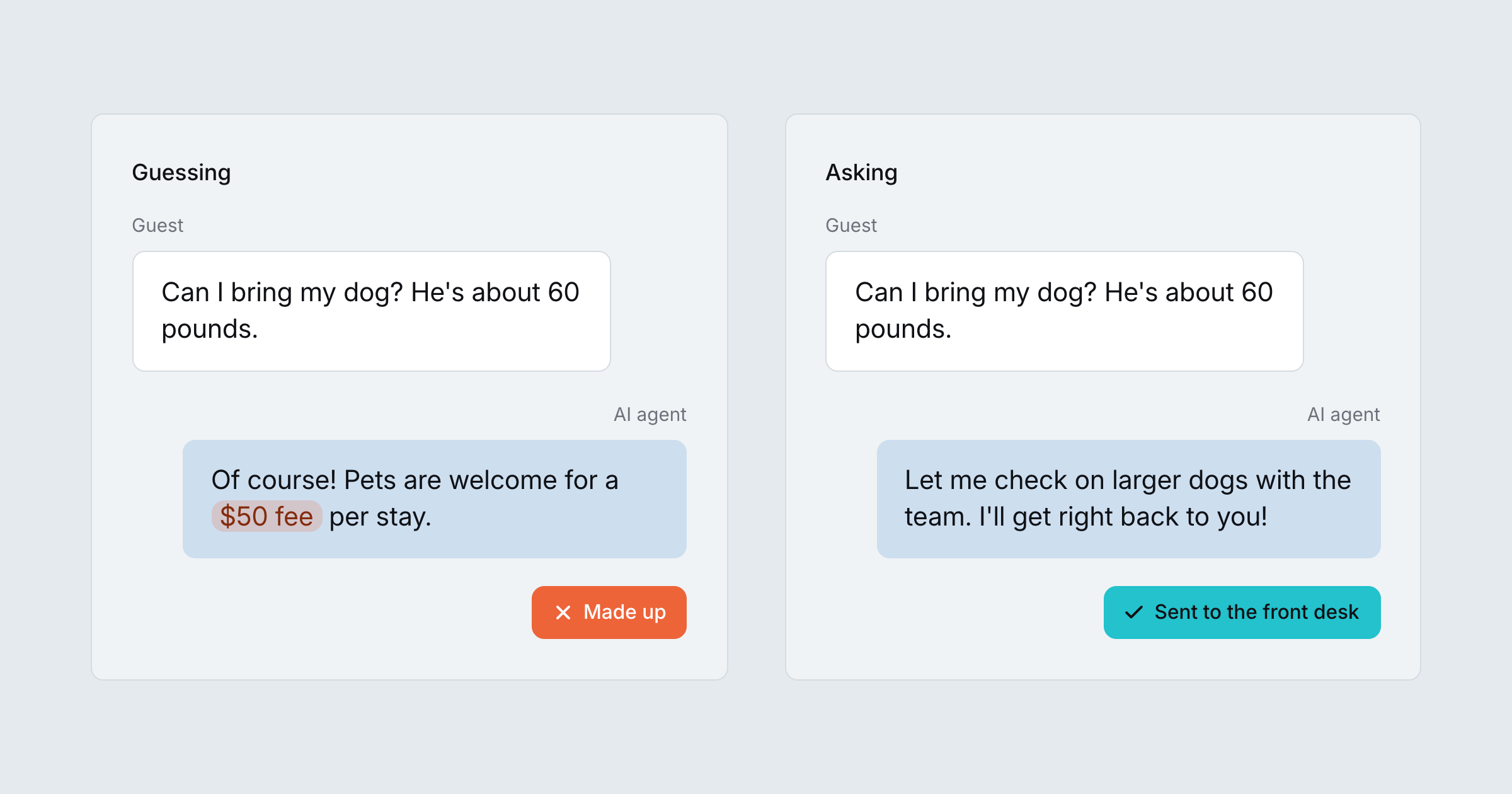
A guest texts at 9:40pm: "Can I bring my dog? He's about 60 pounds." The AI agent replies right away: "Of course! Pets are welcome for a $50 fee per stay."
Your policy allows dogs under 25 pounds, and there's no fee. Nothing in it covers larger dogs or fees, so the agent filled the gap with what most properties charge. An agent needs four things to answer that question correctly, and once you know what they are, you can have it check itself for anything missing.
How an AI agent writes a reply.
Underneath every AI agent is a language model. A language model does one thing: it looks at the words so far and predicts which word should come next. Then it does it again, and again, until it has a full reply. It learned to do that by reading an enormous amount of text, so it's very good at producing sentences that sound right.
Sounding right and being right are different things. The model has read thousands of hotel pet policies, but it has never read yours. So a good agent doesn't just let the model talk. Before it writes anything, it looks up your property's information, like your policies and the guest's reservation in your PMS, and hands the relevant pieces to the model with an instruction like "answer using this."
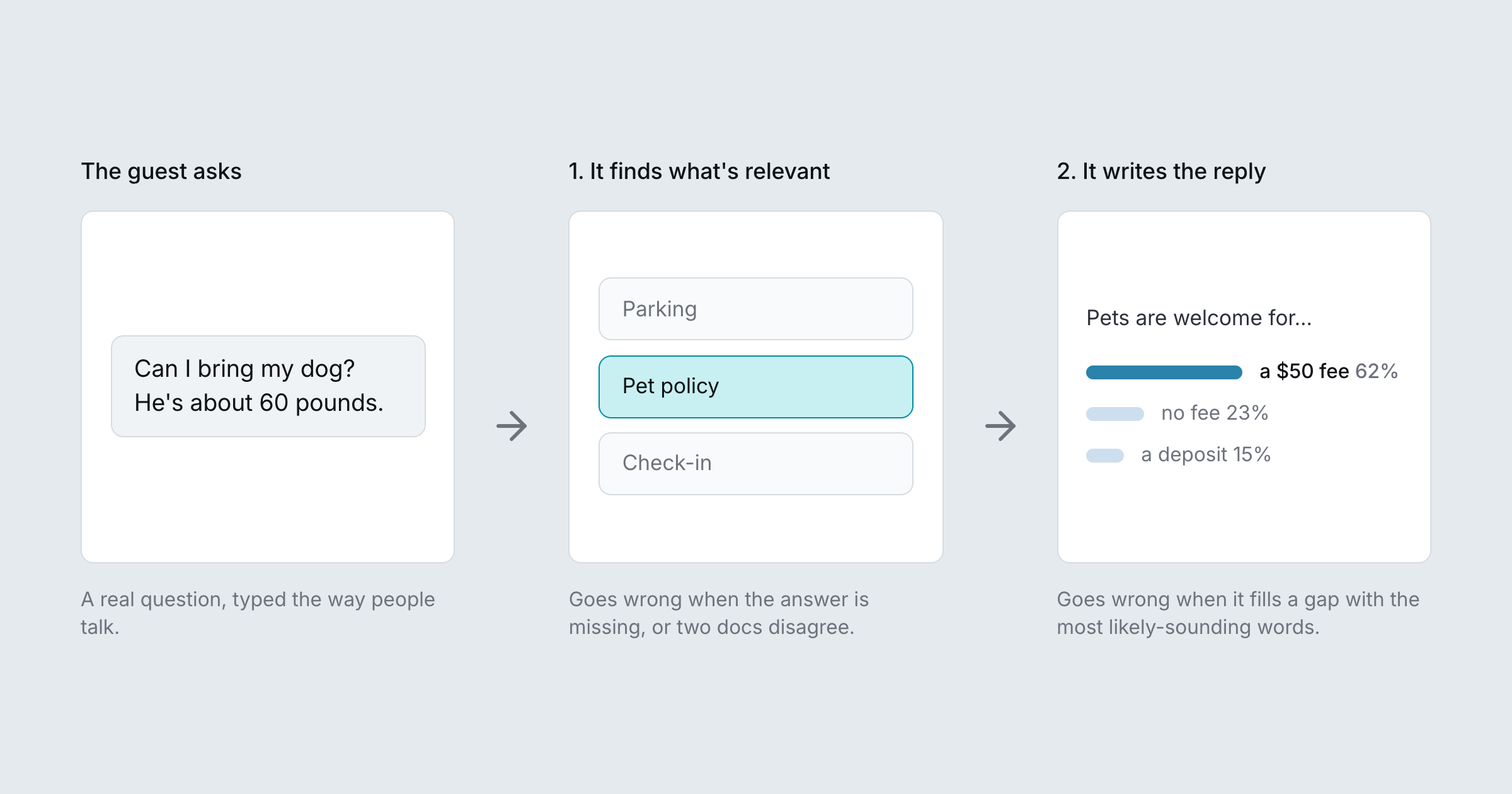
That means every reply goes through two steps. First the agent finds what it thinks is relevant. Then the model writes an answer based on what it found. Both steps depend on what you've given the agent to work with, and at a property that comes down to four things.
The four things your agent needs to answer correctly.
1. Every edge written down.
This is the pet fee problem. Your policy says "dogs under 25 lbs are welcome." It says nothing about bigger dogs, and nothing about fees either way. The agent finds a policy that's close, and the model fills in the rest with what pet policies usually say. Plenty of properties charge a pet fee, so "$50 fee" is a very likely-sounding thing to write.
What it needs: the edges along with the rule. "Dogs under 25 lbs are welcome. We can't accommodate larger dogs. There is no pet fee." Three sentences, and the guess has nowhere to go.
2. One version of every fact.
Your website says checkout is 11am. An old FAQ document says noon. The PMS says 11am but a group block has a noon late checkout built in. The agent finds two answers and has to pick one, and it has no way of knowing which one is stale.
This one is sneaky because the agent will be right most of the time, so nobody notices the conflicting doc is still in there. Then one day it pulls the old one.
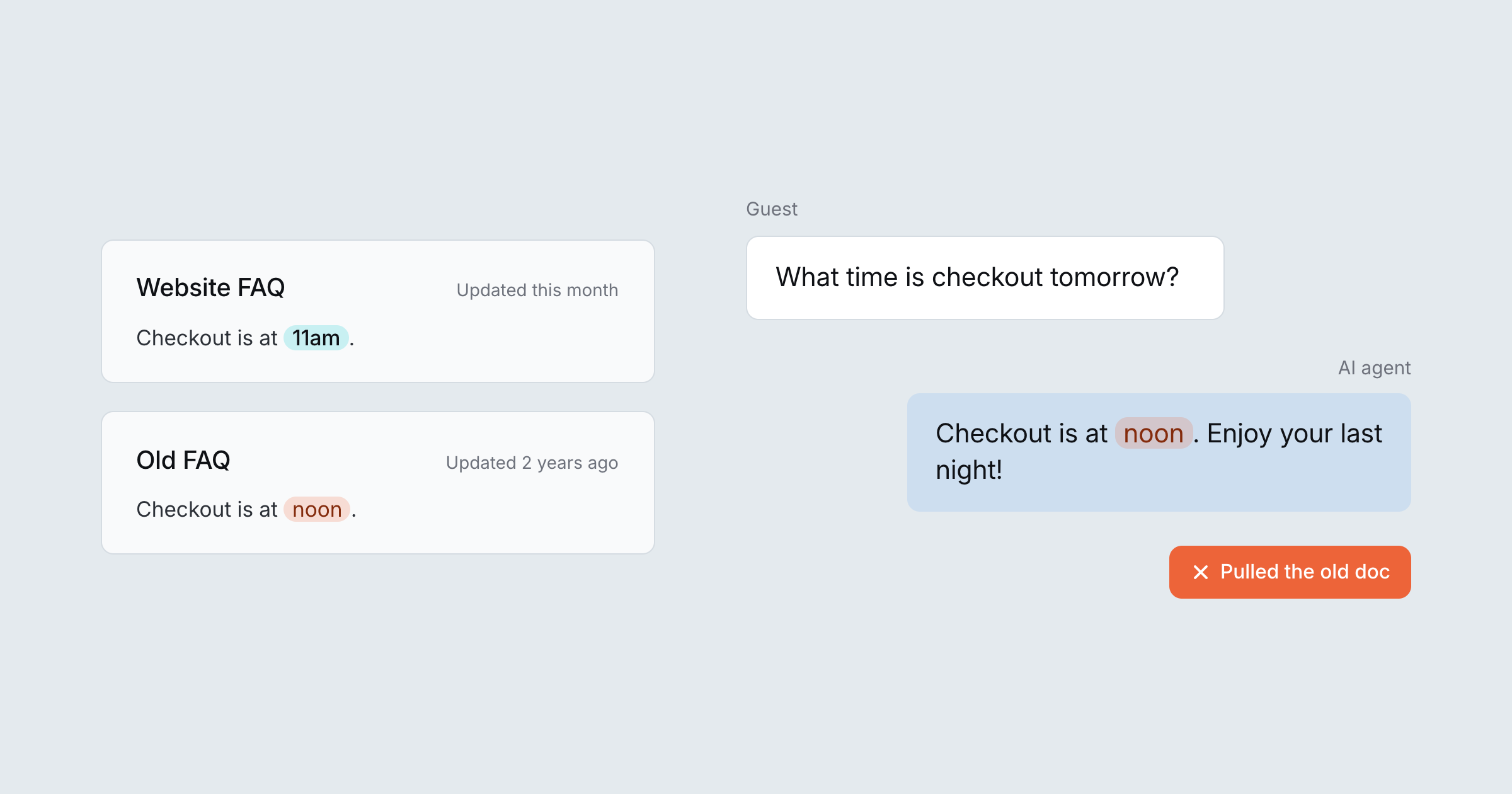
What it needs: one source of truth for every fact. When a policy changes, tell your agent what changed and have it update every place the old version shows up, instead of adding a new document next to the old one. Stale FAQs survive because someone added the new version and never found the old one.
3. Context about the guest.
When a guest asks “Is the pool open?”, the agent has to work out which pool and which time they mean before it can answer. If you have an indoor pool and a seasonal rooftop pool that closes at 8pm, a reply about the wrong one can be accurate and still leave the guest without the answer they needed.
Guests write the way they talk, short and full of assumptions. "What time is breakfast" from a guest booked in your suite package might mean the in-room breakfast, while the same question from everyone else means the restaurant.
What it needs: the guest's reservation, connected from your PMS. With it, the agent can see which package they booked and answer for their stay, so the suite guest gets the in-room breakfast hours and everyone else gets the restaurant's.
4. Permission to ask.
This is the root of the other three. Language models are trained to be helpful, and a fluent, confident answer reads as helpful. Left alone, the model would rather produce something plausible than say "I'm not sure." The fastest way to catch this is to test your AI agent with tricky questions before guests do.
What it needs: clear instructions for what to do when the answer isn't in its information. "If the answer isn't in the property's documents, tell the guest you'll confirm with the team and send the question to staff. If the question could mean two things, ask which one." That turns a made-up pet fee into "Let me check on that for you," and a wrong pool answer into "Do you mean the indoor pool or the rooftop?"
What hallucination actually is.
"Hallucination" is the industry word for when an AI states something false as if it were true.
Remember that the model is always predicting the most likely next word. It has no built-in sense of "I know this" versus "I don't know this." When it has your real policy in front of it, the most likely next words are the ones in your policy. When it doesn't, the most likely next words are whatever sounds like a typical property's answer.
So the $50 pet fee was the most average answer to the question, written by something that didn't have yours.
Why the same question gets two different answers.
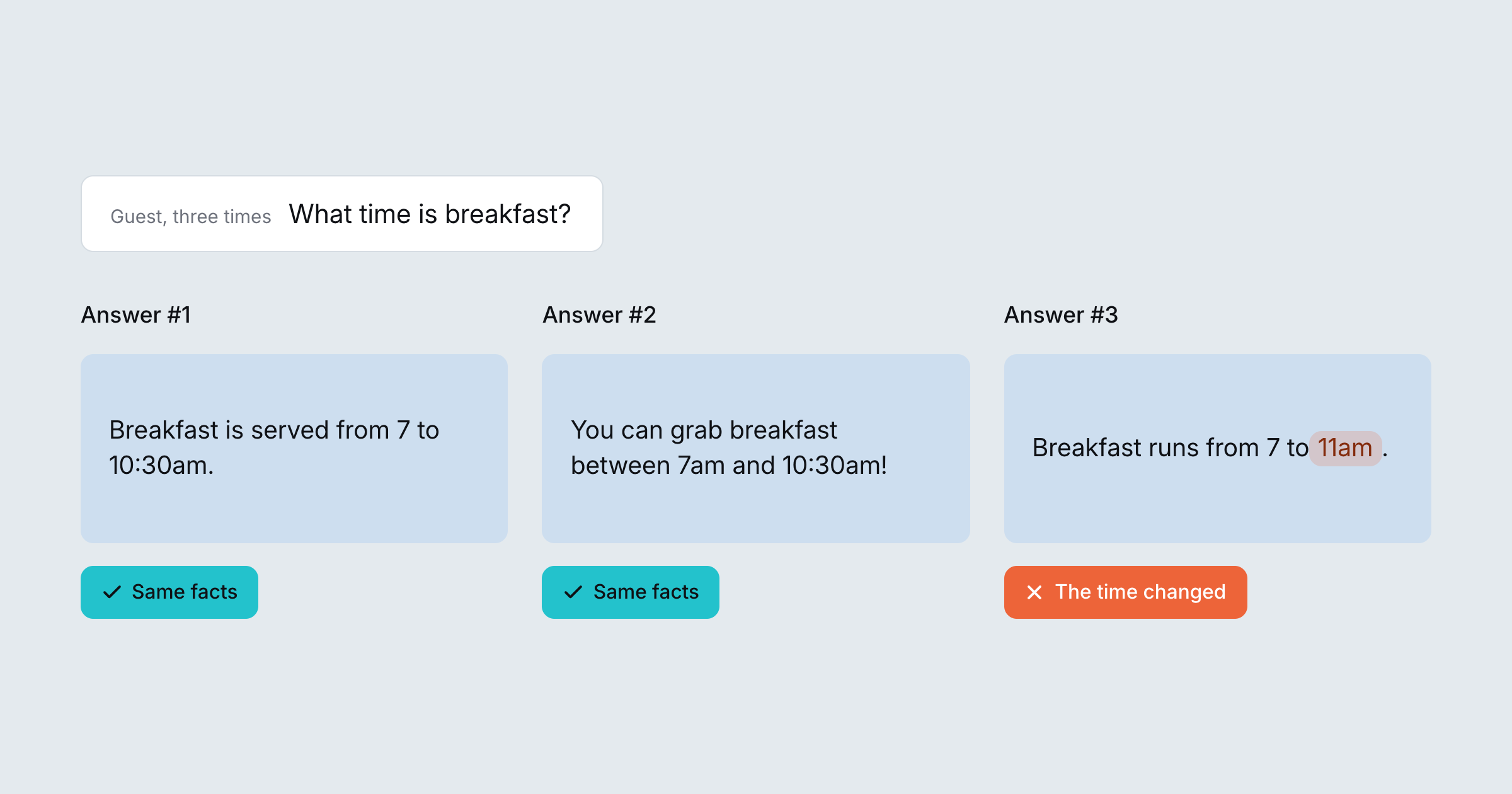
Ask your agent "what time is breakfast?" twice and you might get "Breakfast is served from 7 to 10:30am in Meadowlark" and then "You can grab breakfast at Meadowlark between 7am and 10:30am!" That's normal, and it's fine.
Here's why it happens. When the model predicts the next word, it doesn't always pick the single most likely one. It picks from the top few, weighted by how likely each one is. That small bit of randomness is what makes replies sound natural instead of robotic. If it always chose the top word, every reply would read like the same form letter.
The wording changing is fine. The facts changing is a warning sign. If one reply says breakfast ends at 10:30 and another says 11, the model isn't reading a clear answer. It's filling a gap or choosing between two conflicting sources, and the randomness is just showing you where the weak spot is, which makes it easy to test for.
A 15-minute audit your agent can run itself.
A good AI agent can read its own information and tell you where it's weak, so let it do the audit.
- Ask it for conflicts and gaps. "What conflicts, outdated details, or missing edges are in your knowledge base?" It should flag things like two different checkout times, or a pet policy with no rule for large dogs.
- Ask for its most common questions and its answers. "Show me the ten questions guests ask you most and what you reply to each." Check the answers against your real policies. Guests see these replies every day, so they're the ones to get right first.
- Tell it what to fix. "Checkout is 11am everywhere. Remove the old noon FAQ." The agent makes the change across every document so you don't have to hunt them down.
Then spot-check the answers that matter most by asking each one twice. If the facts change between tries, you've found a weak spot the agent didn't flag.
Run it once a month, and again any time a policy changes. The agent's answers can only be as good as what it's been given to read.
How Akia keeps answers grounded.
- She audits herself. Ask Akia what's conflicting or missing in her Knowledge Base and she'll list it, with suggested edits.
- You fix it by saying it. Tell Akia a policy changed and she updates every place it's used, so the replies change with it.
- Reservation context. Akia reads the guest's booking from your PMS before replying.
- Built to escalate. Akia only answers from your Knowledge Base and connected systems. When the answer isn't there, she tells the guest the team will follow up and opens a ticket, which also shows you what to add to the Knowledge Base.
- Approval first. In supervised mode, your team approves each reply before it sends.
Book a demo to see how Akia answers your guests.