Pull the repair log for almost any property and the same room numbers keep showing up. The AC in 214. The shower in 108. The sliding door in the corner unit that never quite tracks right. Every operator knows this in their gut, and almost no preventive maintenance program is built around it.
Most plans start from the building. Every room gets the same quarterly walk-through and the same filter schedule. That's a reasonable floor. It also spends your hours evenly across rooms that need wildly different amounts of attention, which is why the program can run all year and the same units keep failing.
A better program does two things. It keeps a floor of scheduled work, and it puts real effort into the small set of rooms that generate most of the tickets.
Why the repeat rooms stay invisible
A single room's history is almost never in one place.
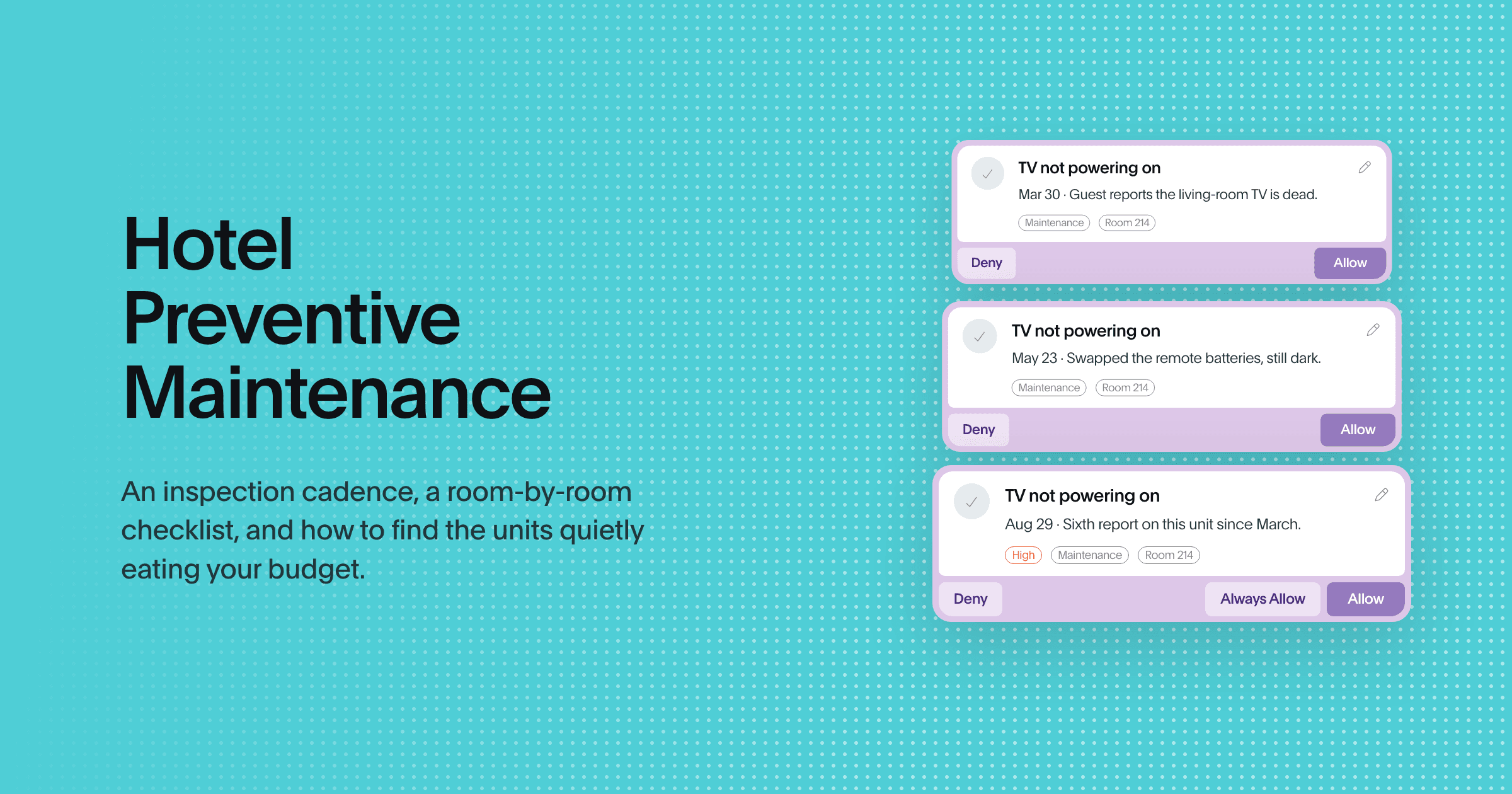
The dishwasher breaks in February. A different tech handles the clogged toilet in April. The television gets logged in May by whoever was on shift. Every ticket closes cleanly, the housekeeping status flips back to clean, and nothing about any one of them says "this unit has a problem."
So the room keeps getting patched instead of diagnosed. "AC not cooling" gets a filter change. A few weeks later it's "AC not cooling" again, because the real problem was the compressor. The sixth television reset happens before anyone asks why the television keeps needing one.
A dozen tickets on one unit are invisible as a dozen afternoons and obvious as one list. Making that list is most of the work.
What a preventive maintenance program actually needs
Four pieces, in order of how much they matter.
A room-level history. Every repair lands on the room it happened in, and stays there. This is the piece most properties skip, and without it the other three are guesswork.
A scheduled floor. Filters, batteries, caulk, and safety checks on a fixed cadence so the predictable failures never become tickets.
An inspection rhythm. Someone walks rooms on purpose, with a checklist, rather than only seeing a room when it breaks.
A repeat-offender list. A short list of units getting root-cause attention instead of another quick fix.
An inspection cadence that holds up
| Cadence | What gets checked | Who |
|---|---|---|
| Every turn | Lights, remote batteries, drain flow, toilet flush, AC response, safe, door lock, visible damage | Housekeeping, as part of the clean |
| Weekly | Vacant and out-of-order units, common-area lighting, pool and gym equipment | Maintenance |
| Monthly | HVAC filters, smoke and CO detectors, GFCI outlets, caulk and grout, water pressure, exterior doors | Maintenance |
| Quarterly | Deep HVAC service, water heater flush, appliance service, furniture and mattress condition, balcony rails | Maintenance, with a supervisor walk |
| Annually | Roof and gutters, exterior paint and seals, major appliance replacement planning, capex review | Property leadership |
The per-turn line does the heaviest lifting. Housekeeping is already in every room, every turn, so a short checklist there catches more than a quarterly walk ever will. The trick is giving them a way to log what they find in ten seconds, because a checklist that costs two minutes and a walk back to the desk doesn't get used.
The room-by-room checklist
Run this on a monthly cycle, and the shorter version every turn.
Bathroom
- Toilet flushes fully and refills without running
- Sink and shower drain within a normal count, no standing water
- No leak under the vanity or behind the base of the toilet
- Grout and caulk intact around tub, shower pan, and vanity
- Exhaust fan pulls air, no rattle
- Hot water reaches temperature within a reasonable wait
Climate and air
- Thermostat matches actual room temperature
- Unit responds to a setpoint change within a few minutes
- Filter clean and dated
- No condensate pooling, no water stain on ceiling or wall below the unit
- Vents clear and quiet
Electrical and electronics
- Every lamp and fixture works, including closet and balcony
- Television powers on, connects, and holds signal
- Remote batteries fresh, remote actually paired
- GFCI outlets trip and reset
- Wifi reaches the far corner of the room
Doors, locks, and safety
- Door lock reads a key on the first try, closes and latches on its own
- Safe opens, closes, and resets
- Smoke and CO detectors test clean, batteries dated
- Balcony and window locks secure
- Peephole and door viewer clear
Kitchen, where you have one
- Fridge holds temperature, no ice buildup
- Dishwasher runs a full cycle without leaking
- Disposal runs clear
- Burners and oven reach temperature
- Under-sink connections dry
Furniture and finish
- Drawers and closet doors track properly
- Chair and bed frame joints tight, no exposed hardware
- Blinds open, close, and are all present
- No chipped paint or damaged drywall at guest height
How to find your repeat maintenance issues
You need every repair attached to a room, and a way to sort by room.
Pull the last twelve months of repairs and count tickets per unit. Sort descending. The top of that list is your program. Take the worst few units out of order for long enough to fix the cause rather than the symptom, and use a maintenance block so the room isn't sold out from under the tech halfway through.
Then look at what those units have in common. Repeat offenders usually cluster: same wing, same HVAC unit age, same appliance model, same plumbing stack. One root cause often explains a dozen tickets across four rooms, and fixing it clears more of the queue than working faster on everything.
The rest of the room inventory keeps the scheduled floor and mostly stays quiet. That's the whole point of separating the two.
The part that breaks in practice
Logging every repair is exactly the step a busy team skips. A guest mentions the television in passing, someone swaps it, and it never becomes a record. The pattern never forms because half the data never got captured, and the problem unit keeps looking like a string of unrelated one-offs.
This is where guest messaging earns its place in an operations stack. When a guest texts "the TV in 214 won't turn on," Akia opens the maintenance task with the room already attached, then answers the guest while she's at it. Nobody stops to type it in, and the tech sees it in Team Chat before the guest has put the phone down.
Multiply that across every message and every room and the log stops being half-kept. It becomes a complete history, which is the only kind that can tell you the unit was never really about the television.
FAQ
What is preventive maintenance in a hotel?
Preventive maintenance is scheduled work done before something fails, rather than repairs made after a guest reports a problem. In a hotel or vacation rental it usually covers HVAC service, plumbing checks, safety device testing, and appliance servicing on a fixed cadence, plus room inspections that catch wear before it becomes a complaint.
How often should hotel rooms be inspected?
A short check every turn, run by housekeeping, catches the most because someone is already in the room. Layer a monthly maintenance inspection on top for filters, detectors, and plumbing, a quarterly deep service for HVAC and appliances, and an annual review for roof, exterior, and capital planning.
What should a hotel preventive maintenance checklist include?
At minimum: toilet and drain function, leaks under fixtures, HVAC response and filter condition, every light and outlet, television and wifi, door lock and safe, smoke and CO detectors, and the condition of blinds, furniture, and finishes. Keep it short enough to run in a few minutes so it actually gets done.
How do I find which rooms cost the most to maintain?
Count repair tickets per room over the last twelve months and sort by volume. Rooms only look like repeat offenders when their history sits in one place, so the first step is making sure every repair is logged against a specific unit rather than a date and a technician.
What's the difference between preventive and reactive maintenance?
Reactive maintenance responds to something that already broke, usually while a guest is in the room. Preventive maintenance is scheduled ahead of failure. Most properties run almost entirely reactive without meaning to, because unlogged repairs make it impossible to see which rooms deserve planned attention.
See how Tasks keeps every repair on the room, so your problem units stop hiding in the log. It's the same guest message Akia already answers, filed as it happens. For the mechanics of queues, assignment, and stages, start with our guide to hotel task management. Works the same across hotels and vacation rentals.