The short answer
For most Airbnb and vacation rental hosts, the best smart lock is a Wi-Fi keypad deadbolt like the Schlage Encode or Yale Assure Lock 2. Both let you create and delete guest codes remotely. For properties without reliable Wi-Fi, igloohome generates time-limited codes that work offline, no internet needed. The bigger decision is what controls the lock. A smart lock connected to your guest messaging software can create a unique code for every reservation and send it to the guest automatically, so you never type a code by hand again.
What makes a smart lock good for a rental
A lock for your own front door and a lock for a rental have different jobs. At a rental, a new person walks up to the door every few days, usually when you're somewhere else. That changes what matters.
Remote code management. You need to create, change, and delete codes from anywhere. Wi-Fi locks do this directly. Bluetooth-only locks usually need a hub or a code system that works offline.
Codes that expire on their own. A guest's code should work from check-in to checkout and then stop. Locks that support scheduled codes save you from remembering to delete them.
A keypad. Guests shouldn't need to download an app to get into your property. A keypad means a code is all they need.
Auto-lock. Guests forget to lock the door. Auto-lock takes that off your list of worries.
A backup way in. Batteries die. A physical key cylinder or an emergency power terminal keeps a dead battery from turning into a lockout.
Integrations. This is the one most buying guides skip, and it's the one that decides how much work the lock creates for you. More on that below.
The best smart locks for Airbnb and vacation rentals
1. Schlage Encode
Best for: most hosts who want a reliable all-rounder.
The Encode is a keypad deadbolt with Wi-Fi built in, so there's no separate hub to install. It stores up to 100 access codes and has a built-in alarm that alerts you to forced entry attempts. It's one of the most widely supported locks among rental software.
Works with Akia: Yes
2. Yale Assure Lock 2
Best for: hosts who want a sleek keypad and lots of options.
The Assure Lock 2 comes in keypad and touchscreen versions, with Wi-Fi models available. It holds up to 250 codes, and each one can be scheduled to specific days and times, which lines up neatly with check-in and checkout.
Works with Akia: Yes
3. Kwikset Halo
Best for: hosts who want Wi-Fi without a separate hub.
Halo connects to Wi-Fi directly and supports up to 250 user codes, each with its own schedule. The Halo Touch swaps the keypad for a fingerprint reader, so it's a better fit for owners and cleaners than for guests.
Works with Akia: Yes
4. August Wi-Fi Smart Lock
Best for: hosts who can't replace the existing deadbolt.
August fits over the inside of the deadbolt you already have, so the exterior and the original keys stay the same. That makes it a good fit for condos with HOA rules about exterior hardware. Add a Yale keypad so guests can enter with a code.
Works with Akia: Yes
5. igloohome Deadbolt Go
Best for: cabins and remote properties with spotty Wi-Fi.
igloohome's algoPIN system generates time-bound codes that work without any internet connection at the lock. If your property is up a mountain road where the Wi-Fi drops every storm, this is the one.
Works with Akia: Yes
Hosting in Europe? Nuki retrofits onto euro-cylinder doors the way August does in the US, and it works with Akia too.
The real decision is what controls the lock
Every lock above can hold a guest code. The work lives in everything around that code: creating it for each reservation, sending it at the right time, and making sure it only goes to a guest who's actually cleared to arrive.
Most hosts start by doing this by hand. A booking comes in, you open the lock app, make a code, copy it into a message, and hope you remembered to set the end date. That works for one property. At five properties it's a part-time job, and at 50 it's where mistakes happen.
Connect the lock to your guest messaging software and that whole job disappears. With Akia, it works like this:
- A booking lands and Akia creates a unique code for it. Every reservation gets its own code, valid from check-in to checkout.
- Akia holds the code until the guest is ready. You pick the conditions, for example a signed rental agreement, passed ID verification, and a paid balance. The code stays put until everything clears.
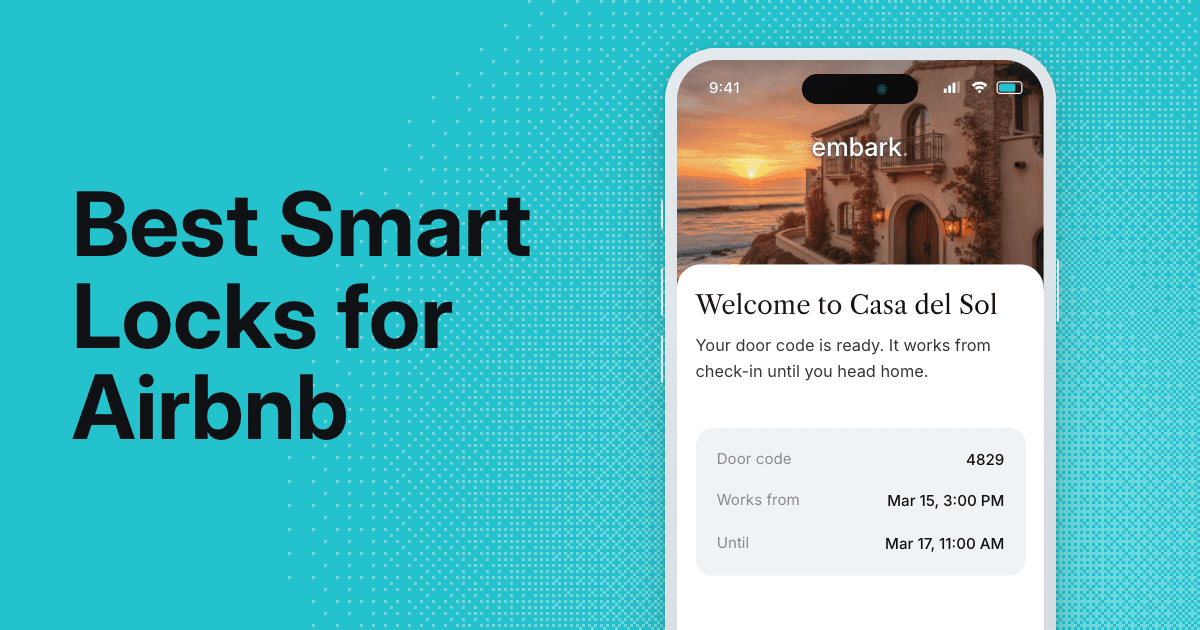
- Akia sends it at the right moment. The code goes out by SMS, WhatsApp, or email on arrival day, or the moment the last condition clears if that's later. Nobody has to text you for it.
Akia connects to the locks already on your doors, including August, Schlage, Yale, Kwikset, Nuki, igloohome, and Wyze. It works through Device Hub, Akia's own lock connection, and through lock platforms like RemoteLock, Salto KS, and FLEXIPASS, so switching software doesn't mean buying new hardware.
Akia has issued more than 380,000 door codes across more than 160,000 reservations.
When the keypad won't take the code
Here's the moment every host dreads. It's 11 PM, the guest is standing at the door with luggage, and the code isn't working.
Lock apps can make codes, but they can't talk to a guest. With Akia, the guest just texts. Akia checks the reservation, confirms the code she issued, and sends a fresh one on the spot. You hear about it in the morning, if at all.
The quick code generation and ability to send door codes within one system have made managing guest communication and access across properties much easier.
Daniel Korn, Managing Partner, The Angler Lodge
The Angler Lodge now gets door codes to guests more than 50% faster. Read the case study.
Smart locks for Airbnb, answered
How does a smart lock work on Airbnb?
A smart lock replaces a physical key with a keypad code, a phone app, or both. The host creates a code for each guest that works only during their stay, then shares it before arrival. Some smart locks connect to Airbnb or to property management software, so codes are created and sent automatically for every booking.
What does self check-in mean on Airbnb?
Self check-in means the guest gets into the property without meeting the host. On Airbnb this usually happens with a smart lock, a keypad, or a lockbox. The guest receives their entry details before arrival and lets themselves in at check-in time.
Which platforms generate unique access codes automatically for each booking?
Guest messaging and property management platforms with smart lock integrations can generate a unique code for every reservation. Akia creates a code for each booking, holds it until conditions like a signed rental agreement and a paid balance are met, and then sends it to the guest by SMS, WhatsApp, or email. It connects to locks through Device Hub, Akia's own lock connection, and through lock platforms like RemoteLock, Salto KS, and FLEXIPASS.
Can I automate guest access with timed entry codes through my property software?
Yes, if your software integrates with your lock. Akia reads reservations from your PMS, creates a code valid from check-in to checkout, and sends it to the guest automatically. The code stops working at checkout, so there's nothing to delete.
Are smart locks safe for Airbnb?
Smart locks are generally safer than physical keys for rentals, because every guest gets a code that expires when they leave. Keys can be copied or lost. A code that's tied to a reservation works only for that guest during their stay. For extra protection, choose a lock with auto-lock and tamper alerts, and change owner and cleaner codes periodically.
What's the best smart lock for a property without Wi-Fi?
igloohome is the strongest option for properties with weak or no Wi-Fi. Its algoPIN codes are generated offline and still expire on schedule. A Bluetooth lock paired with an offline code system works too, as long as your software supports it.
Pick the lock, then automate the rest
Any of these locks will get a guest through the door. Connecting it to Akia means you don't have to be the one getting them there. See how automated door codes work.