The front desk agent couldn't answer.
A guest texts at 9 PM asking whether the pool closes before their check-in is even complete. No one's at the desk. The message sits. By morning, the guest has assumed the worst, composed a mental note about poor communication, and started evaluating other options for their next trip. Nothing went catastrophically wrong — and the experience still cost the property a repeat stay.
Guest experience failures are rarely dramatic. They're usually a slow accumulation of small moments where the property didn't show up: a question that went unanswered, an amenity that wasn't explained, a check-in process that felt like a DMV line. By the time a guest leaves a 3-star review, half a dozen of those moments have already stacked up.
What hotel guest experience actually means.
Hotel guest experience is the sum of every interaction a guest has with a property, from the moment they book to the moment they leave a review. It is not just service quality during the stay. It includes the pre-arrival message they received (or didn't), how long it took to answer a question, whether check-in felt frictionless, how a complaint was handled, and what checkout felt like.
Operators sometimes narrow this to "service" or "hospitality standards," but the full definition matters because guests evaluate the entire arc. A smooth in-stay experience doesn't erase a frustrating check-in. A warm welcome doesn't fix the unanswered text from two days before arrival. Guest experience is cumulative, and every gap shows.
Why getting it right matters.
Cornell University's Center for Hospitality Research found that a one-point increase in a hotel's guest satisfaction score (on a five-point scale) can produce an 11.2% increase in RevPAR without adding room inventory or changing pricing strategy. The mechanism is direct: guests who have good experiences book directly more often, return more reliably, and refer more consistently than guests who booked through OTAs and forgot the property name.
The inverse is equally measurable. Research from Medallia found that 61% of guests who had a poor experience shared it publicly, either through a review or word of mouth. A negative TripAdvisor or Google review doesn't just reflect lost satisfaction; it actively suppresses future bookings as prospective guests compare properties before they commit. Properties with average satisfaction scores of 4.0 or below on Google lose bookings to nearby competitors without ever knowing why.
Five components of a strong hotel guest experience.
Not all guest experience work is equal. These five components cover the full arc from booking to post-stay and represent the areas where most operators have the clearest room to improve.
Pre-arrival communication. What guests receive before they arrive sets the frame for everything that follows. A pre-arrival message that confirms the stay, answers the three questions guests always ask (parking, check-in time, Wi-Fi), and surfaces relevant amenities or offers reduces friction on arrival and lowers the chance of a complaint rooted in unmet expectations. Properties that automate pre-arrival outreach report fewer day-of questions and higher satisfaction scores at check-in, not because the property changed, but because the guest arrived knowing what to expect.
Check-in experience. The first ten minutes on property disproportionately shape a guest's overall perception. A long line, a missing reservation, or a confused handoff between systems creates an impression that can take multiple positive interactions to overcome. Properties that reduce check-in friction — through digital registration, clear communication about the process in advance, or both — consistently see better overall satisfaction scores, even when nothing about the room itself changed.
In-stay responsiveness. Guests ask questions during their stay. How fast and how accurately those questions get answered is the primary driver of in-stay satisfaction. The gap isn't usually staff willingness; it's capacity. A front desk covering multiple responsibilities can't respond to every text in under two minutes. Properties that close this gap see measurably fewer complaint-driven reviews, regardless of how they close it.
Consistency across the team. A guest who interacts with one staff member and receives a helpful, warm response, then reaches a different team member and gets something slower and less complete, registers the gap. Guest experience consistency is an operational problem as much as a culture problem. It requires that every team member has access to the same information, the same policies, and the same ability to respond accurately. Training alone doesn't get there; the systems underneath have to support it.
Post-stay follow-up. Most operators end the guest experience at checkout. The ones who recover their reputation faster ask about it. A post-stay message sent within 24 hours of departure gives dissatisfied guests a private channel to raise concerns before they write a public review, and gives satisfied guests a prompt to leave the review they meant to write and forgot. Post-stay outreach is one of the highest-leverage, lowest-cost improvements available to most properties.
Six best practices for improving hotel guest experience.
1. Send a pre-arrival message every time. Not just for bookings that came through your website. Every reservation, regardless of channel, should receive a pre-arrival touchpoint 24–48 hours before arrival. If you're sending more than ten reservations a week, automate this; it won't happen consistently otherwise.
2. Answer guest messages within five minutes during business hours. Five minutes is the threshold above which satisfaction on in-stay communication begins to drop. A guest who texts about a noise complaint and waits two hours for a reply is far more likely to document the experience in a review than one who gets a resolution in under five minutes.
3. Give every guest access to property information, not just the guests who ask. Most guests don't know to ask about amenities they'd enjoy. A digital guidebook sent on arrival, covering pool hours, restaurant options, local recommendations, and parking, reduces questions at the front desk and increases the likelihood guests use what the property offers.
4. Create a clear escalation path for complaints. Akia's analysis of 1- and 2-star reviews found that room condition is the top complaint category at 21.8% (a guest satisfaction survey is how most properties catch it first) — six times larger than the next. Most of those complaints surface first as a guest message, not a front desk confrontation. Map an explicit path: guest texts a complaint, front desk receives an alert, response and resolution happen within a defined window. Properties with explicit escalation workflows handle complaints faster and earn better recovery reviews.
5. Personalize around the reservation data you already have. The reservation record contains information most operators never use for guest communication: number of guests, room type, special requests, booking source, length of stay. A family staying five nights in a suite has different relevant information than a solo traveler checking in for one night. Start with what's already in the PMS before reaching for additional data.
6. Track satisfaction scores the same way you track RevPAR. Guest satisfaction is not a soft metric. Properties that review satisfaction scores weekly by channel and stay date identify service gaps before they accumulate into review patterns. Build it into the same operational review where you look at occupancy and ADR.
Five mistakes that undercut hotel guest experience before the stay even starts.
1. Treating pre-arrival communication as optional. Guests who arrive without having received any communication from the property have higher expectations for flawless in-person service, because they have no context. Properties that skip pre-arrival messaging spend more time during check-in answering basic questions that a message could have addressed.
2. Letting guest messages queue behind desk calls. Phone calls get prioritized because they're immediate. Texts wait because they feel asynchronous. The guest who texted doesn't experience it that way. Treat every channel on the same timeline: a message that came in needs a response as urgently as a ringing phone.
3. Training staff on hospitality without training them on the tools. A team member who knows exactly how to handle a guest's complaint but can't find the reservation in the PMS, or doesn't know how to update a booking, provides worse service than the training would suggest. Guest experience depends on operations working. Both need investment.
4. Reviewing guest feedback quarterly instead of weekly. Quarterly review means you're looking at service patterns that are already two months old. By the time you identify the issue, hundreds of guests have experienced it. Weekly review catches problems early enough to fix them before they become review patterns.
5. Leaving post-stay communication to chance. A guest who had a genuinely good stay and doesn't hear from the property again has no particular reason to return. Post-stay is where loyalty gets built: a follow-up message, a direct booking offer, a simple thank-you. Properties that let guests leave without a follow-up touchpoint are handing their best prospects back to OTAs for the next booking.
Why this gets harder as you scale.
A single-property operator who handles most guest communication personally can maintain consistency through proximity. They know their regulars, remember the complaints from last weekend, and can catch a slow response before the guest notices.
Add a second property and that personal knowledge doesn't transfer. Add staff turnover, which runs at 70–80% annually across hospitality, and the consistency that lived in one person's head disappears with the next hire. Add five or ten properties and the only way to deliver consistent guest communication is to take it out of the individual staff workflow entirely.
This is where guest experience strategy and guest experience operations diverge. Most properties have strong opinions about what good guest experience looks like. Fewer have built the systems that make it happen without depending on any single person being on shift, having a good day, and knowing all the right answers. At that point, the goal isn't to motivate the team harder. It's to build a communication layer that doesn't depend on any one person.
How Akia handles hotel guest experience.
Akia, the AI Agent for hospitality, handles guest communication across the full stay: pre-arrival through post-stay, across every channel a guest might use to reach a property.
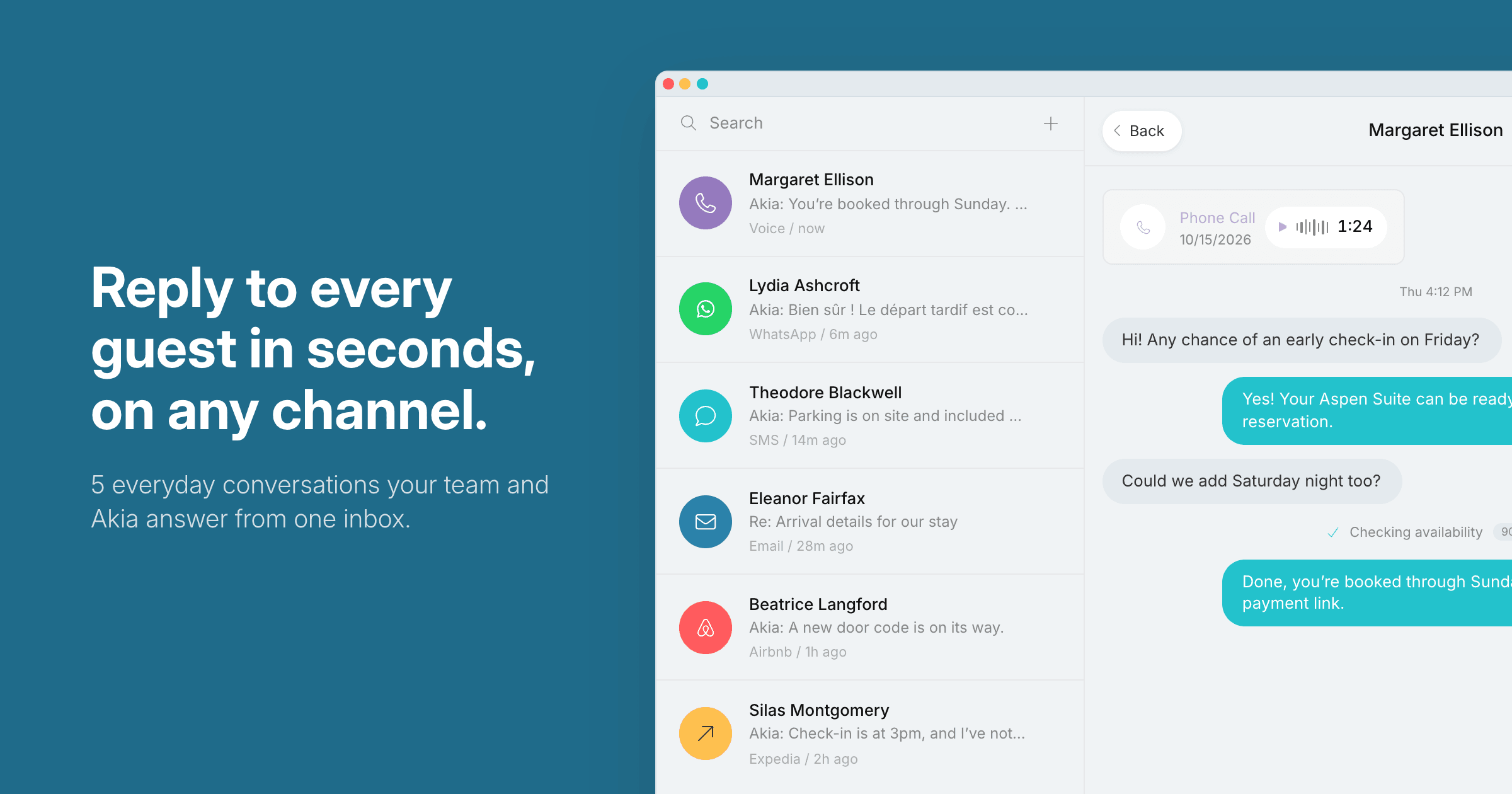
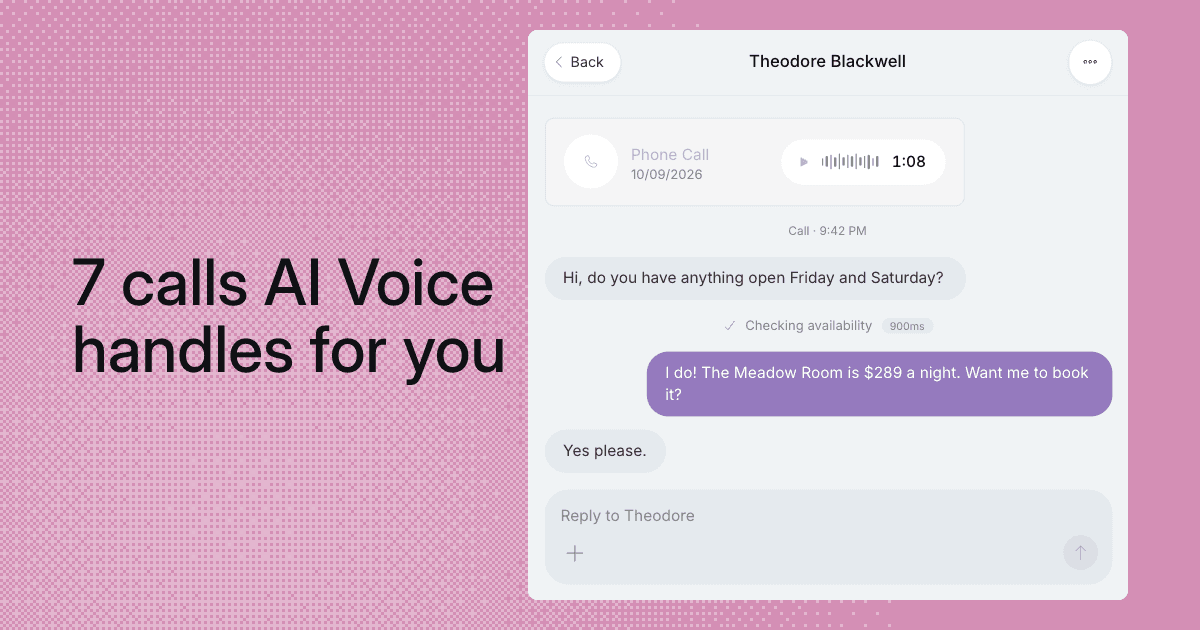
Akia answers guest questions 24/7. When a guest texts at 9 PM asking about pool hours, Akia responds immediately, drawing from the property's own policies and information. Staff don't have to watch the inbox for after-hours questions to get answered. Akia handles SMS, WhatsApp, web chat, email, OTA inboxes (Airbnb, Booking.com, Vrbo, Expedia), and social from a single place.
Akia routes to staff when human judgment is needed. Not every guest question should be handled by AI alone. When a situation requires a real decision — a complaint that warrants a comp, a special request that needs confirmation, a guest who wants to speak with someone directly, Akia routes the conversation to the right team member with context already attached. Staff see what the guest asked and what Akia already communicated, so the handoff is invisible to the guest.
Akia learns from how staff respond. When a staff member handles a message in a way Akia hadn't been trained for, Akia auto-suggests that response as a future reference. Properties don't have to schedule training sessions to keep Akia current. The Agent improves from the work the team is already doing.
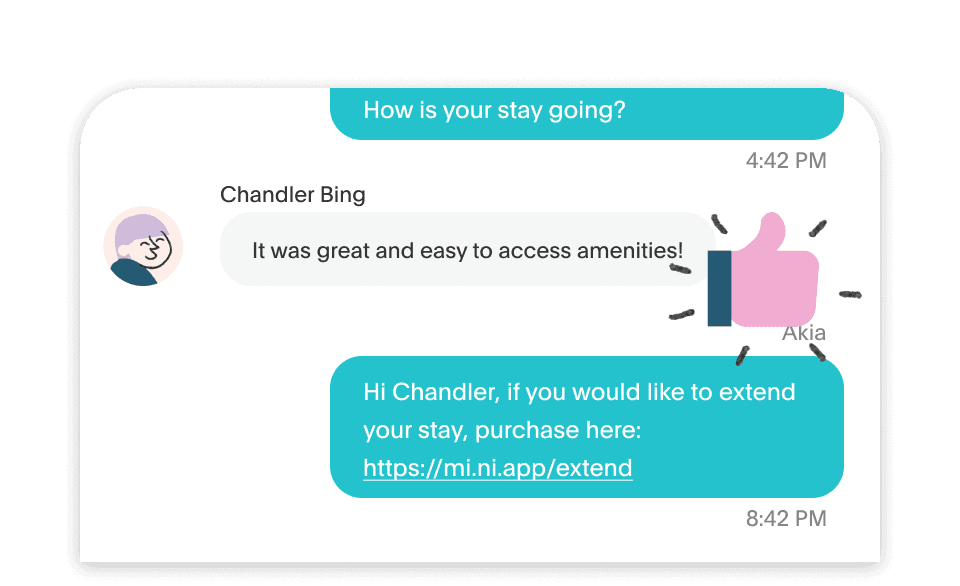
Akia sends pre-arrival and in-stay touchpoints on schedule. Pre-arrival messages go out on the timeline the property sets: confirming the stay, sharing check-in instructions, surfacing relevant amenities. In-stay messages check in, invite feedback, or surface offers at the right moment in the stay. No manual trigger required.
"Loyalty and returning guests are what make our smaller hotels truly succeed. You need frictionless, memorable experiences to keep them coming back year after year — and Akia helps us achieve that."
— Greg Williams, EVP Operations, Revival Hotels
Revival Hotels built its Invisible Hospitality™ model around the principle that great guest experiences don't depend on large, always-on teams. With Akia handling 70% of guest communication automatically, Revival reduced operating costs by over 50% while increasing guest satisfaction scores 24% above its competitive set.
"Before Akia, we spent hours customizing different information in emails for our guests based on different criteria like day of week or condo unit. Now Akia handles all of this automatically, and it really saves time so we can really take care of our guests."
— Maren Trader, Office Manager, Fairfield Plantation Resort
Fairfield Plantation Resort, a 2,500-acre resort community in metro Atlanta, now sees 75% guest engagement on its automated pre-arrival and in-stay messaging. The time that used to go into manually customizing each guest's email by unit and arrival day now goes into the guests themselves.
Getting started: three steps toward a better guest experience.
1. Map every guest touchpoint from booking to post-stay. List every moment a guest interacts with your property: the confirmation, the pre-arrival message, check-in, in-stay questions, checkout, and the follow-up after departure. Mark which ones happen consistently and which ones depend on someone remembering to do them. The gap between "happens every time" and "when we get to it" is where guest experience breaks down.
2. Fix the highest-friction moment first. For most properties, the biggest gap is either pre-arrival communication (guests arriving without context) or in-stay responsiveness (messages going too long without a reply). Pick the one generating the most complaints or the most staff time, and close that gap before moving to the next.
3. Automate the repetitive, protect the human. The questions every guest asks (Wi-Fi password, parking instructions, check-in time, pool hours) don't need a person to answer them. The conversations requiring judgment, empathy, or a real decision do. Build a communication layer that handles the former so staff can show up fully for the latter.
Guest experience doesn't have to depend on everyone being on shift, carrying full knowledge, and executing perfectly every time. The properties guests return to and recommend have built systems underneath the experience so it runs without heroics.
Guest experience and public rating move together, which is why hotel review management belongs in the same plan.
See how Akia's guest services skill works, or book a demo to see how it runs on your property type.