The short version.
Email is the one guest channel you actually own. No algorithm decides who sees it, and no OTA takes a cut when it books. Done well, hotel email marketing turns a one-time stay into a repeat guest and a repeat guest into a direct booking. This is what to send, when to send it, and how Akia drafts it for you.
What hotel email marketing is, and what it isn't.
Hotel email marketing is the property reaching out with something worth money: a pre-arrival upgrade offer, a come-back rate for a past guest, a seasonal package before the calendar fills. It's promotional, and it's aimed at revenue.
That's different from your transactional email, the booking confirmations and receipts that just acknowledge something happened. Both matter. Only one of them fills rooms. This playbook is about the second kind.
Why email is the highest-ROI channel you own.
Social reach depends on an algorithm. OTA bookings cost you commission every time. Email is neither. You own the list, you own the relationship, and every booking that comes back through it is a direct booking with no middle cut.
It's also where your best guests already are. Someone who stayed once and liked it is far likelier to open your email than a stranger is to find you on an OTA. Email markets to the people who already chose you once.
Circle Hotel Fairfield, an 80-room boutique hotel in Fairfield, Connecticut, made post-stay email its top revenue channel, generating over $125,000 in direct bookings in four months. One early-November win-back campaign brought in $20,000 on its own and filled rooms through the slow winter season. Because Akia syncs guest data from their Stayntouch PMS and captures an email from every guest at check-in, the hotel now markets to 100% of its guests, up from the days when more than 60% of bookings arrived through masked OTA addresses it couldn't reach. The plays were ordinary ones: a back-to-school push for the local universities, seasonal offers, a repeat-guest list, and automated win-backs and anniversary emails that run in the background.
When guests book after a campaign.
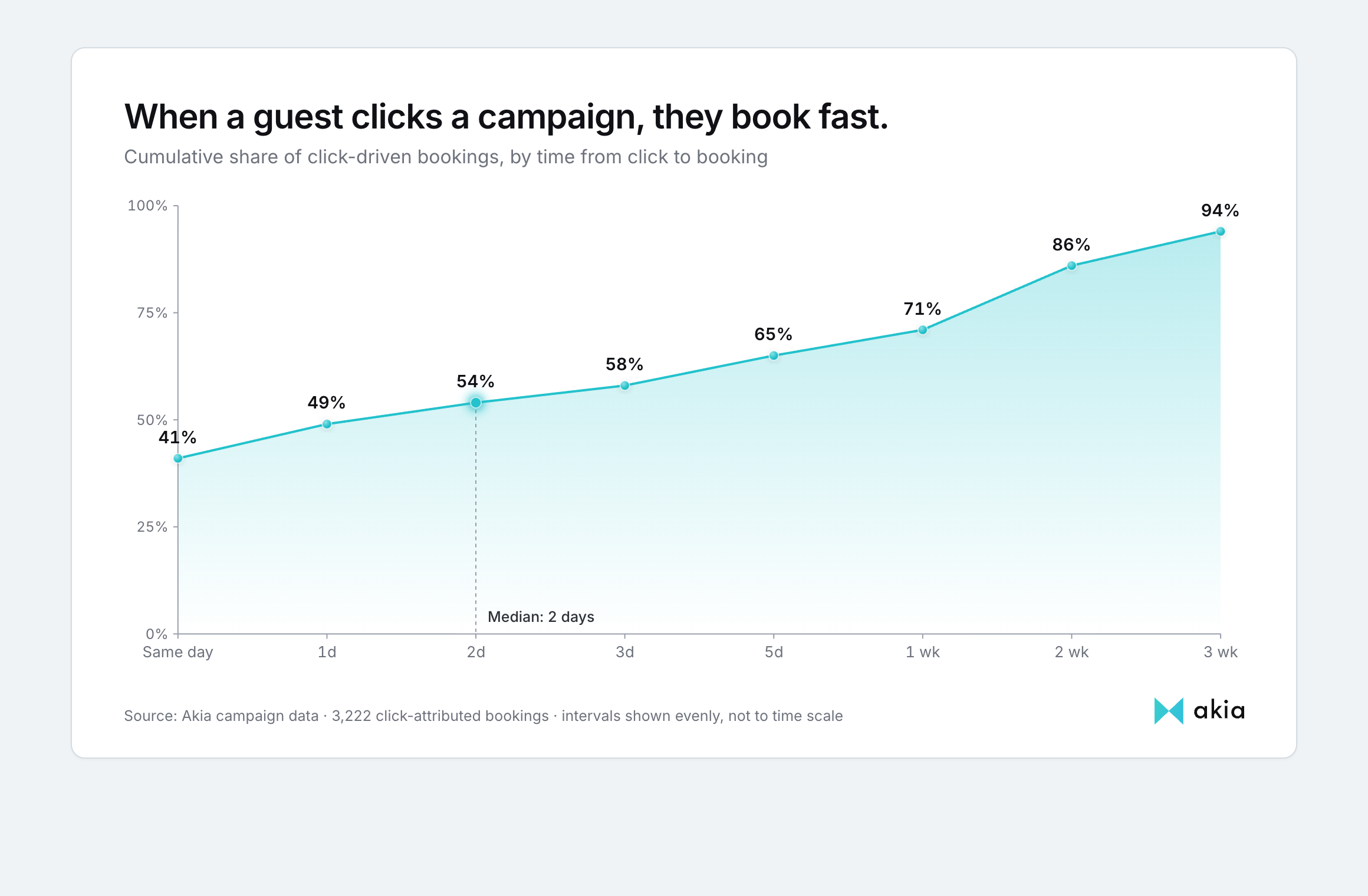
Akia credits a booking to a campaign when the guest clicks it and books soon after. Across 3,222 of these click-attributed bookings, 41% book the same day they click and 71% book within a week. By three weeks, 94% of what a campaign will produce is already in, and the median guest books two days after clicking. You can read a send in days, so give a campaign about two weeks before the final tally.
Does texting book faster than email? Yes. On SMS, 53% of click-driven bookings land the same day, against 40% on email. Texting is the immediate nudge a guest reads within minutes, and email carries the longer, visual campaign. Most properties run both.
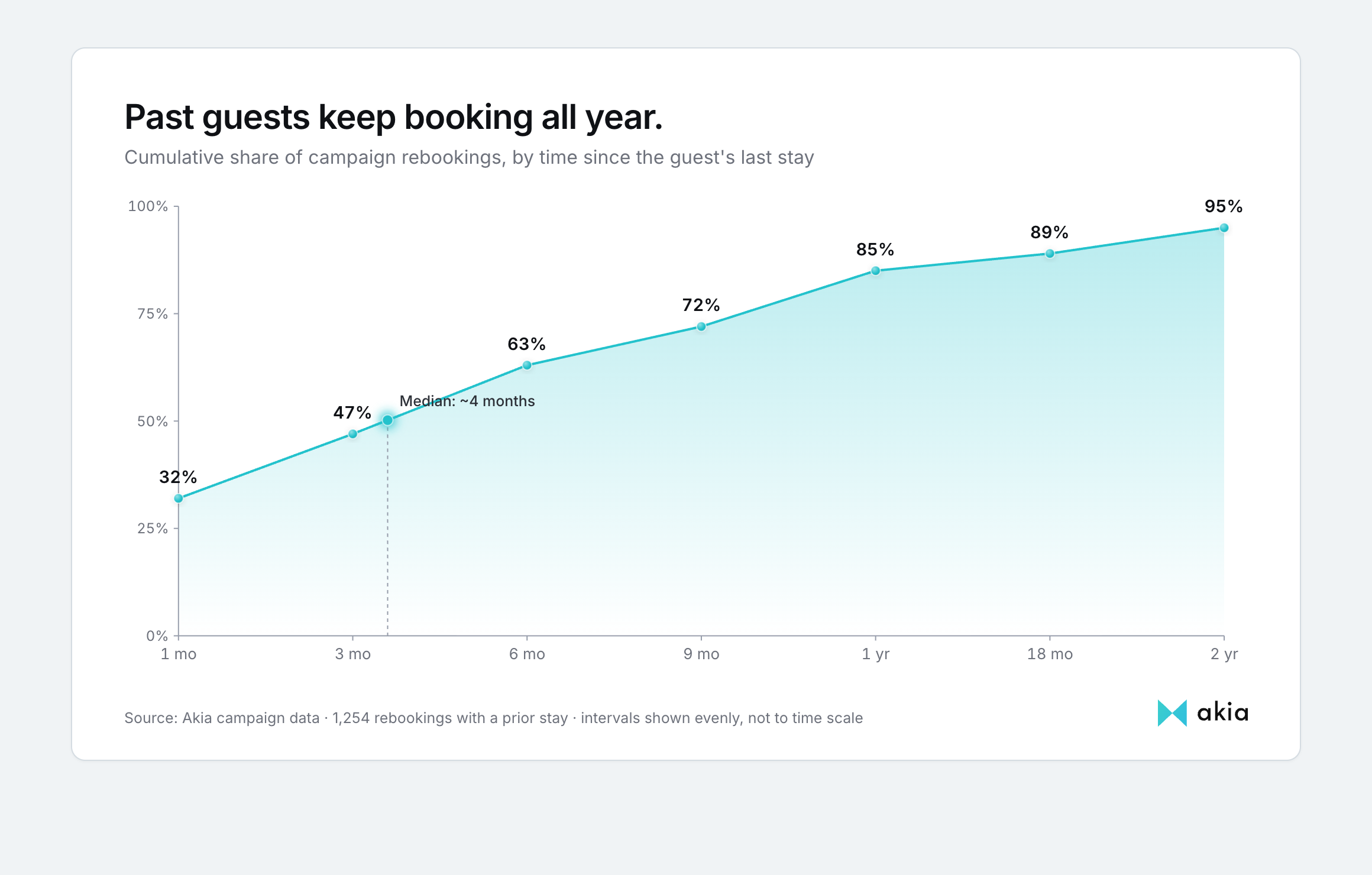
When do past guests come back and rebook? Among guests who rebook through a campaign, 85% had last stayed within the past year. About a third return within a month and two-thirds within six months. The window stays open for months, so a year-round re-engagement rhythm beats a one-off blast.
The campaigns that actually drive revenue.
A few plays do most of the work:
- Pre-arrival upsell. Before a guest arrives, offer the early check-in, the room upgrade, the bottle of wine waiting in the room. They're already excited about the trip, so this is the moment they say yes. The data on which offers actually sell is in which hotel upsells sell best.
- Post-stay win-back. A guest checks out happy, then hears nothing for a year. A warm note a few weeks later with a reason to rebook keeps you top of mind.
- Ask why they're coming. A guest here for an anniversary wants a different offer than one here for a conference. Capture the reason at check-in, and Akia tags the guest, so the couple gets the champagne package and the conference block gets a group rate.
- Seasonal packages. Fill the shoulder season before it arrives. A ski package in October, a summer rate in March.
- Birthday and anniversary. A small gesture on the right date books a lot of celebrations.
- Review requests. A short ask after checkout, sent to the guests who left happy, lifts your rating where future guests look first.
Email fills the slow season.
The biggest wins in the data come from the quiet months. IMPRINT Hospitality, a group of boutique ski-town hotels, drove $75,000 in four months by re-engaging past guests through the fall, ahead of ski season, with a separate campaign matched to each property's brand so the rates stayed premium. WERFY, a Montreal rental manager on Cloudbeds, doubled its revenue in its slowest months by sending deeper discounts only in October and November, a Halloween offer and a nature-stay campaign among them. Both ran the same play. The discounts go out when occupancy dips, so you fill the quiet weeks without training guests to wait for a sale.
Hotel email marketing examples.
The campaign is only as good as the email. A few that work:
- Pre-arrival upgrade. Subject: Your room is ready. Want to make it the suite? Body: one photo of the upgrade, the price for the nights they're booked, one button to say yes.
- Post-stay win-back. Subject: We saved your favorite room. Body: a warm line referencing their last stay, a return rate, a booking link.
- Seasonal package. Subject: Ski season opens. So does the fireplace suite. Body: the package, what's included, the dates.
- The monthly newsletter. Not a hard sell. What's new at the property, a local event worth the trip, one soft offer at the bottom. It keeps you in the inbox between stays so the win-back isn't cold.
The pattern holds across all of them: one clear offer, one photo of the thing being sold, one button. A guest reads it on a phone in ten seconds, so it earns the click by being simple.
How Akia writes them for you.
Building these by hand is where most email programs stall. Akia is an AI-native marketing tool built for hotels and vacation rentals, so you ask her for the campaign in plain language and she drafts it.
Say "Create a pre-arrival upsell email for guests arriving this weekend." She writes the subject line, the copy, and pulls the offer, on your brand, ready for you to review and adjust. She reads your reservations from your PMS, so she can send the win-back only to guests who checked out last month, or the ski package only to past winter guests. You direct and approve. She does the drafting and the sending.
Ask her plainly:
- "Create a pre-arrival upsell email for guests arriving this weekend."
- "Write a win-back offer for guests who checked out last month."
- "Draft a ski-season package for last winter's guests."
Every campaign ties back to a real booking, so you see which sends made money and which audience they came from, direct or OTA.
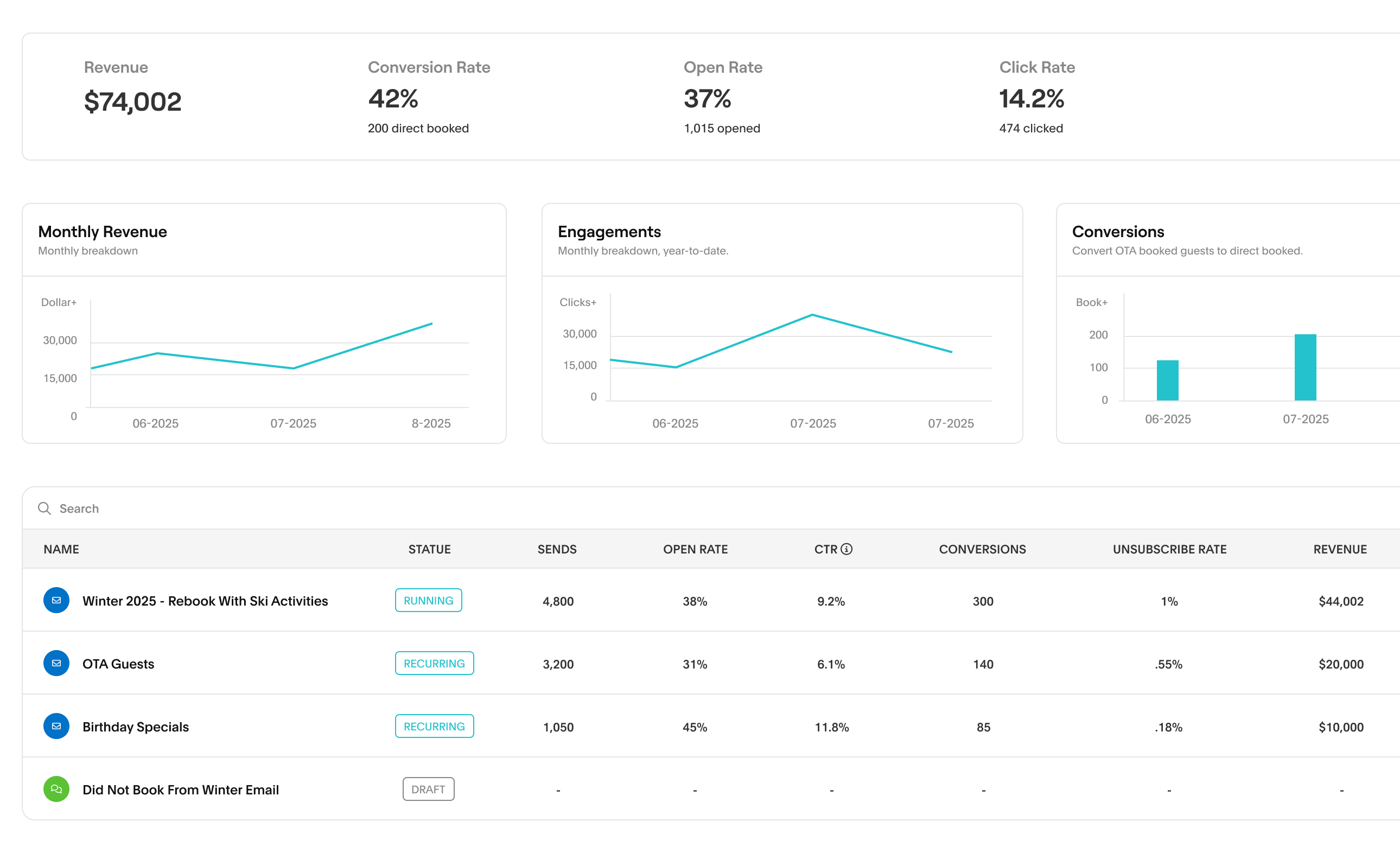
Faria Resorts, a lakefront vacation-rental collection on the Streamline PMS, drove $89,000 in post-stay revenue in a single month. With audiences syncing straight from their reservations, their marketing manager went from occasional blasts to shipping four campaigns in that month.
I really like how it's integrated with everything so I can pull all the audiences from our reservations. It's pretty simple with the drag and drop, and I love that you can see exactly who booked it. Jenelle Hostetter, Marketing Manager, Faria Resorts
See how Akia handles marketing.
Common questions.
What is hotel email marketing? Hotel email marketing is sending promotional email to past and upcoming guests to drive repeat stays, direct bookings, and on-property revenue. Common campaigns include pre-arrival upsells, post-stay win-back offers, seasonal packages, and a recurring newsletter. It's distinct from transactional email like booking confirmations, which are operational rather than promotional.
Should hotels use email or SMS marketing? Both, for different jobs. Email carries the longer, visual message: packages, newsletters, anything with a photo and a story. SMS is short and immediate, better for a time-sensitive nudge a guest reads within minutes. Most properties run them together. Our hotel marketing playbook and hotel SMS marketing guide cover each in depth.
How do you know which emails actually made money? Attribution ties each booking back to the campaign that drove it. Revival Hotels generated $13,500 in post-stay revenue across just two properties by tying every send to real reservations and capturing OTA guests' emails at check-in, so they could see exactly which campaign booked which guest and double down on what worked.
Do hotels need guest consent to send marketing emails? Yes. In the US, the CAN-SPAM Act requires a clear way to unsubscribe and an honest subject line. Guests in the EU and UK are covered by stricter opt-in rules under GDPR. The safe practice is to collect explicit consent when a guest gives you their email and honor unsubscribes immediately. Here are some tactics for collecting guest emails the right way.
See it in action.
Akia drafts your next campaign in the time it takes to ask. Book a demo.