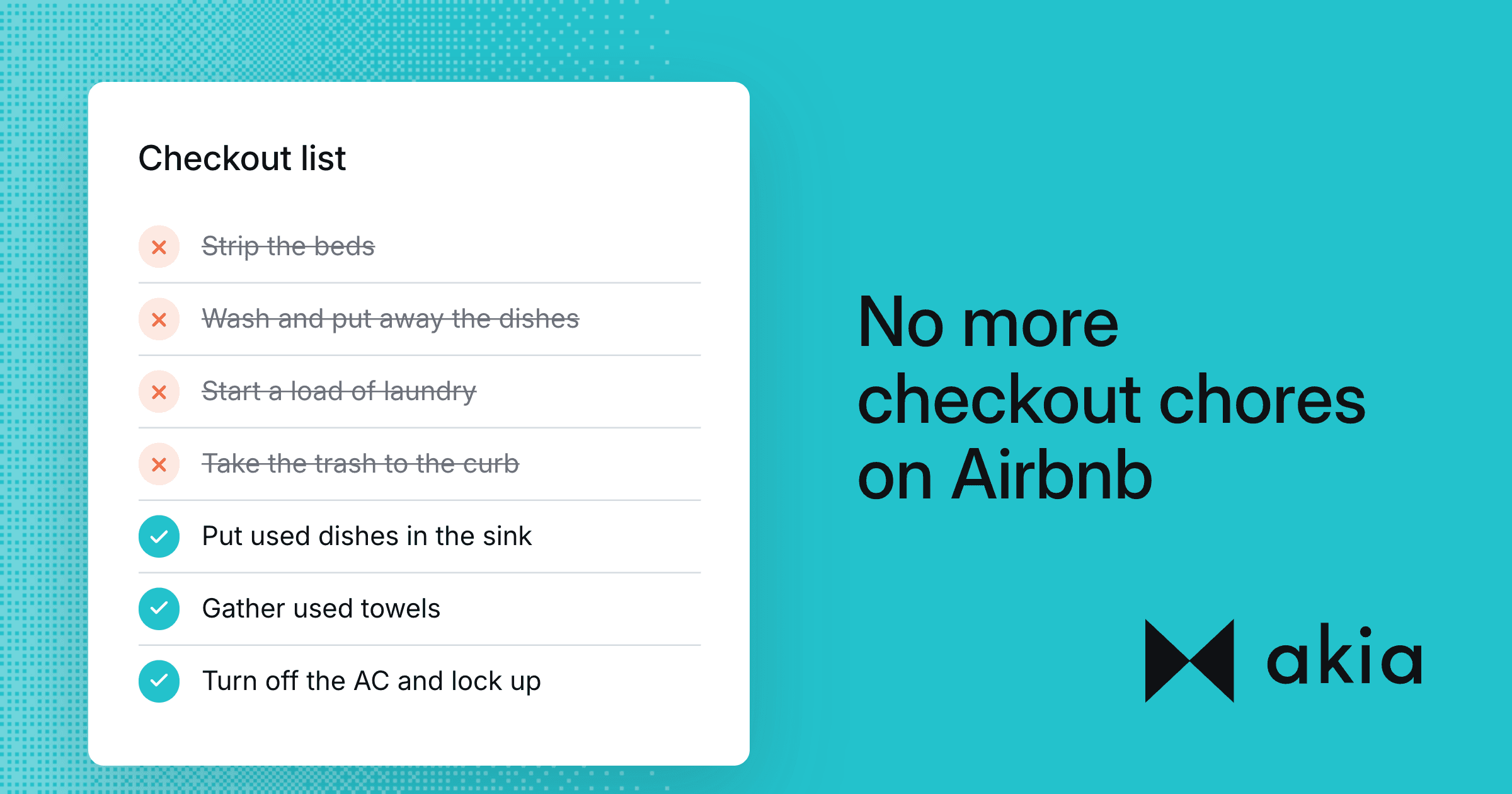
The front desk was the wrong place to sell upgrades.
A guest texts two days before arrival: "Will there be any availability for early check-in?" The front desk agent reads it, figures they'll circle back later. By the time they do, the guest has stopped thinking about it. The early check-in slot went to someone who called the phone. The upgrade never happened — not because the guest didn't want it, and not because the room wasn't available. The offer just didn't get made at the right moment.
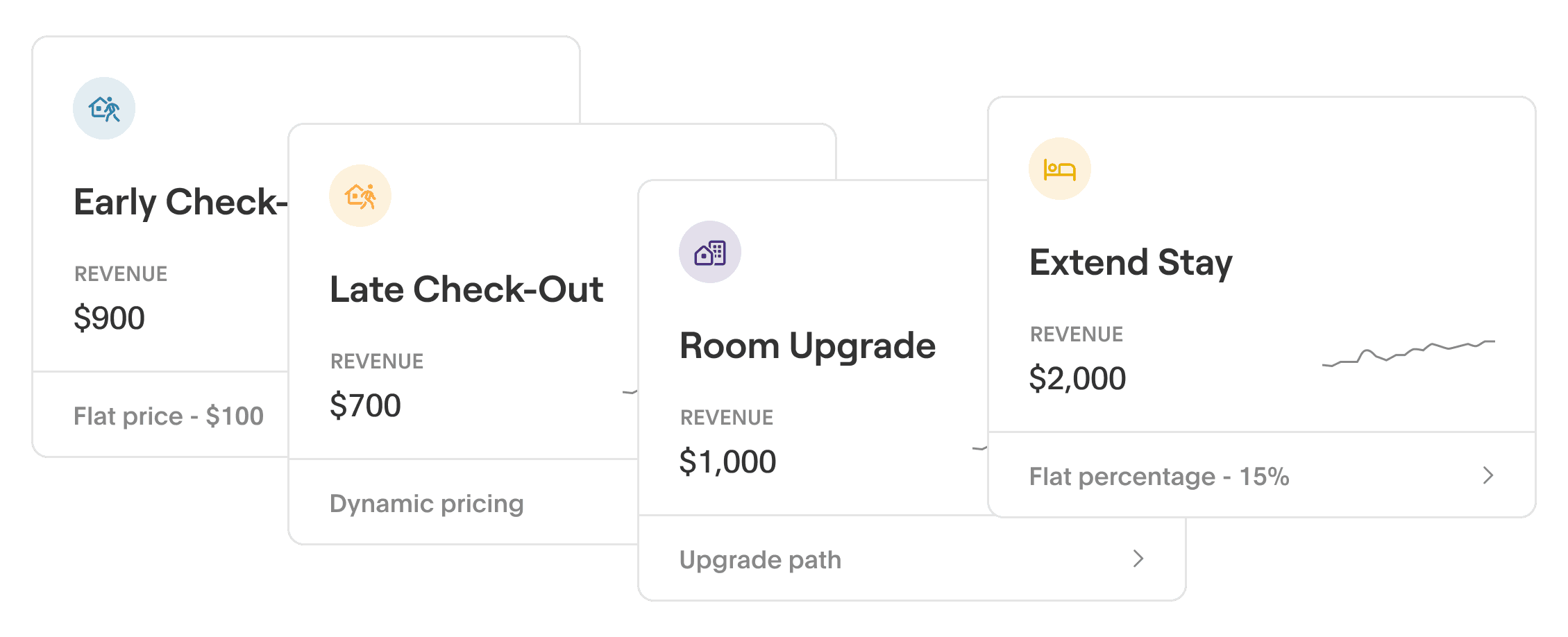
Most operators already have something worth upselling. Early check-in, late checkout, room upgrades, the chance to extend the stay, activities and attractions, parking. The hard part is getting those offers in front of guests when they're ready to say yes, collecting payment without adding a manual step, and making sure the PMS reflects what sold. Hotel upsell software exists to close that gap.
What hotel upsell software actually does.
Hotel upsell software surfaces the right offer to the right guest at the right moment and handles the transaction. That's the core job. Vendors label it differently. Upsell software, upselling platform, and upselling tool all describe the same category, so compare on capability rather than on what it's called.
What it is not: an upsell tab inside your PMS, a script for front desk staff, or a form that someone has to remember to email. If you're still evaluating the desk stack underneath it, hotel front desk software walks through what that layer needs to cover. Dedicated upsell software is built so that timing, delivery, and payment collection happen without manual intervention. The best platforms connect to your property management system so they know what's available before sending any offer. They deliver through a channel the guest is already using: text, WhatsApp, or a mobile-friendly link. When the guest buys, the PMS updates automatically. No staff follow-up required.
Why timing matters more than the offer itself.
Most upsell attempts fail not because the offer was wrong, but because it arrived at the wrong moment. The highest-conversion window is 24–72 hours before arrival. Guests are engaged with the trip, their credit card is already mentally committed, and they have time to evaluate an upgrade without the pressure of standing at a check-in desk after a flight. Hotels using automated pre-arrival upsell messaging see 20–30% more ancillary revenue per guest compared to those relying on front-desk pitches alone.
Akia's own sales data puts a finer point on the window. Across a year of paid upsells, 58% were bought between 7am and 1pm local time, with early check-in peaking around 10am and late checkout around 8am. Those are the six hours when your front desk has the least capacity to answer, which is exactly why the offer is worth automating.
Non-room revenue (F&B, upgrades, activities, packages) can reach 40% of total hotel revenue at properties that manage it well. At most independent and mid-scale hotels, that number is far lower, not because the inventory is missing, but because the offers are inconsistent. Staff forget. Email goes unread. The inventory exists; the delivery doesn't.
Five types of hotel upsell software.
Not all upsell tools work the same way. Before evaluating vendors, know which category fits your operation.
1. Pre-arrival upgrade tools. Purpose-built to send room upgrade and amenity offers before guests arrive. These tools typically connect to PMS inventory to verify availability and deliver the offer via email or text. Works well for properties where room upgrades are the primary upsell.
2. In-stay ancillary tools. Focused on F&B, spa, activities, and service add-ons during the stay. Often delivered via in-room tablet, QR code, or a link in a mid-stay message. Better suited for resorts and full-service hotels where on-property spend potential is high.
3. Messaging-integrated upsell. Upsell offers embedded directly inside the guest messaging layer — so when a guest texts "can I check in early?", the system responds with a payment link in the same thread. No separate platform for the guest to navigate, no handoff between systems.
4. PMS-native upsell modules. Some property management systems include upsell functionality. Convenient, but these often have limited delivery options (email only, no conversational interface) and minimal timing controls. Most suited for large hotel groups that want upsells consolidated in one place.
5. AI-driven upsell platforms. The system reads the reservation, guest history, and available inventory, then drafts and sends a personalized offer: early check-in for the guest who always asks, a suite upgrade for the anniversary stay, a parking hold when a late flight is on file. Timing, personalization, and PMS updates happen automatically.
Six things to look for when evaluating hotel upsell software.
Run every vendor through this checklist before signing.
1. Real-time PMS integration. The platform should check live inventory before sending any offer. A tool that sends room upgrade offers without verifying availability will oversell rooms — and that's harder to recover from than missing an upsell entirely.
2. Delivery via text or WhatsApp. Email open rates for pre-arrival messages typically run 20–30%. SMS and WhatsApp are consistently higher. Look for platforms that treat text messaging as a primary delivery channel, not a bolt-on to an email-first tool.
3. In-flow payment collection. Any gap between "yes, I want the upgrade" and completing the transaction kills conversion. The best tools present a payment link inside the same message thread so guests finish in under 60 seconds. Offers that require calling the front desk or clicking through to a separate portal close at a fraction of the rate.
4. Automated offer timing across the stay journey. Pre-arrival, day-of, in-stay, and pre-checkout windows each capture different offers and different guests. Look for scheduling rules that send the right offer at each stage without manual queuing.
5. Availability suppression rules. Confirm the platform lets you suppress offers when inventory is unavailable — not just globally, but by date and room type. An early check-in offer sent on a sold-out arrival day isn't an upsell; it's a complaint.
6. Revenue-focused reporting. Volume of offers sent is not the number that matters. Look for reporting that surfaces revenue per available room impact, conversion rate by offer type, and which timing windows close best for your property.
Five mistakes that cut upsell revenue before it starts.
Operators who've run upsell programs for a while recognize these quickly.
1. Running upsell software as a standalone tool. A platform that isn't connected to your guest messaging layer creates a disjointed experience. Guests receive an upsell text from one system and a check-in message from another, with different branding and no shared history. They notice the seams.
2. Waiting until check-in to make the offer. The front desk pitch has a structural disadvantage: the guest is tired from travel, standing in a line, and not in the mindset to weigh an upgrade. The same offer sent via text two days earlier, when the guest is home and thinking about the trip, closes at a measurably higher rate.
3. Pricing upgrades based on cost instead of demand. Once the room is clean and the key is active, an early check-in costs you nothing in labor. Guests flying in from across the country will still pay $30–$75 for it. Price based on what guests would reasonably pay, not on your operating cost. Across 4,729 paid upsells sold in a year, the most common price guests paid was $50. The same early check-in sold for $20 at a budget motel and past $250 at a luxury boutique, tracking each property's own room rate rather than any industry benchmark.
4. Skipping integrated payment. Offers that say "reply YES and we'll get you confirmed" create staff follow-up work and depress conversion. Offers with an embedded payment link close themselves.
5. Choosing a pure-play upsell tool when the real gap is delivery. Some properties don't need more upsell inventory — they have early check-in, packages, and room upgrades that nobody buys because the offers never get made consistently. Fix the delivery problem first.
Why upsell programs get harder to manage as you scale.
A single-property operator can make upselling work manually. Track who's arriving tomorrow, send a few texts, process payments by phone. It's not efficient, but it's manageable.
Add a second property and the manual tracking breaks down. Add staff turnover and the upsell workflow lives in one employee's head. Add five or ten properties and the only way to run a consistent upsell program is to take it out of the staff workflow entirely.
At that point, dedicated upsell software stops being a convenience and becomes a revenue protection mechanism. Properties that rely on staff consistency for upsells see revenue swing with every hiring cycle. Properties that automate offer delivery and payment collection decouple revenue from headcount — the offers go out whether the team is new, stretched thin, or buried at check-in on a busy Saturday.
How Akia handles hotel upsells.
Akia is the AI Agent for hospitality. Upsell automation is one of the things Akia handles autonomously, built into the guest communication layer rather than running as a separate tool. See how Akia works for hotels.
Akia reads the reservation and determines what to offer. Before any message goes out, Akia checks inventory, reviews guest history, and identifies the most relevant upsell for that specific stay: a suite upgrade for an anniversary reservation, early check-in for a guest who requested it last visit, a parking hold when a late flight is on file.
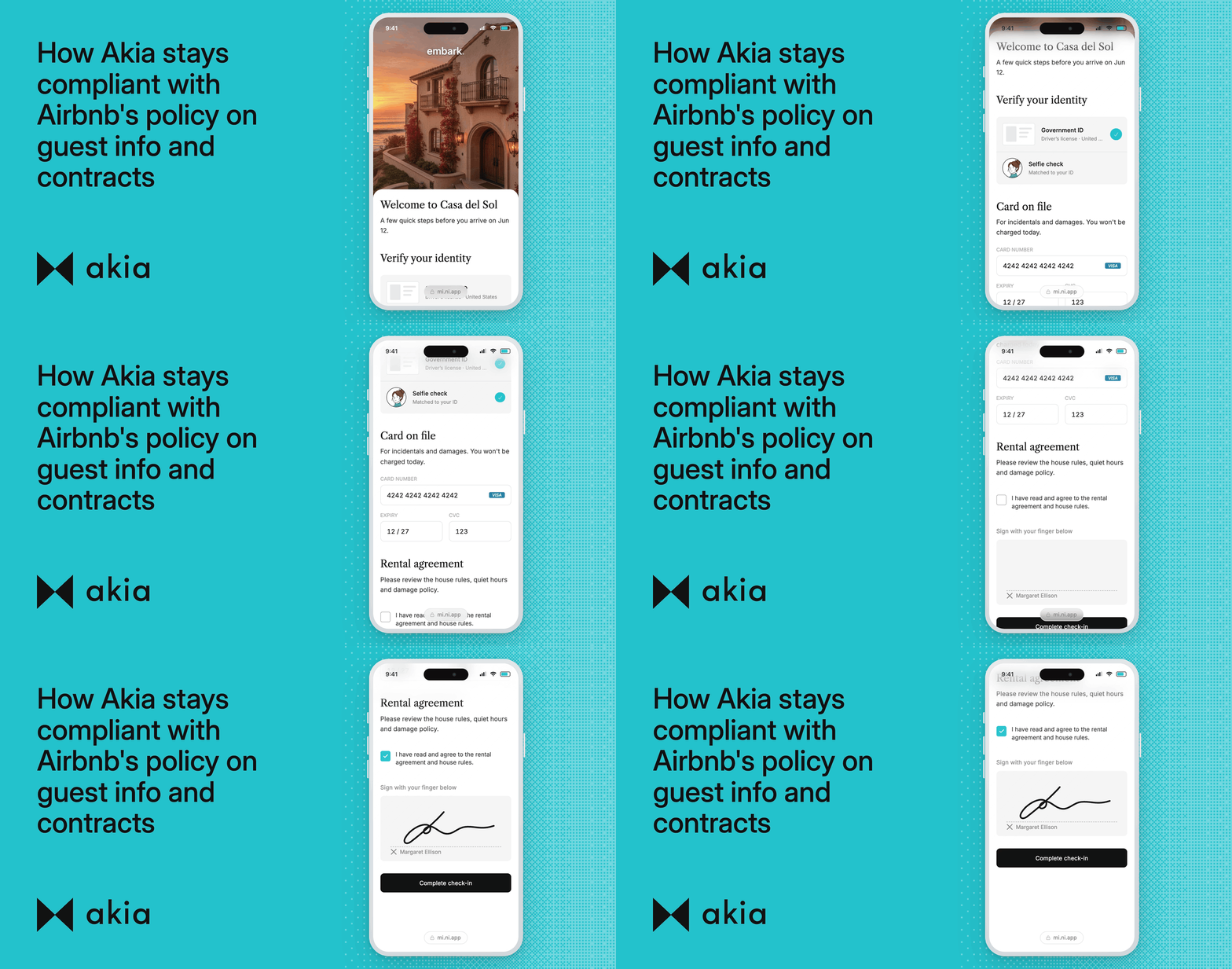
Akia delivers offers through text, WhatsApp, or a Mini App link. Guests receive the offer in the same thread as their pre-arrival information. Payment is embedded in the message. No redirect or phone call. The Mini App doubles as the guest portal for in-stay upsells, so a guest can buy a late checkout or extend the stay without downloading anything.
Akia schedules offers across the full stay journey. Pre-arrival, day-of, in-stay, and post-checkout windows can each be configured with their own offer logic. A guest who didn't buy early check-in pre-arrival might still buy a late checkout mid-stay. Akia sends the appropriate offer at each stage without a manual trigger.
Akia updates the PMS when a guest accepts. When an upgrade or add-on is purchased, Akia writes the update back to the PMS automatically, so the front desk sees the correct room assignment on arrival without a separate reconciliation step.
"Before Akia, we had a hard time promoting items that we offered. Now, we automatically send out our order forms during pre-arrival and their stay to increase exposure."
— Mike Kelly, Director of Operations, Cedar Lakes Estate
Cedar Lakes Estate, a 500-acre Hudson Valley retreat offering activity packages and curated experiences, went from manually emailing upsell forms with low open rates to $20K per month in upsell revenue after automating offer delivery through Akia.
"Before, almost every guest asked about early check-in. Now, it's automated. Guests who want it can just purchase, and I don't have to keep answering the same question over and over."
— Ashley Cornwell, Owner, The Villa Toscana
The Villa Toscana now averages $1,153 per month in upsell revenue from early check-in and late checkout alone. Neither offer was being made consistently before.
Getting started: three steps before you pick a platform.
1. List every upsell you currently offer. Early check-in, late checkout, room upgrades, parking, packages, activities, F&B. If you can't produce a clear list, the software will have nothing to work with. The same is true of every other process you'd hand over, which hotel automation goes through. Upsell automation amplifies what's already there — it doesn't invent it. Then check which ones actually sell. In that same year of upsell data, early check-in and late checkout took 90% of the revenue and 96% of every sale. Most of the rest of the catalog is decoration.
2. Map the timing window for each offer. Pre-arrival (24–72h before check-in), day-of, in-stay, and pre-checkout are the four primary windows. Assign each upsell type to the window where it closes best before you demo any vendor. This will make the demo evaluation much faster.
3. Confirm PMS integration before committing. Ask every vendor to demonstrate a live PMS sync during the demo — not a slide about one. If the PMS update requires manual reconciliation or runs on a significant delay, every upgrade sale creates a front desk problem.
Properties that automate upsell delivery consistently capture revenue from offers that used to go unmade: early check-ins, room upgrades, package add-ons. No extra staff time, no training new hires on a sales pitch. The offers go out, guests buy when they're ready, and the PMS reflects it.
Frequently asked questions
What features should I look for in hotel upselling software?
Six things. Live PMS inventory checks before any offer goes out, delivery by text or WhatsApp rather than email only, payment collected inside the same message thread, timing rules for each stage of the stay, availability suppression by date and room type, and revenue reporting broken out by offer type. The checklist above covers each one in detail.
How can hotels increase upsell revenue through AI?
An AI agent reads the reservation, checks live inventory, and picks the offer most likely to land for that specific stay. Then it sends at the hour that offer actually converts and takes payment in the thread. Akia's own sales data shows 58% of paid upsells happen between 7am and 1pm, which is exactly when a front desk has the least time to sell anything.
How do you automate hotel guest upsells?
Connect the upsell tool to your PMS so it can see live availability, assign each offer to a timing window (pre-arrival, day-of, in-stay, pre-checkout), and embed payment in the message. After that the offers send themselves. The manual version works at one property and breaks at two.
What is the best hotel upsell software?
There's no single answer, because the five categories solve different problems. Pre-arrival upgrade tools fit properties whose money is in room upgrades. In-stay ancillary tools fit resorts with spa and activity spend. Messaging-integrated upsell fits properties where guests already text. Pick the category that matches your inventory, then compare vendors inside it.
How much revenue can hotel upsell software generate?
About $76 per room, per month. That's the average across 4,729 paid upsells Akia sold for hotel and vacation rental operators over the twelve months ending July 2026, with the typical sale at $78. At that rate, a 40-room hotel earns about $3,000 a month. The strongest programs earned $50 to $100 per room in their best month, at properties from nine rooms to three hundred. Which hotel upsells sell best has the full breakdown.
Are booking engine upsells enough?
A booking engine catches one moment: the guest adding breakfast or parking while they book. Upgrades and early check-in usually get decided later, when the trip is close. Akia's sales data shows 58% of paid upsells happen between 7am and 1pm local time. Use both: the booking engine for add-ons at booking, and a pre-arrival tool for everything guests decide after that.
Is a front desk upselling tool enough?
Usually not. The front desk pitch lands when the guest is tired from travel and standing in a line. That same early check-in offer, sent by text two days earlier, reaches them at home while they're still planning the trip. A front desk upselling tool also adds a step for staff who are already busy.
Should upsell offers go out by email or text?
Text. Email upselling for hotels runs a 20% to 30% open rate on pre-arrival messages, and SMS and WhatsApp sit consistently higher. An email-first platform with a text feature bolted on will underperform one built around messaging from the start.
See how Akia's upsell automation works, or book a demo to see it running on your property type.