For decades, calling a hotel meant the same ritual. A recorded voice reads a list. Press 1 for reservations, press 2 for the front desk, press 3 for housekeeping. Guests guess wrong, sit through the list again, mash 0 to skip the whole thing, or hang up and book somewhere else.
AI answers the phone differently. Guests say what they need in their own words and get it handled.
The question every operator asks next is whether that means replacing the hotel phone system they already paid for. It doesn't. Here are the two things people mix up, and what actually has to change.
A PBX is your hotel phone system.
PBX stands for Private Branch Exchange. It's the system that connects every phone on the property to each other and to the outside world. Room phones, the front desk, housekeeping, the restaurant, they're all extensions on the PBX. When a guest in room 214 dials 0, the PBX is what decides that call rings the front desk.
Older properties run an on-premise box in a back office from vendors like Mitel, NEC, Avaya, or Phonesuite. Newer ones run a cloud VoIP service instead. Hotel PBX systems usually have one extra piece: an interface to the PMS that handles wake-up calls, do-not-disturb, and the room-status codes housekeepers punch in from the room phone.
That's the whole job of a PBX. It moves calls around. It has no opinion about what the caller wants.
An IVR is the menu callers hear.
IVR stands for Interactive Voice Response. It's the recorded menu that greets the caller and pushes them down a branch. Press 1, press 2, press 3. Some take keypad presses and some listen for a spoken word, but either way it's a fixed tree someone drew in a flowchart. You'll also see it called an auto attendant, which means roughly the same thing.
The IVR was sold as a way to keep calls off the front desk. In practice guests learned to press 0 immediately, so the calls arrive anyway, just later and with an annoyed person on the other end.
The PBX is the plumbing. The IVR is the script.
This is the distinction worth getting straight, because it's where the anxiety comes from.
Your PBX decides who can be connected to whom. Your IVR decides what a caller hears and which branch they get pushed down. Two separate jobs, and AI only takes over one of them.
Akia replaces the script. She becomes the voice that answers, and she resolves the call herself instead of routing it into a queue. The plumbing stays where it is. Your extensions still work, housekeeping is still ext. 180, and the room phones still do what they always did.
What changes when Akia answers.
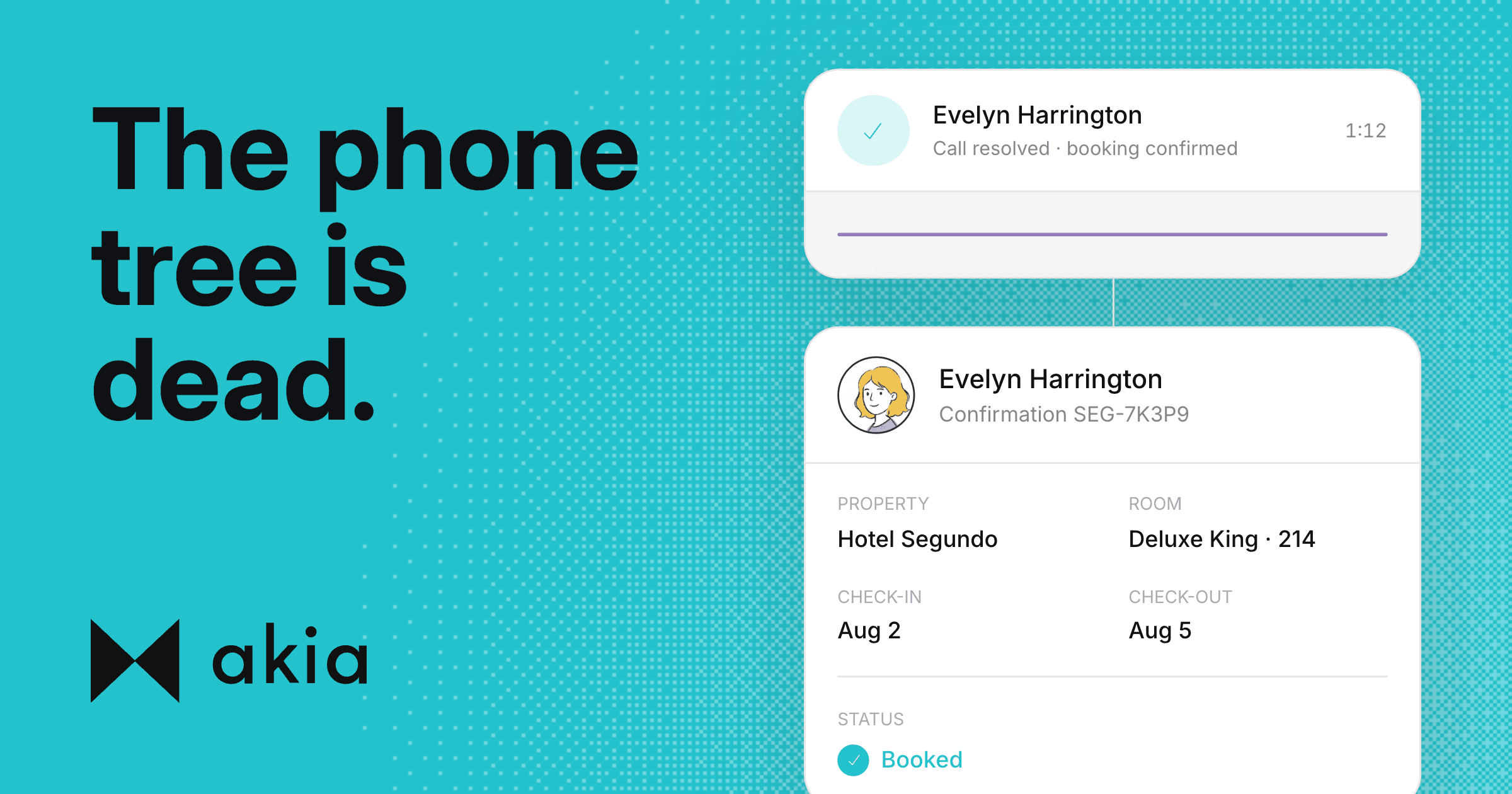
She picks up on the first ring and has a real conversation. She reads reservations from your PMS, so she knows who's calling and what stay they're on. She books rooms, answers questions about the property, takes payment on the call, and sells the late checkout while your front desk is busy with the family at the counter.
When something genuinely needs a person, she transfers to the right extension with the context already gathered. Maintenance gets the room number and the problem. The manager gets the escalation, not a cold handoff.
That's the difference between a menu and an agent. A menu moves the call. AI Voice finishes it.
You don't have to replace your hotel phone system.
Most properties connect Akia by forwarding a number to her. That's a setting on the system you already have, not a new phone system. It works whether you're on a cloud VoIP service or a box that's been in the back office since 2009.
There's a ladder here, and you can start anywhere on it.
Overflow only. Akia picks up when nobody answers after a few rings, when the line's busy, or overnight. Your call flow is untouched the rest of the day. This is where most properties start, because nothing about the front desk changes except that calls stop going unanswered.
After hours. She takes the phone from close to open. Reservations still get booked at 11pm, which is when a surprising number of them happen.
The main line. Forward the published number to Akia full-time. She's the front door, and she hands off to your extensions when a person is needed. This is the point where the phone tree comes down for good.
Retire the IVR. Delete the menu entirely. Akia is the greeting, and the departments behind her stay exactly as they are.
Whichever rung you pick, the PBX keeps doing its job. Nobody unplugs anything.
Every department needs the same rule.
Any destination you want Akia to reach directly needs the same treatment. Housekeeping, maintenance, reservations, ownership. A private, one-way destination that's never forwarded back into her.
If an extension falls back to Akia on no answer, and she transfers to that same extension, you get the identical loop one level down. Check each one before launch rather than discovering it on a live call.
No phone tree on the other end.
Whatever number Akia transfers to should ring a person, not another menu.
If your front desk phone system still answers with its own recorded greeting and a list of options, a guest who just had a natural conversation gets handed right back into "press 1 for." Akia should be the last menu your guests ever hear.
Frequently Asked Questions.
What is a PBX in a hotel?
A PBX, or Private Branch Exchange, is the telephone system that connects a property's internal phones to each other and to the public phone network. Room phones, the front desk, housekeeping, and the restaurant are extensions on it. Hotel PBX systems also typically interface with the property management system to handle wake-up calls, do-not-disturb, and room-status codes dialed from the room phone. Common hotel PBX vendors include Mitel, NEC, Avaya, Alcatel-Lucent, and Phonesuite.
What is the difference between a PBX and an IVR?
A PBX is the phone system itself, the infrastructure that routes calls between extensions and the outside line. An IVR, or Interactive Voice Response, is the recorded menu a caller hears before reaching an extension. The PBX determines where a call can go. The IVR determines how the caller chooses. A property can replace its IVR without replacing its PBX.
Do I need to replace my hotel phone system to use AI voice?
No. Akia connects by forwarding an existing number, which is a configuration change on the phone system a property already has. The PBX continues to route internal extensions, room phones, and departments as before. Properties running on-premise systems and properties running cloud VoIP connect the same way.
Can AI transfer a call to a specific department?
Yes. Akia hands calls to named destinations such as front desk, housekeeping, maintenance, or a manager on duty, each mapped to an extension. She passes along what she has already gathered, so the person picking up gets the room number and the issue instead of starting over. Each destination needs to be a direct, one-way number that does not forward back into Akia, or transfers will loop.
What is the difference between a hotel phone system and an answering service?
A hotel phone system, or PBX, is the property's own infrastructure for routing calls between extensions. An answering service is a third party that picks up calls the property cannot take, usually taking a message for someone to action later. Akia is neither. She answers on the property's own line and resolves the call during the call, including booking a room or taking payment.
Does AI voice work with my PMS?
Akia reads reservations from PMSs including Mews, Cloudbeds, StayNTouch, Guesty, and Hostaway, matching a caller's number to their booking so she knows their name, their room type, and their dates before she says hello. See the full list on the integrations marketplace.
The phone tree is dead. Good.
Guests never liked "press 1 for reservations." They want to say what they need and get help, and now they can, without you touching the phone system in the back office.
If your front desk is drowning in calls it shouldn't be taking, that's the same problem unified guest messaging solves on every other channel. The phone was just the last one to get fixed.