Key Findings
A first-party look at AI agents vs. chatbots in guest messaging, based on 900,000 real messages.
-
Across a 30-day sample of inbound guest messages on Akia, most are routine such as wifi codes, parking, check-in times, breakfast hours, late-checkout requests, and policy questions. The AI Agent handles these the day you turn it on.
-
Messages get sharper with training — multi-step requests, edge cases, property-specific judgment calls. This is where an Agent earns its name. A chatbot can't do this work. An Agent that learns your property, your policies, and your tone can.
-
A few stay with your team on purpose — active complaints, refund disputes, sensitive escalations. When reputation, safety, or money is on the line, the right answer is a human voice.
Definitions
AI Agent vs. chatbot. A chatbot pattern-matches keywords against canned responses. AI for hotels walks through where the difference shows up day to day. An AI Agent reads live context from the PMS, reservation, and property knowledge base, takes multi-step actions (creates housekeeping tasks, applies upcharges, updates the PMS), and escalates with a full handoff summary when it can't resolve a request.
How much of your staff's day is spent answering things AI could handle in seconds.
Roughly 80% of inbound guest messages at the average property are repetitive, factual questions such as wifi codes, parking, gate codes, check-in times, that have a single correct answer already written down somewhere. Here's what that looks like in practice.
A guest texts at 9:47pm asking for the wifi password. Three minutes later, another guest asks where to park the rental car. At 11:14am, two minutes after a front-desk agent finally sat down, a third person asked for the gate code.
None of these messages needed a person. Each one has a single correct answer, written somewhere in a binder, a PMS field, or the property's website.
When we looked across a 30-day sample of inbound guest messages flowing through Akia, four out of five were asking for information that already exists. Routine questions with a single right answer and what they needed at the moment.
How we categorized messages.
We classified the 900,000 guest messages along two axes: whether a single correct answer exists in the property's knowledge base or PMS, and whether the stakes of getting it wrong are low or high. Those two axes produce four quadrants — three handled by AI, one reserved for humans. We call this the Akia Message Tier framework.
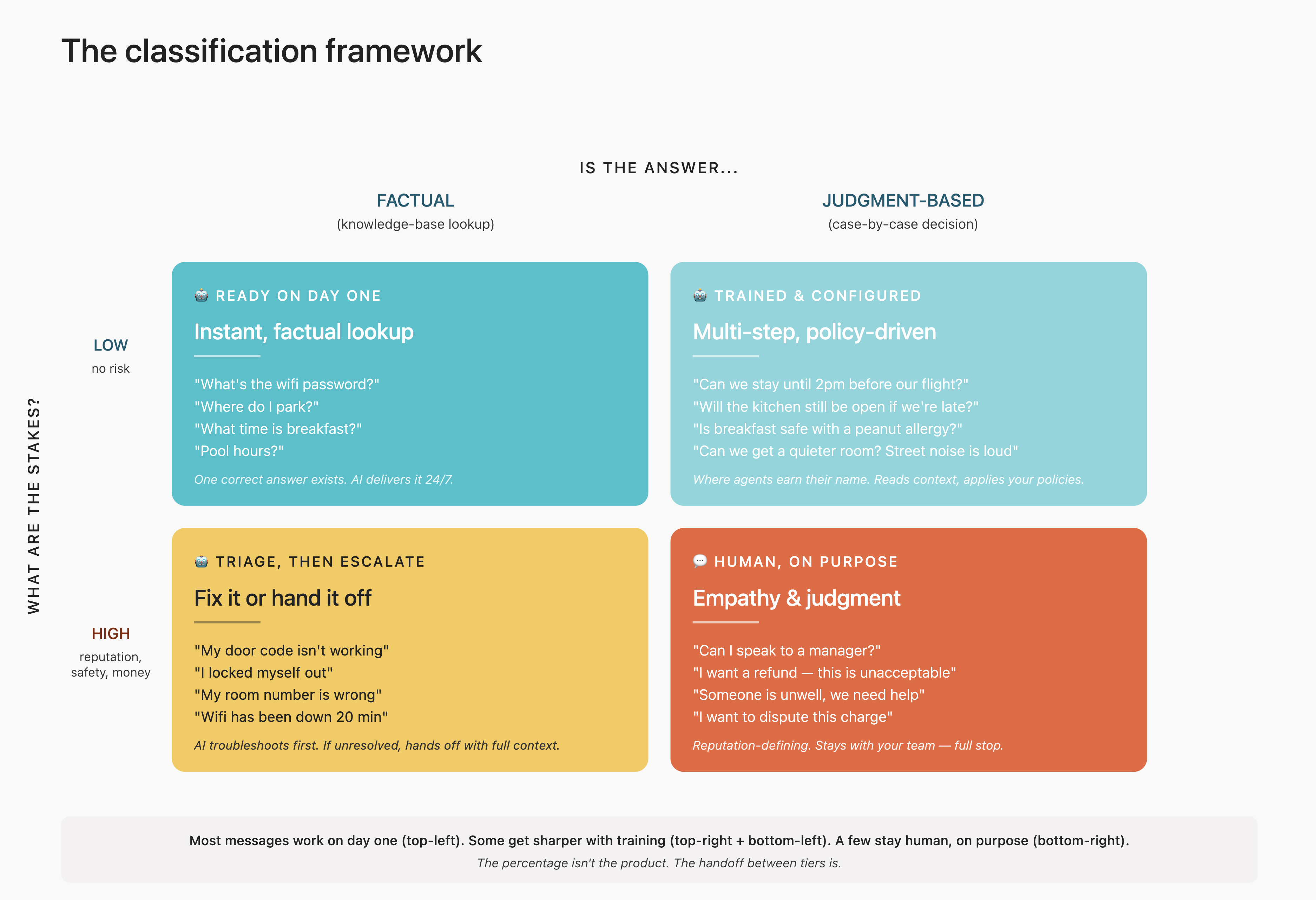
Figure 1: The 2x2 classification framework — factual vs. judgment on the horizontal axis, low vs. high stakes on the vertical. Three of the four quadrants are AI work; only high-stakes judgment stays with humans.
1st is whether a single correct response exists somewhere in a knowledge base, policy doc, or PMS field, or judgment-based, meaning the right response depends on context, history, or the specific guest in front of you.
2nd is the stakes: low (no real downside if the response is wrong) or high (reputation, safety, money, or a guest who is already upset).
Those two axes give you four quadrants. Three of them, anything factual at any stakes, plus low-stakes judgment calls that can be resolved with a clear policy, are AI work. One of them, high-stakes judgment, is human work.
What we saw was the same thing everywhere we looked. Across thousands of properties, most of what guests are asking are the same questions, over and over.
But "AI handles it" isn't one thing. It splits into two tiers: the work that's ready on day one, and the work that gets sharper as the Agent learns your property.
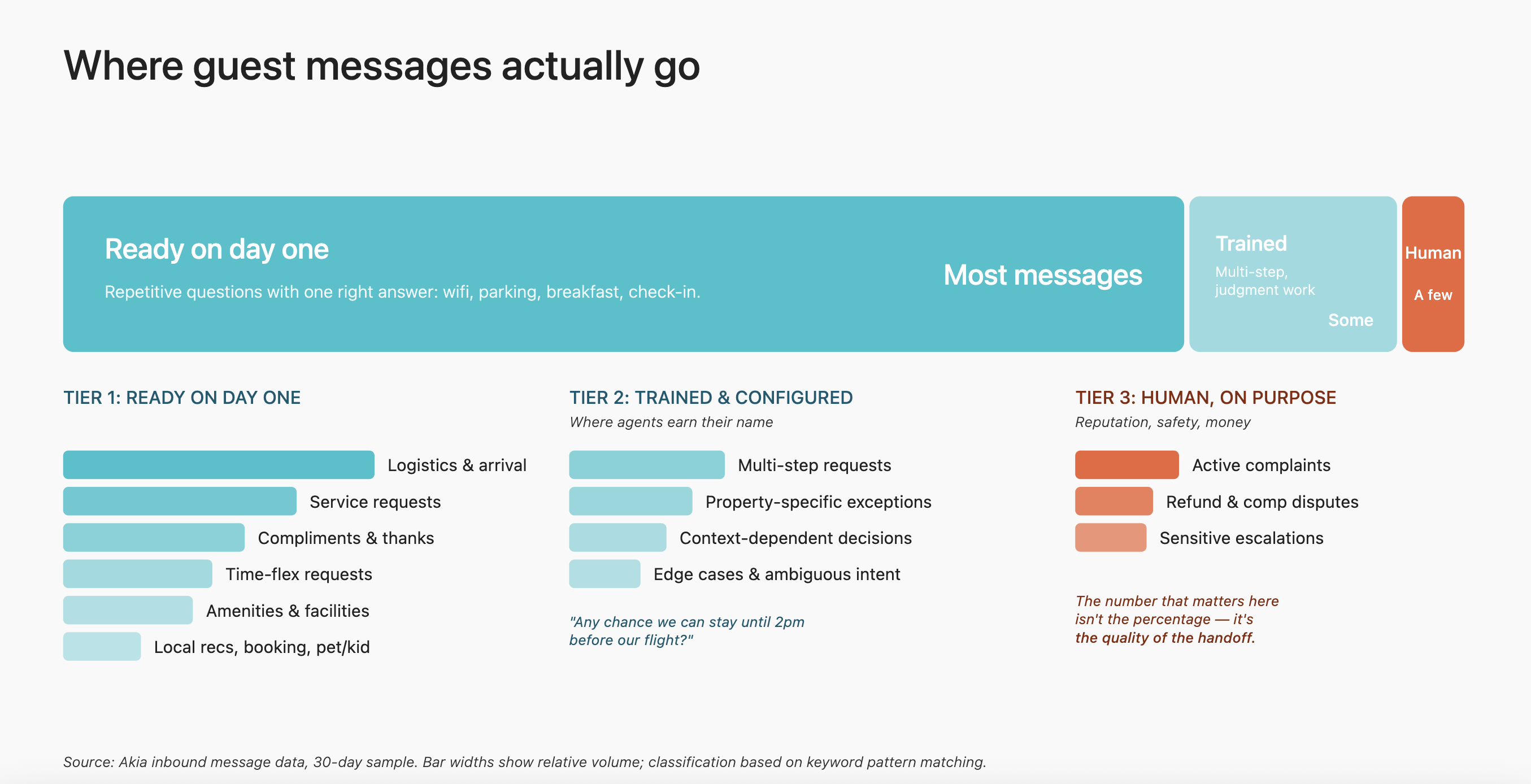
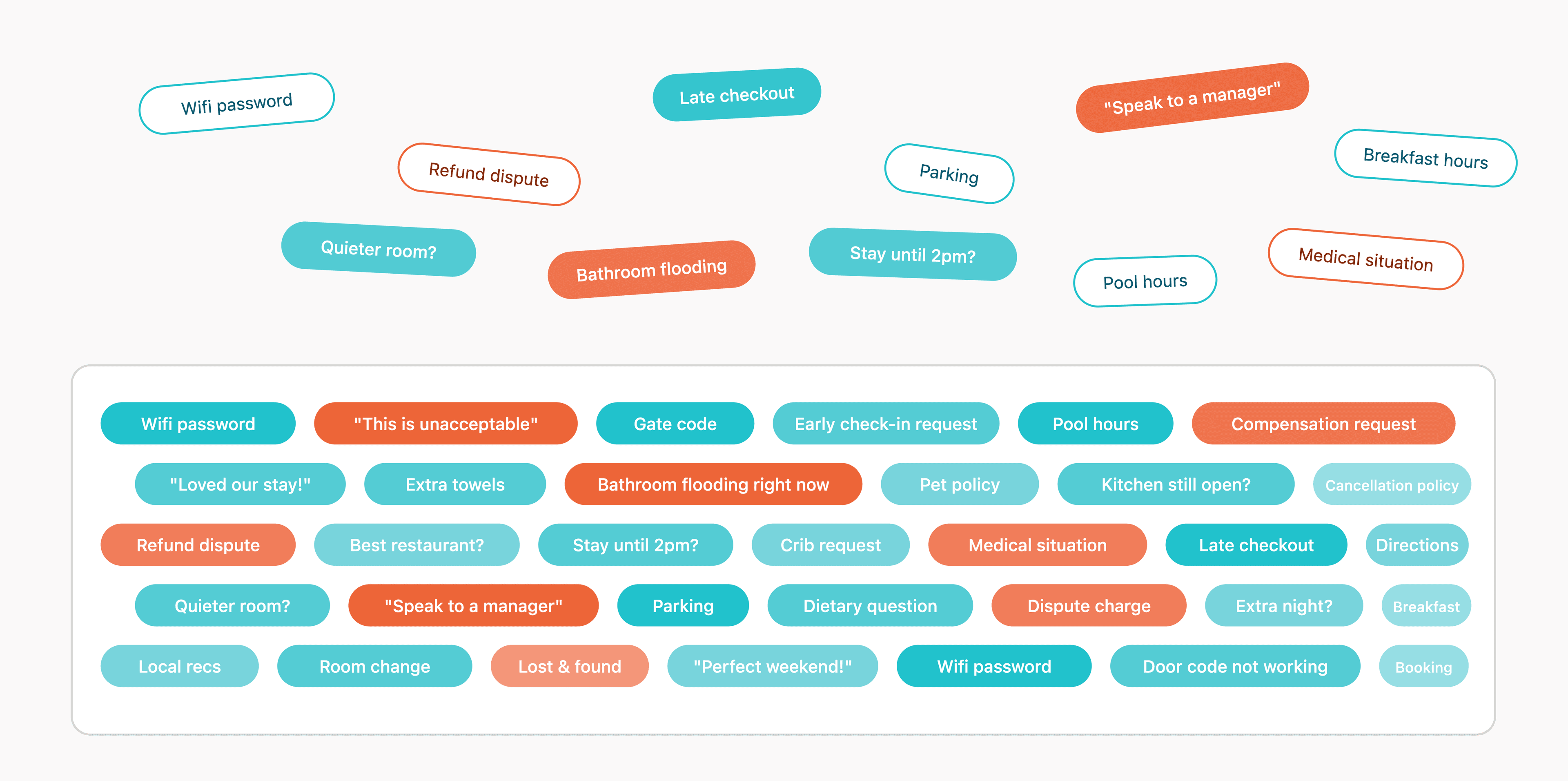
Figure 2: Volume distribution across the three tiers. Most guest messages are ready-on-day-one (Tier 1: logistics, service requests, compliments, time-flex, amenities, local recs). Some require a trained agent (Tier 2: multi-step requests, property-specific exceptions, context-dependent decisions, edge cases). A few stay human on purpose (Tier 3: active complaints, refund disputes, sensitive escalations). Source: Akia inbound message data, 30-day sample.
Better: Tier 1: Guest messages AI handles on day one (~80% of volume).
AI Agents handle four categories of guest messages on day one: logistics and arrival, service requests, compliments and thanks, and time-flex requests. These cover roughly 80% of inbound volume.
Information from your PMS or website - automatically available.
Logistics and arrival: Check-in times, addresses, gate codes, wifi passwords, parking. Every property's knowledge base has the answer.
Service requests: Extra towels, more pillows. These are tasks to route to housekeeping. An AI Agent can read the request, create the housekeeping task, and confirm with the guest in the time it takes a human to glance at their phone.
Compliments and thanks: "Loved our stay." "Perfect weekend." None of these need a person, but if no one responds, the guest feels ignored. Freeing staff from typing "we're so glad!" forty times a week isn't a small recovery.
Time-flex requests: Early check-in, late checkout, and extra night. The answer is often "yes, for a fee." A well-configured AI Agent quotes the policy, applies the upcharge, and closes the upsell while the guest still has their phone in their hand.
Other categories include amenities, local recommendations, booking policy, and pet and kid logistics.
Tier 2: Multi-step requests that need an Agent trained on your property.
The middle tier is where the difference between an FAQ bot and an AI Agent actually shows up.
Message like: "We had a really late night. Any chance we can stay until 2pm before heading to the airport?"
A chatbot pattern-matches on "checkout" and either replies with the standard 11am checkout time (missing the request entirely) or gives a flat "yes/no" without checking anything.
An AI Agent reads the reservation, checks whether the room is booked again that afternoon, applies the property's late-checkout policy (free until 1pm, $30 after), confirms with the guest, and updates the housekeeping schedule so the room isn't flagged for an 11am turn.
The Agent has to learn your property's specific policies and team's escalation patterns.
A few examples of what lives in this tier:
-
"We're running 30 minutes late, will the kitchen still be open?" (Reads the F&B hours, checks against ETA, offers an alternative if the kitchen will close, holds a reservation if it won't.)
-
"My partner has a peanut allergy. Is breakfast safe?" (Looks up dietary information, confirms with kitchen contact if uncertain, escalates if the answer isn't definitive.)
These messages can quietly eat up most of your front desk's time, because they require pulling information from three different systems and making a small judgment call. But this is what an Agent does that a chatbot doesn't.
Tier 3: Guest messages that should always escalate to a human.
The last tier is where you should lean on your team. Active complaints, refund disputes, in-progress room issues, and any message that names a staff member or describes how a guest was made to feel, these aren't knowledge-based questions. A bot fumbling is how you end up with angry reviews and refunds you didn't need to give.
Akia's view: this should escalate to a human. And when it does, the staff knows exactly what's been said, who said it, and what they need next.
What an AI Agent does that a chatbot can't.
A true AI Agent does four things a chatbot can't: it pulls live context from the PMS and reservation in real time, executes multi-step work across systems, distinguishes between similar-sounding messages with different intentions, and escalates to a human with a full handoff summary.
Pulls live context. It reads the PMS, the reservation, the property's website, and the room status in real time.
Handles multi-step work. Agents can read a reservation, check housekeeping availability, apply a policy, execute a PMS update, and reply to the guest.
Knows the difference between similar messages. "What is my door code" is a different question than "I'm at the door and the code isn't working." Same words, different intentions, different actions. An Agent reads the situation; a chatbot reads the keywords.
Escalates with full context. When a human is needed, it hands them off with a summary, the steps already taken, and what the human needs to do next. It's understanding "when the AI hands off, does my team have what they need to be useful?"
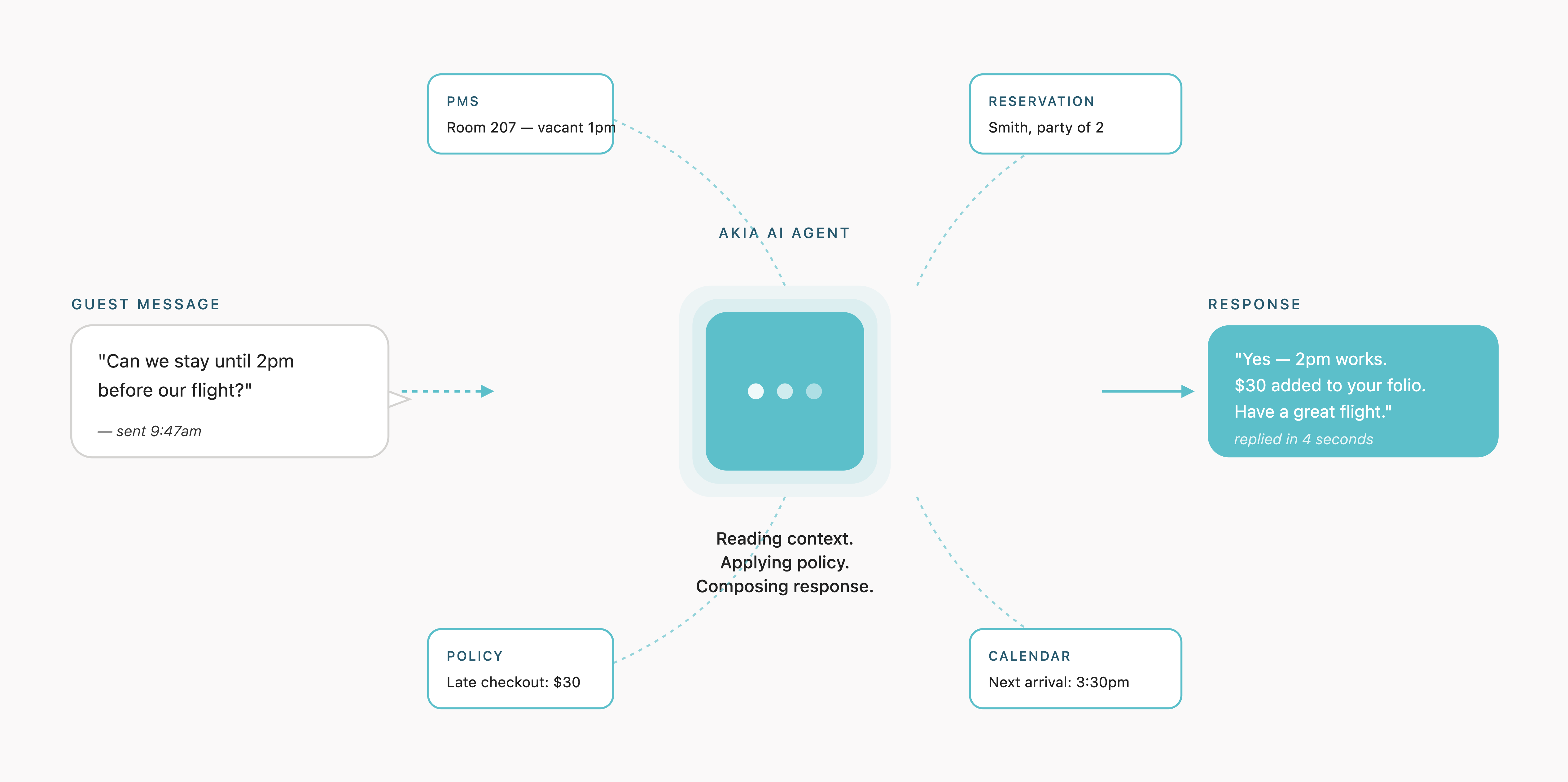
Figure 3: How an Akia AI Agent answers a late-checkout request. The guest asks "Can we stay until 2pm before our flight?" — the Agent reads the PMS (Room 207 vacant at 1pm), the reservation (Smith, party of 2), the late-checkout policy ($30), and the calendar (next arrival 3:30pm), then composes a single response that confirms the time, applies the charges, and wishes the guest well.
What operators should do.
When deciding which guest messages to automate first, start with the most repetitive question types regardless of where they currently land, typically logistics, amenities, and policy questions. Then evaluate vendors specifically on how they hand off escalated messages to your team.
Start with the most repetitive questions. Automate the type of question that comes up most, regardless of where it lands. Start with logistics and amenities (wifi, parking, check-in times). Then layer in policy questions like early check-in and late checkout. That order gets you most of the time savings in the first few weeks.
Keep humans on the messages that need them, and judge AI by how it hands them off. Configure the system so complaint language, refund language, and health-and-safety always escalate to a human, no matter how confident the AI's response is. When you're evaluating vendors, ask "when you escalate, what does my team see?"
Frequently Asked Questions.
- What's the difference between an AI agent and a chatbot for hotels? — A chatbot pattern-matches keywords to canned replies; an AI agent reads live context from the PMS and reservation, takes multi-step actions, and escalates with a full handoff summary.
- What percentage of guest messages can AI handle? — Across a 30-day sample of 900,000 guest messages on Akia, roughly 80% are repetitive questions an AI agent handles on day one.
- Which guest messages should always go to a human? — Active complaints, refund disputes, and safety issues should always escalate to a person.
- Should hotels automate guest messaging? — Start with the most repetitive question types (logistics, amenities, policy), then judge any vendor by how cleanly it hands escalations to your team.