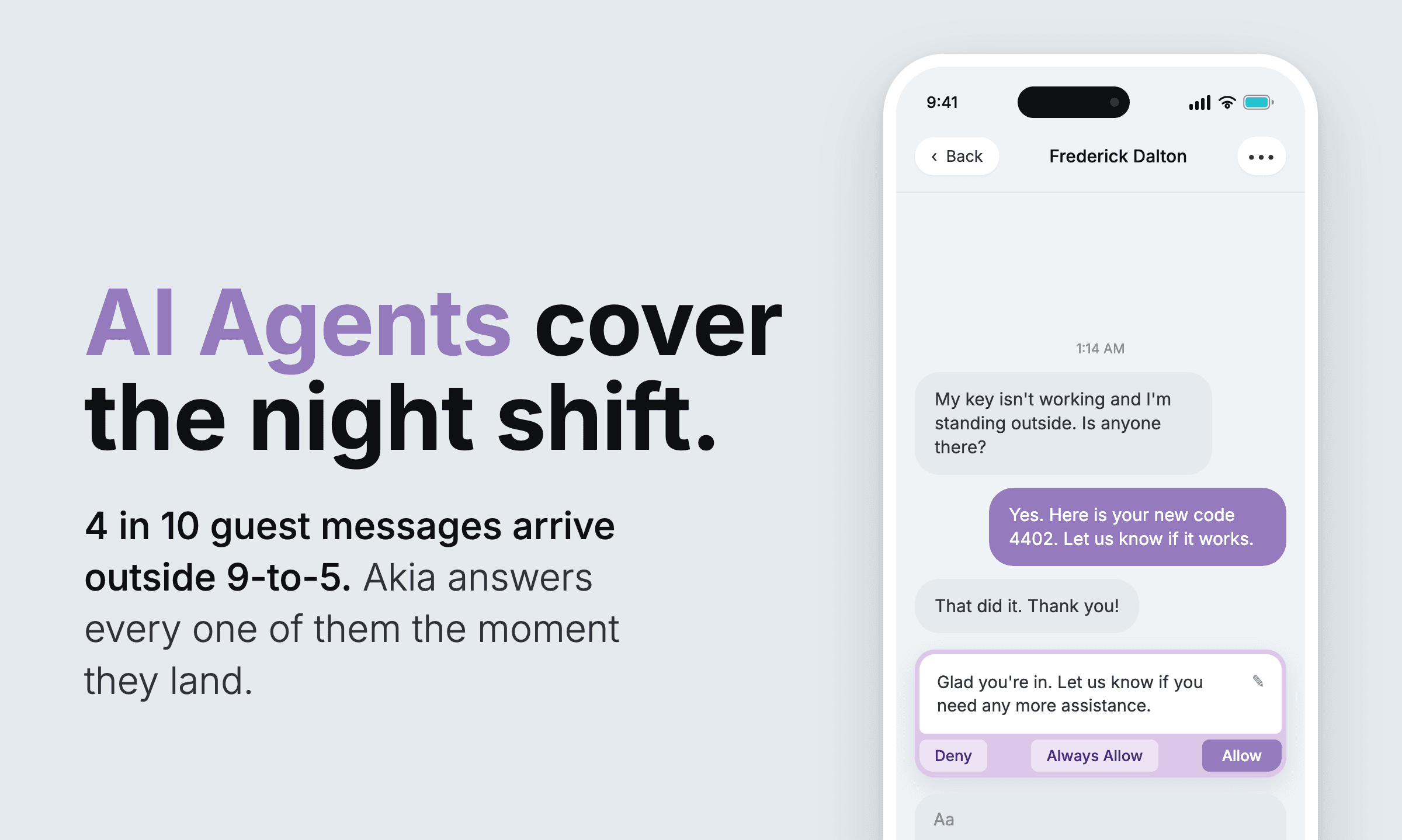
TL;DR: Across a 30-day sample of 1.4 million guest messages, about 4 in 10 arrived outside 9-to-5. The late evening is when problems spike, and after midnight lockouts are the only thing that gets more likely rather than less.
Key findings
-
About 4 in 10 guest messages arrive outside 9-to-5
-
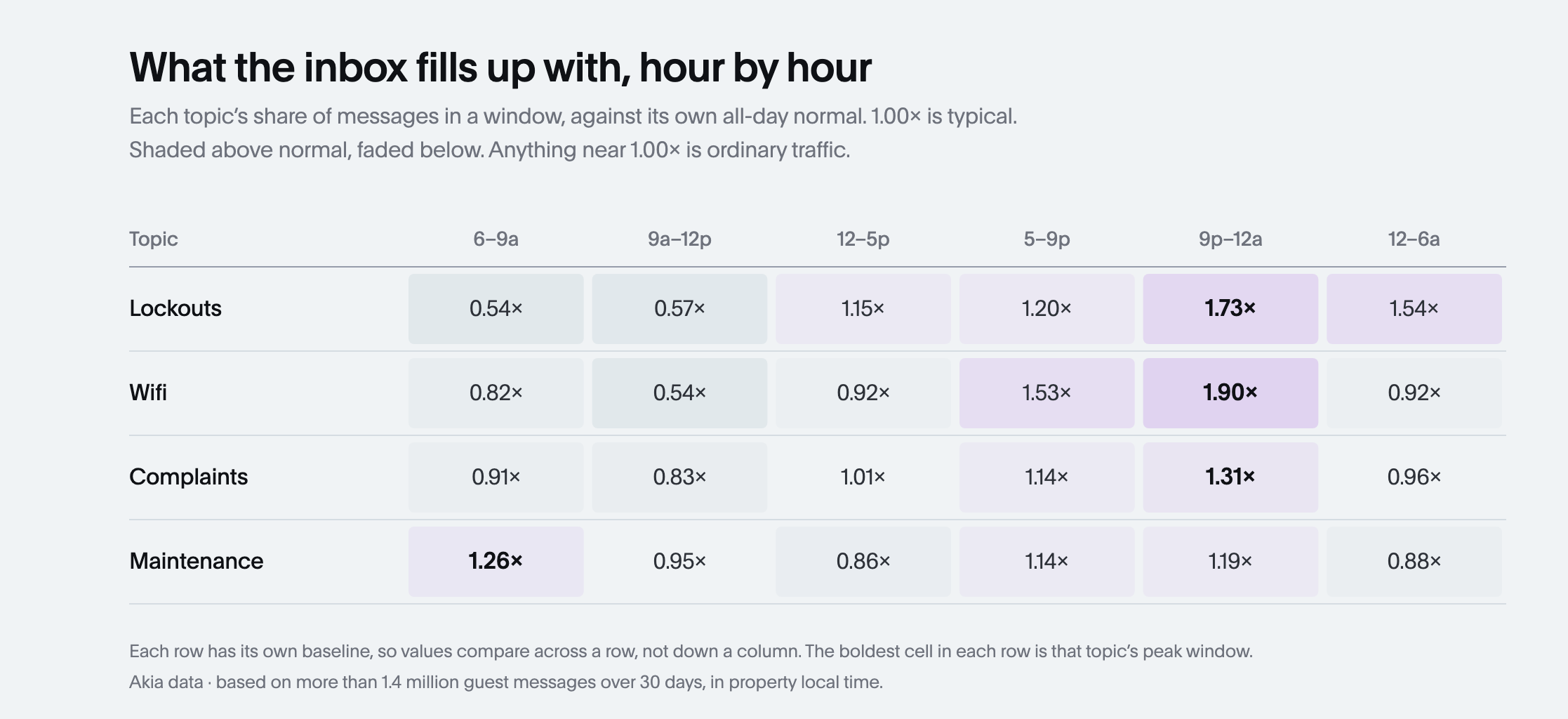
Between 9pm and midnight, wifi problems run 1.9× their normal share and lockouts 1.7×. Complaints move less than you'd expect, at 1.3×.
-
Lockouts peak between 11pm and 2am, and after midnight they're the only topic still running above normal.
Once the front desk goes home for the night, the guests don't. Somewhere around 1am you get the worst version of it: a guest stuck at the door with a code that won't work, nobody awake to help, and a message that just sits in the inbox until morning. By the time someone finally answers, the guest's been locked out for ages and the one-star review is already half-written.
We wanted to see how common that overnight scramble really is, so we looked at 1.4 million guest messages over 30 days, converted every one to the property's local time, and sorted them by what the guest was actually asking.
Our last report went through 900,000 guest messages and found roughly 80% are the same repeatable questions over and over. That was what guests ask. This one's about when they ask it, because the message landing at 1am is nothing like the one that comes in at 1pm.
When do guests message the most?
Guest messaging runs around the clock, and about 4 in 10 messages arrive outside 9-to-5. During the day, the inbox is mostly logistics: check-in times, arrival questions, where to park. After dark, the mix tilts toward the messages you least want to miss. Wifi problems and lockouts climb hardest in the late evening, and maintenance is the odd one out, running above normal first thing in the morning instead.
Late at night, it's lockouts.
When a guest is standing at the door at 1am with a code that won't work, every minute is a guest getting angrier and a review getting written. That's why lockouts are the message to watch overnight.
And they cluster exactly when no one's around to help. Lockouts and "the code isn't working" messages peak between 11pm and 2am. At 1am, lockouts run about twice their normal share of the inbox.
How Akia covers the overnight shift.
Akia is the AI Agent for hospitality, and overnight is exactly the window it's built for: the hours when a guest still needs an answer and no one's awake to give it.
Akia answers using your property's knowledge and the guest's reservation.
A guest messages at 1am and Akia already knows who they are, what unit they're in, and what their stay looks like. Akia pulls the right entry steps for that specific unit and walks the guest through them on the spot, in whatever channel they messaged from.
Example on how to instruct your Agent with step-by-step instructions.
Title: Room Access Troubleshooting
Instructions: When a guest says they cannot enter their room or their code/key is not working, help them troubleshoot step by step.
- First, confirm the room/unit name or number and ask what happens when they try to enter.
- Ask them to verify they are at the correct door.
- Ask them to re-enter the code slowly and carefully.
- If relevant, remind them to press any confirm/unlock button after entering the code.
- Ask them to try the handle after entering the code.
- If it still does not work, ask them to wait 30 seconds and try again.
- If available, ask them to send a photo of the keypad/lock or describe any lights, sounds, or error messages.
- If the issue still is not resolved, apologize and escalate to staff immediately.
Agents handle issues around door codes, wifi, devices like TVs and air conditioners within the room as well.
A lockout is the clearest case.
Akia confirms the guest and their reservation, checks whether a valid code exists for that stay, and reissues the code or triggers door access right there in the conversation. A lot of overnight access problems get solved before anyone has to be woken up or sent out to the property. See the door locks Akia works with.
You decide how far Akia goes.
Akia can complete the action on its own, ask a staff member to approve it first, or prep the handoff with the full context attached. You set that per question type, and move things from supervised to agentic as your confidence grows.
Anything that needs a person gets escalated with the context already there.
A real complaint, a safety issue, anything Akia isn't sure about, will notify your team with the guest, the reservation, and the full conversation attached. Your on-call staff gets woken up for the things that actually need them, not for a door code.
Akia covers every channel from one inbox.
SMS, WhatsApp, Airbnb, Booking.com, Vrbo, web chat, and email all run through the same place, so a guest who switches from Airbnb to a text at midnight gets the same answers without re-explaining anything.
Where AI Voice fits.
The 2am problem is a person who can't get into their room. They'll use whatever reaches someone fastest, and for plenty of guests that's the phone. AI Voice picks up already knowing which stay they're on, and resolves most calls without waking anyone. It's the same Akia who answers your texts. She just picks up the phone too.
FAQ
What percentage of guest messages arrive after hours?
About 4 in 10 guest messages arrive outside 9-to-5. Daytime volume skews to logistics like check-in times, arrival questions, and parking. After dark the mix tilts toward wifi, lockouts, and complaints, which are the messages a property least wants to leave sitting until morning.
What time do guest lockouts peak?
Lockouts and "the code isn't working" messages peak between 11pm and 2am. At 1am they run about twice their normal share of the inbox, and after midnight they're the only topic still running above their all-day average.
Which guest requests spike overnight?
Measured against each topic's own all-day normal, wifi problems run 1.90x between 9pm and midnight, lockouts 1.73x, and complaints 1.31x.
What happens to a guest message when no one is awake?
A hotel answering service takes the message and passes it to staff in the morning, which means a guest locked out at 1am waits until someone opens the office. An AI agent answers in whatever channel the guest used, already knowing the reservation and the unit, and resolves it on the spot by reissuing a door code or walking them through wifi setup. Anything it can't finish gets escalated with the full conversation attached.