You're not alone if you chose the restaurant with 4.5 stars over the one with 2.5 stars. Shoppers lean hard on reviews before they spend, and for a local business the numbers are stark (BrightLocal):
What guests do with reviewsShareRead reviews before choosing a local business82%More likely to use a business with positive reviews91%Turned away by a negative review82%Won't consider a business rated under 4 stars53%
AI is reading your reviews now.
Travelers aren't the only ones reading your reviews anymore. When someone asks Google's AI Overview or ChatGPT for the best boutique hotel in town, the answer is built from the same review signals: your rating and what recent guests actually said. Reviews are only one input. Our guide covers everything that decides whether AI recommends your property.
It's tempting to write AI search off as a niche. The numbers say otherwise. OpenAI put ChatGPT at 900 million weekly active users in early 2026, and it crossed a billion users soon after. Google is bigger still, and it now runs AI Overviews across its results for roughly a billion people. Here's the scale side by side:
Where people searchReach (2026)Google search~13.7 billion searches a dayGoogle AI Overviews / AI Mode~1 billion usersChatGPT~1 billion users, 900 million weekly active
Google still dwarfs everything on raw volume, and that's exactly the point. The AI-generated answer now sits on top of those billions of daily searches, above the old blue links. Whether a traveler asks ChatGPT or just Googles your city, an AI is often the first thing that answers, and it's pulling from your reviews to do it. Strong, fresh reviews mean the AI names your property. A thin or dated profile means it gets skipped.
It's probably no surprise that most travelers also use reviews to decide which hotel to book with. After all, 76% of people trust online reviews as much as personal recommendations, and people read an average of 10 reviews before making a purchase decision. Your last ten reviews are the first thing a prospective guest sees. Having good reviews for your hotel is undoubtedly important in this review-driven world, but what you might not know is that reviews can make or break your hotel profits. According to a study, 76% of travelers are willing to spend more on a hotel if it has higher reviews. If a hotel can increase their rating by 1-star, they can charge 11.2% more while maintaining the same occupancy and market share.
Let's break this down together. Assume that a hotel has a 67% occupancy for a 100-room hotel. It has a 3-star rating, and it charges $100 per night. Over the course of 30 days, the hotel would be making $201,000. Now, if the hotel could increase their rating to 4-stars, it could make an additional $22,512 every month, and they're only missing out on that revenue because of their ratings.
It's clear that reviews matter for hotels, but it's also important to focus your reputation management on the platform that can make the greatest impact. No, we're not talking about TripAdvisor. We're talking about Google.
With Google taking up almost 87% of the global search engine market, it's not hard to imagine that Google's review system is constantly growing, and even outgrowing TripAdvisor. Google dominates the search engine market, and their review system is integrated into their search engine and maps. When the majority of people take that first step in searching for a local business, Google has just about everything they need to see on the Google My Business page: location, hours, phone number, website, rates, and reviews. There's little reason to look anywhere else when it's all in one place.
There's no question that Google is a very powerful company. Not only is the company a leader in technology, but it also has a very widespread reach. Google reviewers are verified by their Google accounts and their location service to ensure that they've actually been to the business, so people can trust that there won't be as many fake reviews to skew ratings one way or the other. Google's algorithm also prioritizes reviews left directly on Google over reviews from 3rd-party websites like TripAdvisor, and having more direct reviews on Google influences how a business ranks in the local search results. The logic is simple: Get more direct reviews → Show up higher on local search → Get more bookings.
With all of this in mind, hotels need a plan to keep their Google reviews strong and their rating above four stars.
How to get more Google reviews.
Getting more reviews comes down to asking the right guests at the right moment. Happy guests will leave a review when you make it easy and you catch them while the stay is fresh. The full guide to improving your hotel's review score.
Ask right after a good moment. Akia watches the stay and asks for the review right after a high point, not weeks later when the glow has faded.
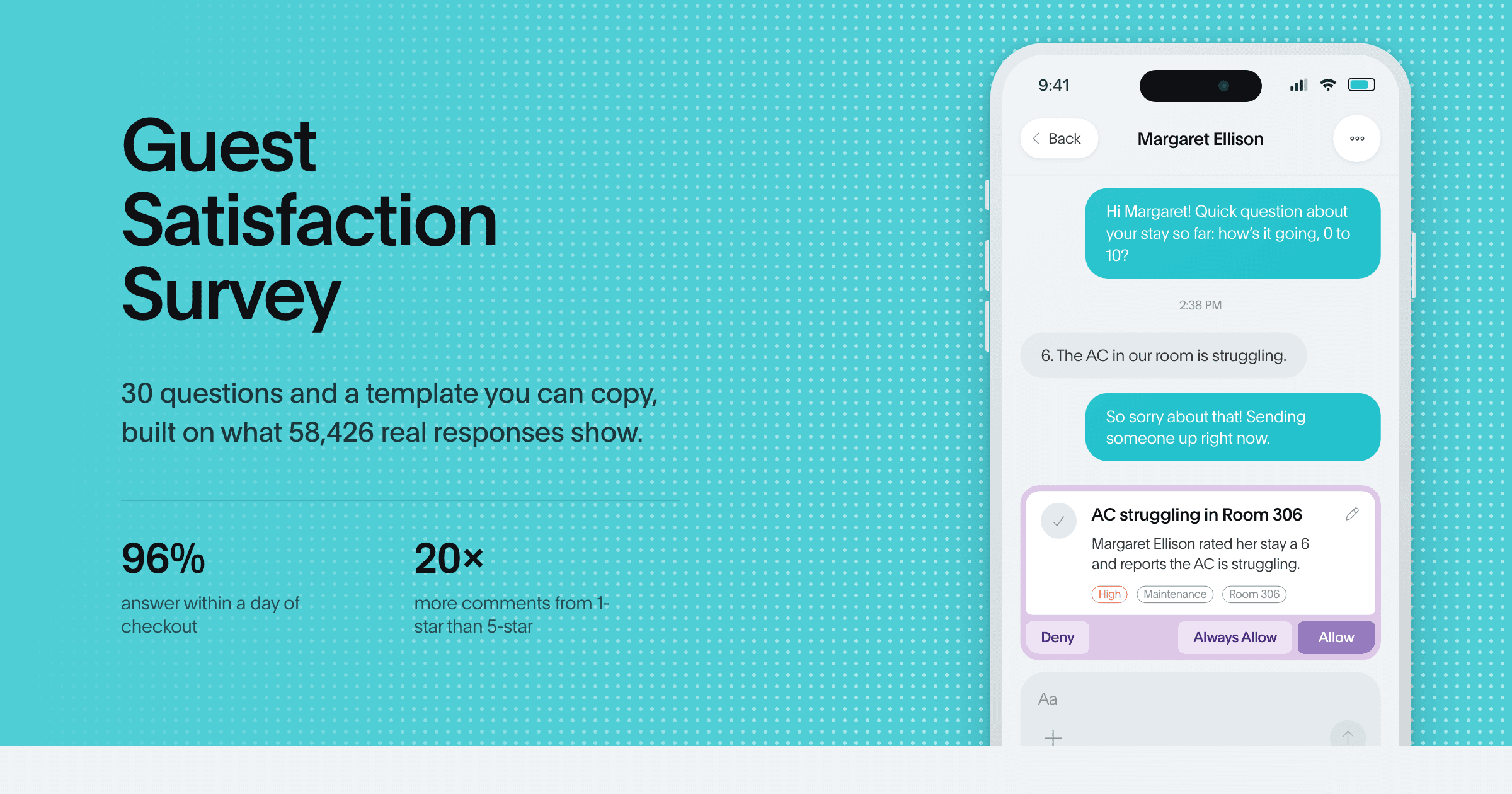
Send only the happy ones. A quick survey sorts the happy guests from the unhappy ones. Akia sends the happy guests to your Google page and quietly routes the rest to your team instead.
Make it one tap. Akia drops the direct Google review link right in the guest's chat, so leaving a review takes seconds.
Do this every stay and your Google rating climbs, with your AI-search visibility and bookings right behind it. See how Akia manages your reputation.